This page covers the essential concepts and links to more specialised resources. Capabilities, constraints and rules must always be checked against the relevant site and use case.
The short answer
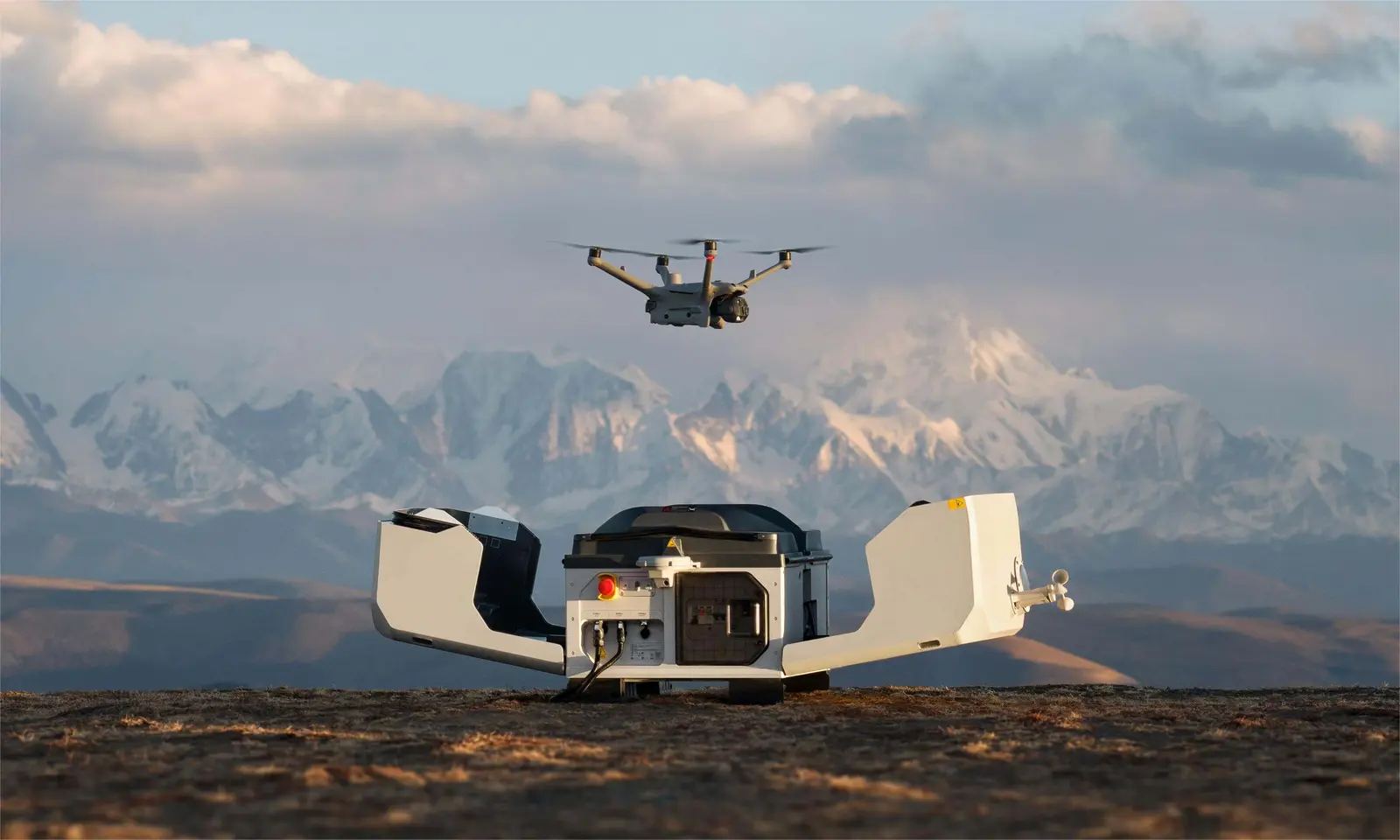
DJI Dock 3 is the most coherent of the three for repeated local missions, compact deployment and rapid turnaround. For verification, see DJI Dock 3 and Matrice 4D/4TD · specifications.
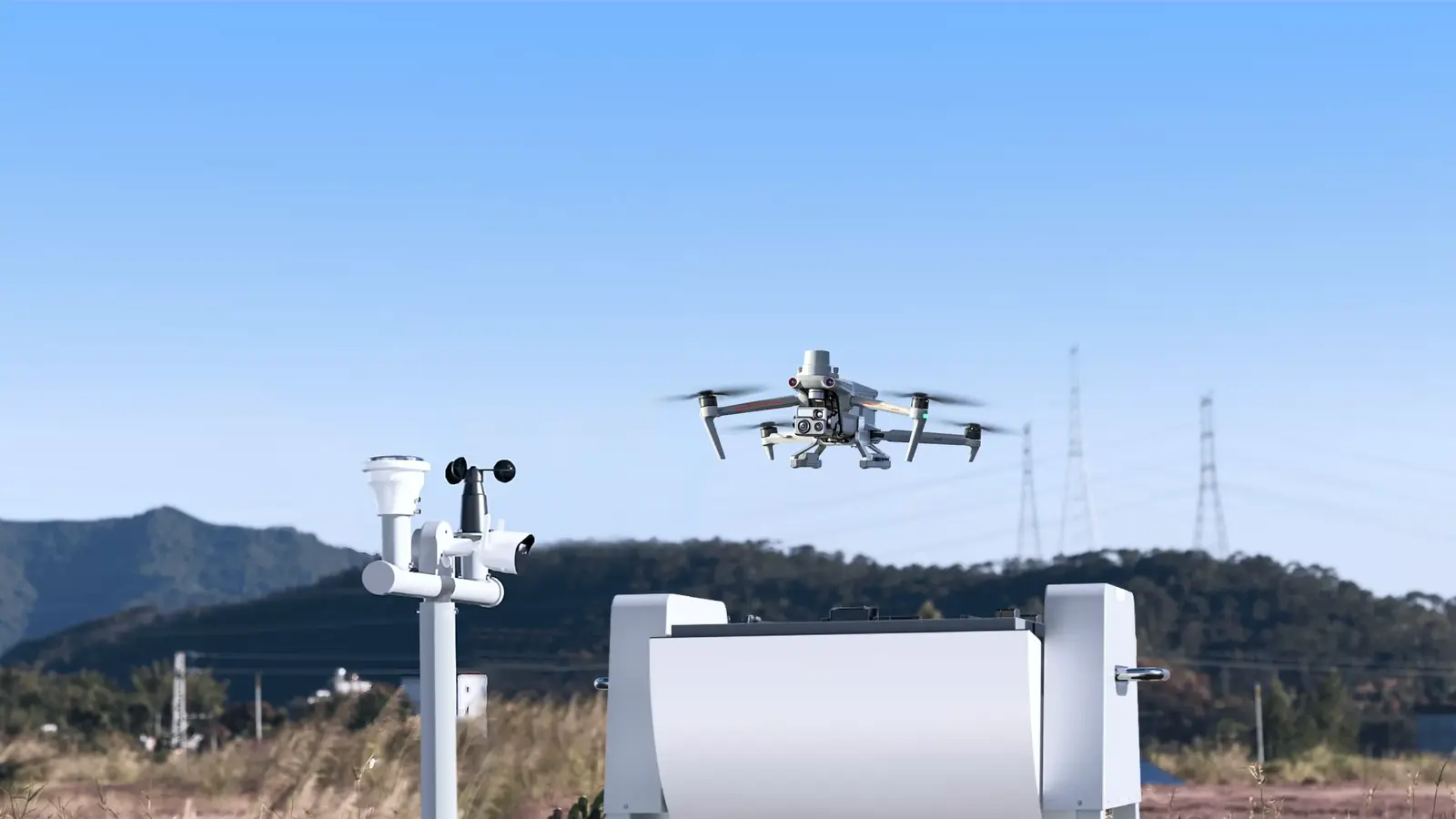
Autel EVO Nest is a credible multirotor alternative. The exact generation, published inconsistencies, service and delivered software require written confirmation. For verification, see Autel EVO Nest · official FAQ.
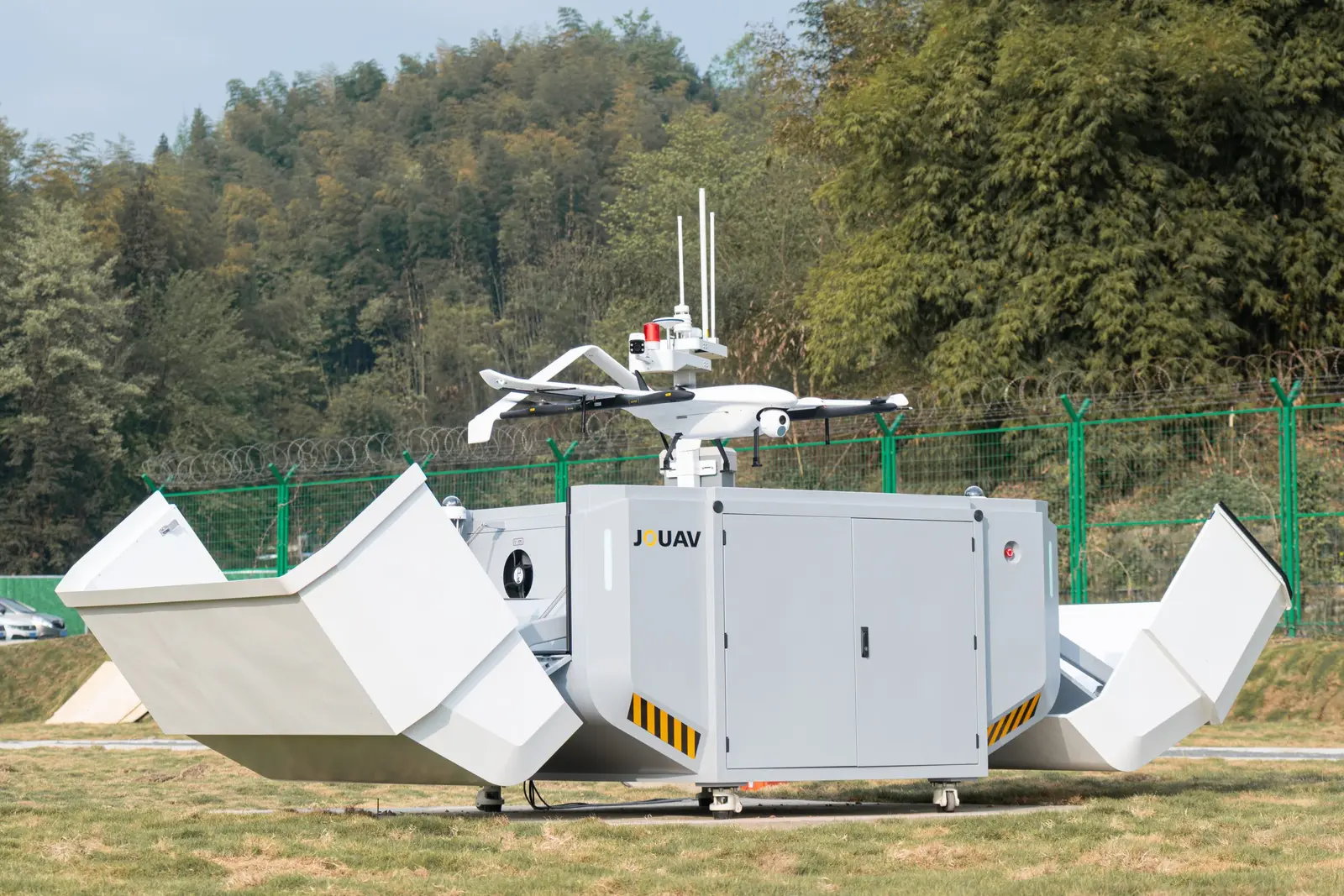
JOUAV VTOL Hangar is not a direct substitute for either compact dock. It becomes relevant for power lines, pipelines, railways, mines and dispersed infrastructure.
None of these systems provides permanent security coverage alone. Fixed cameras, perimeter sensors and human response remain necessary while the aircraft charges or cannot fly.
Routine remote operation in Switzerland will generally be BVLOS and therefore belong to the specific category.
Two aircraft families, not three equivalent products
DJI Dock 3 and Autel EVO Nest house multirotors. These aircraft can hover, move slowly and position their sensors precisely around a gate, roof or asset. Their natural missions are local patrol, alarm verification and point inspection.
JOUAV CW-15V takes off vertically before transitioning to wing-borne cruise. The aircraft uses its wings to travel efficiently over long distances. Its advantage appears across corridors and extended estates, but it requires a much larger station and a more demanding operating concept.
A comparison based only on 42, 54 and 120 minutes of manufacturer endurance would therefore be misleading.
DJI Dock 3, Autel EVO Nest and JOUAV compared
All values below are manufacturer figures reviewed on 9 August 2026. They help shortlist an architecture but do not guarantee availability, range or image quality on the intended site.
Autel publishes different station weights and range figures across its own pages. JOUAV publishes two charging times and two hangar ingress-protection ratings. These inconsistencies should be resolved through contractual specifications rather than an arbitrary choice. For verification, see DJI Dock 3 · official page and Autel EVO Max 4T V2 · official page.
| Criterion | DJI Dock 3 + Matrice 4D/4TD | Autel EVO Nest + EVO Max 4T V2 | JOUAV JOS-C700 + CW-15V | Project interpretation |
|---|---|---|---|---|
| Architecture | Compact multirotor dock | Transportable multirotor station | Fixed-wing VTOL and large automated hangar | JOUAV addresses a different scale |
| Natural mission | Local patrol, alarm verification and nearby inspection | Local surveillance, thermal verification and inspection | Corridors, networks and extended territories | Start with mission geography |
| Published endurance | Up to 54 min | Up to 42 min | 120 min with payload | Useful endurance will be lower |
| Published radius | Up to 10 km under DJI conditions | 4.4 miles on the overview, about 12 km in the FAQ and 8 km CE aircraft transmission | 47 km in the technical table and 50 km in overview copy | Clarify inconsistent figures |
| Hovering | Natural multirotor capability | Natural multirotor capability | Used in vertical phases, while wing-borne cruise provides the main advantage | Multirotors suit stationary observation |
| Sensors | 4TD includes three visible cameras, 640 × 512 thermal, NIR and laser ranging | Visible, zoom, 640 × 512 thermal and ranging depending on gimbal | Dual payload bays with visible, thermal, zoom, RGB or LiDAR options | Compare required evidence, not sensor count |
| Station weight | 55 kg without aircraft | About 60 kg in the table and 70 kg elsewhere | Under 900 kg including stated backup power | JOUAV is fixed infrastructure |
| Published charging | 15% to 95% in 27 min at 25°C | 10% to 90% in 25 min under specified conditions | Under 100 min in the table and 30 min in marketing copy | JOUAV needs a contractual figure |
| Station protection | IP56 | IP55 | IP55 in the table and IP54 in other copy | IP ratings do not guarantee weather availability |
| Station temperature | -30°C to 50°C | -30°C to 55°C | -30°C to 50°C | Test local temperature cycles |
| Aircraft wind figure | 12 m/s | 12 m/s cruise and 10.7 m/s take-off and landing | 13.8 m/s stated | Operating limits require margin |
| Ground connectivity | Gigabit Ethernet, optional 4G and FlightHub 2 | Wired, 4G or 5G, AICS and possible direct link | Ethernet, fibre, JoCloud, private deployment and SDK claims | Obtain data-flow and fallback designs |
| Deployment | Fixed or vehicle-mounted | Transportable with claimed two-person setup | Fixed hangar and foundation | Logistics differ radically |
| Best fit | Warehouse, industrial site, quarry or compact construction site | Alternative local multirotor platform | Power grid, pipeline, mine or dispersed infrastructure | There is no universal winner |
For a deeper analysis, read Autel EVO Nest. Multirotor alternative, thermal sensing and open questions.
Multirotor versus fixed-wing VTOL
A multirotor spends energy to remain airborne. In exchange, it can hover and reposition precisely. This is valuable when an operator needs to inspect a gate, compare visible and thermal imagery or observe one zone from several angles.
A fixed-wing VTOL uses more complex launch and transition phases before entering efficient cruise. It can travel much farther, but it is not naturally optimised for prolonged stationary observation.
The architecture should match the distance between operational decisions. If all relevant zones are within one industrial perimeter, a compact multirotor is usually more proportionate. If the aircraft must follow a pipeline or connect dispersed assets, fixed-wing cruise may justify the additional infrastructure.
For a deeper analysis, read JOUAV VTOL Hangar. A fixed-wing VTOL architecture for extended territories.
Coverage and sensors: technical radius is not security coverage
DJI publishes a maximum 10 km operating radius under its test conditions. Autel publishes several distances that do not fully align. JOUAV states 47 km in its technical table and 50 km in overview copy.
None of these values should be copied as usable Swiss range. The actual route depends on wind, payload, reserve, terrain, obstacles, interference, airspace and authorisation.
An aircraft observes only one area at a time. During charging, maintenance or a weather cancellation, the aerial layer is unavailable. Fixed cameras, perimeter detection and response procedures remain necessary.
DJI Matrice 4TD and Autel EVO Max 4T V2 combine visible, zoom, thermal and ranging functions. CW-15V accepts several payloads. Thermal imaging does not see through walls or establish intent. Procurement should define the object, distance, angle, weather and confidence required.
Weather, communications and cybersecurity
Dock IP ratings and published temperature ranges describe defined tests or configurations. They do not prove that a mission should launch in heavy rain, snow, icing, fog or turbulent wind.
A pilot should measure cancellations, early returns, image quality, battery turnaround, landing accuracy and lost-link behaviour. Local wind around buildings or terrain may matter more than the headline maximum.
DJI uses O4+ Enterprise, FlightHub 2, Ethernet and optional cellular connectivity. Autel presents AICS, wired, 4G and 5G mission delivery and direct station-to-aircraft communication. JOUAV combines an integrated data link, Ethernet, fibre and JoCloud. For verification, see FOCA · drone flight rules.
The buyer needs a documented design covering primary and backup links, aircraft behaviour after link loss, cloud boundaries, hosting, administrator accounts, encryption, logs, APIs, updates, data export and supplier exit.
For a deeper analysis, read Surveillance-drone guide. Integration, weather, data and operational limits.
Infrastructure and logistics
DJI Dock 3 has the lowest infrastructure burden of these three systems based on its published size and weight. Vehicle mounting may support temporary or distributed operations, but every deployment still needs stable positioning, drainage, power, communications and obstacle review.
Autel EVO Nest is also presented as transportable. Its own pages publish different weights, which should be resolved before handling and mounting are designed. For verification, see Autel EVO Nest · official page.
JOUAV JOS-C700 is fixed infrastructure. The closed station measures 2.45 × 1.9 × 1.9 m, opens to roughly 4.5 m wide and weighs under 900 kg with its stated backup system. Civil works, access and physical security become part of the project. For verification, see JOUAV JOS-C700 and CW-15V · unattended system.
Swiss BVLOS requirements
FOCA states that BVLOS is not permitted in the open category. A routine remote dock operation will therefore generally belong to the specific category. For verification, see FOCA · introduction to the specific category.
The operator must use the applicable authorisation or declaration procedure. Depending on the operation, this may involve an STS, PDRA or SORA. Standard scenarios require C5 or C6 aircraft and defined operating conditions.
The operating case must address air and ground risk, uninvolved people, roads, neighbouring property, terrain, communications loss, weather, maintenance, competencies, normal procedures and emergency response. Technical radius never creates operating permission.
Images of identifiable people are personal data. Routes, camera angles, zoom positions, access and retention should be designed around necessity and proportionality.
Recommendations by use case
Warehouse, construction site or compact industrial perimeter
DJI Dock 3 is the most proportionate of the three. Autel EVO Nest deserves a pilot when its exact configuration, service and data architecture can be confirmed. JOUAV will usually be excessive.
Large site with several nearby zones
Compare DJI and Autel through local testing. Time to actionable imagery, radio coverage, mission success, data controls and integrator response matter more than brochure endurance.
Power line, pipeline, railway or dispersed network
JOUAV best matches the geography. It still requires a credible BVLOS case, communications across the route, safe recovery options and contractual support.
Small business or private property
None should be the default choice. Fixed cameras, lighting, perimeter detection and human response will often be more proportionate. For verification, see FDPIC · private video surveillance.
Our assessment and pilot metrics
DJI Dock 3 and Autel EVO Nest compete directly for local multirotor operations. DJI presents a compact platform, rapid turnaround and detailed public documentation. Autel offers relevant capabilities, but its published weight and range inconsistencies require contractual clarification.
JOUAV should not be presented as a third equivalent dock. Its value appears when distance dominates the mission. That advantage comes with heavier infrastructure and a more demanding aviation case.
The best system is not the one with the largest brochure range. It is the one that delivers useful information on time, with measured availability and an authorisable operating concept.
Ten pilot acceptance metrics
Measure the complete chain from alert to human decision.
- Alert-to-image time.
- Mission completion rate.
- Useful endurance with reserve.
- Link quality across the authorised route.
- Visible, zoom and thermal image quality.
- Weather cancellations.
- Confirmed, dismissed and inconclusive alerts.
- Actual charging time.
- Continuity after link or power failure.
- Maintenance response and parts availability.
For a deeper analysis, read DJI Dock 3. Detailed assessment of the compact dock and Matrice 4D/4TD.
Frequently asked questions
Which is best: DJI Dock 3, Autel EVO Nest or JOUAV VTOL Hangar?
There is no universal winner. DJI and Autel serve local multirotor missions. JOUAV serves corridors and extended territories.
Can the published 10, 12 or 47 km ranges be used in Switzerland?
Not automatically. They are manufacturer figures. The actual route depends on risk, communications, reserve and FOCA authorisation.
Can these systems operate in all weather?
No. IP ratings and temperature ranges do not guarantee operation in heavy rain, snow, icing, fog or turbulent wind.
Is Autel EVO Nest a direct DJI Dock 3 alternative?
Yes, within the multirotor dock category. The exact aircraft generation, contractual specifications, support and enabled functions require confirmation.
Can JOUAV replace DJI Dock 3?
Only when the mission scale changes. JOUAV fits long corridors and dispersed assets. It is generally disproportionate for one warehouse.
Which systems offer thermal imaging?
DJI Matrice 4TD and Autel EVO Max 4T V2 integrate thermal imaging. JOUAV offers thermal payloads depending on configuration.
Does drone-in-a-box mean pilotless operation?
No. Technical steps can be automated, but an accountable operator, supervision and operating procedures remain necessary.
Can their prices be compared?
Not reliably without configured quotations. Integration, software, infrastructure, authorisation, maintenance and support may cost more than the aircraft and dock.