Feasibility assessment
Define the missions, survey the terrain, identify constraints and establish whether a robot adds practical value.
Security robots
Deploy reliable robotic patrols that support your security operations.
My Robot Guard helps organisations assess, select, integrate and test a security robot suited to the site, terrain and existing response procedures.
Your objective
A sound project does not begin with a particular model. It begins with a defined mission: check a gate, patrol a car park, inspect doors, observe outdoor stock or move towards an area after an alert.
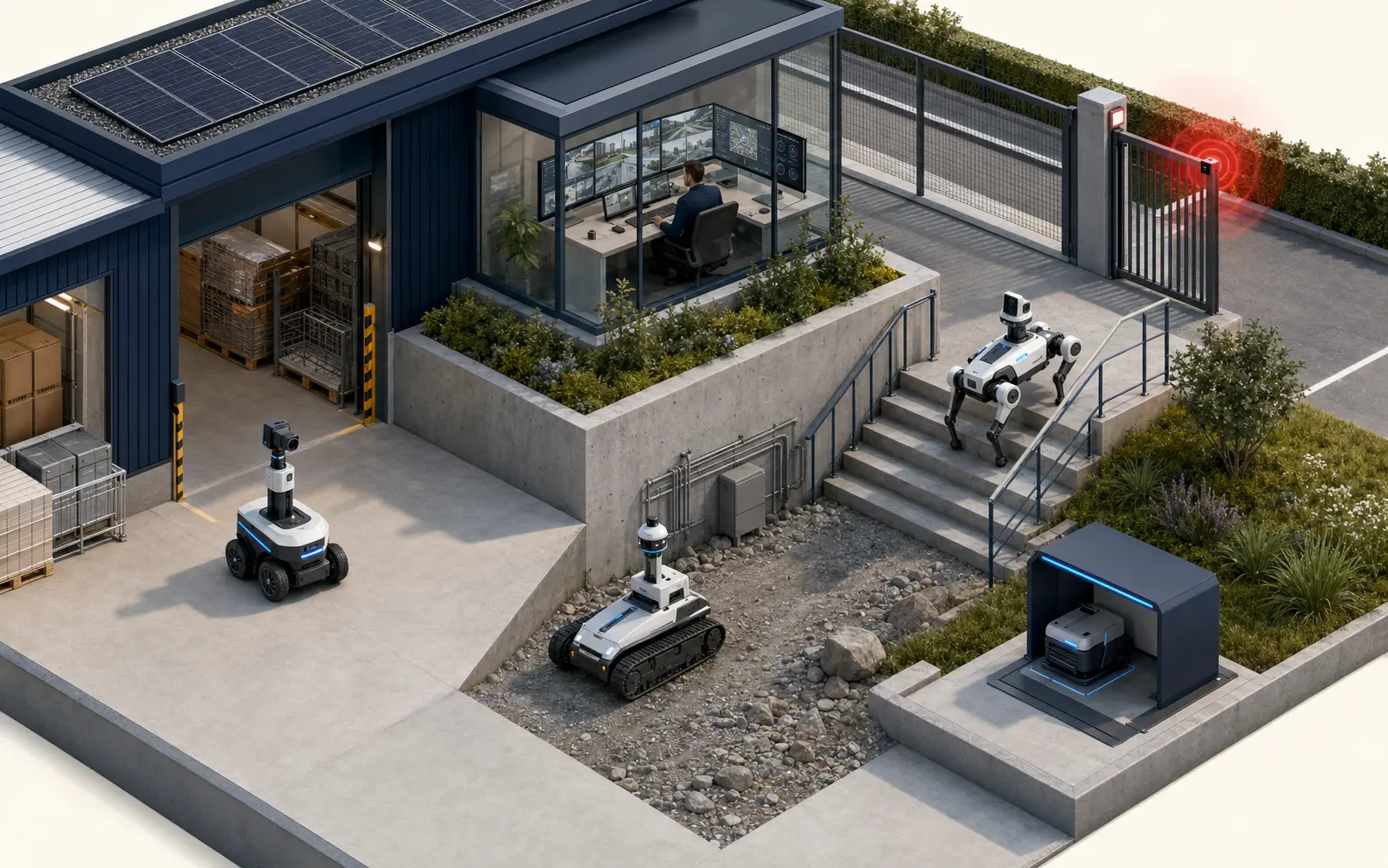
The feasibility assessment examines routes, gradients, thresholds, surfaces, pedestrian and vehicle flows, network coverage, charging options and areas that must remain outside the camera's field of view.
The platform is then selected for the actual mission. It needs to communicate with compatible equipment, transmit useful events and fit a clear monitoring and response procedure.
A bounded pilot tests route completion, alert quality, safe stops, return to the dock and the workload left to human operators. Coverage should expand only when the results provide measurable value.
The challenge
01Terrain, thresholds, gradients and site traffic can make a platform unsuitable.
02A standalone robot is not a complete security service: alerts need monitoring and a defined response.
03Connectivity, charging, privacy, human safety and maintenance determine real operational reliability.
A purpose-built architecture
Define the missions, survey the terrain, identify constraints and establish whether a robot adds practical value.
Compare mobility, sensors, docking, integrations and support against the site's actual requirements.
Connect missions and events with compatible equipment, human operators and existing procedures.
Test a bounded route against agreed scenarios, success criteria and degraded operating modes.
Use cases
Frequently asked questions
There is no universal model. Selection depends on terrain, obstacles, mission, weather, required sensors, connectivity, charging and available support. The route should be assessed before a platform is chosen.
This may be possible when the equipment and interfaces are compatible. Alert flows, access rights, image transmission, cybersecurity and the operator's response procedure all need to be verified.
No. It can automate selected repetitive patrols and provide a mobile viewpoint, but judgement, communication, unexpected situations and sensitive interventions remain human responsibilities.
The pilot covers a limited route and a small set of measurable scenarios. It assesses mission completion, human assistance, alert quality, immobilisations, return to the dock and behaviour when connectivity is unavailable.
There is no single authorisation covering every project. Use must comply with requirements including human safety, data protection, neighbour rights and workplace protections. Each site configuration requires its own assessment.
Cost depends on the platform, sensors, dock, network, integration, monitoring, maintenance and service level. A credible estimate requires a defined mission and perimeter. A pilot helps establish the cost of each genuinely useful patrol.
On-site pilot