This page covers the essential concepts and links to more specialised resources. Capabilities, constraints and rules must always be checked against the relevant site and use case.
A drone-in-a-box architecture built to travel much farther
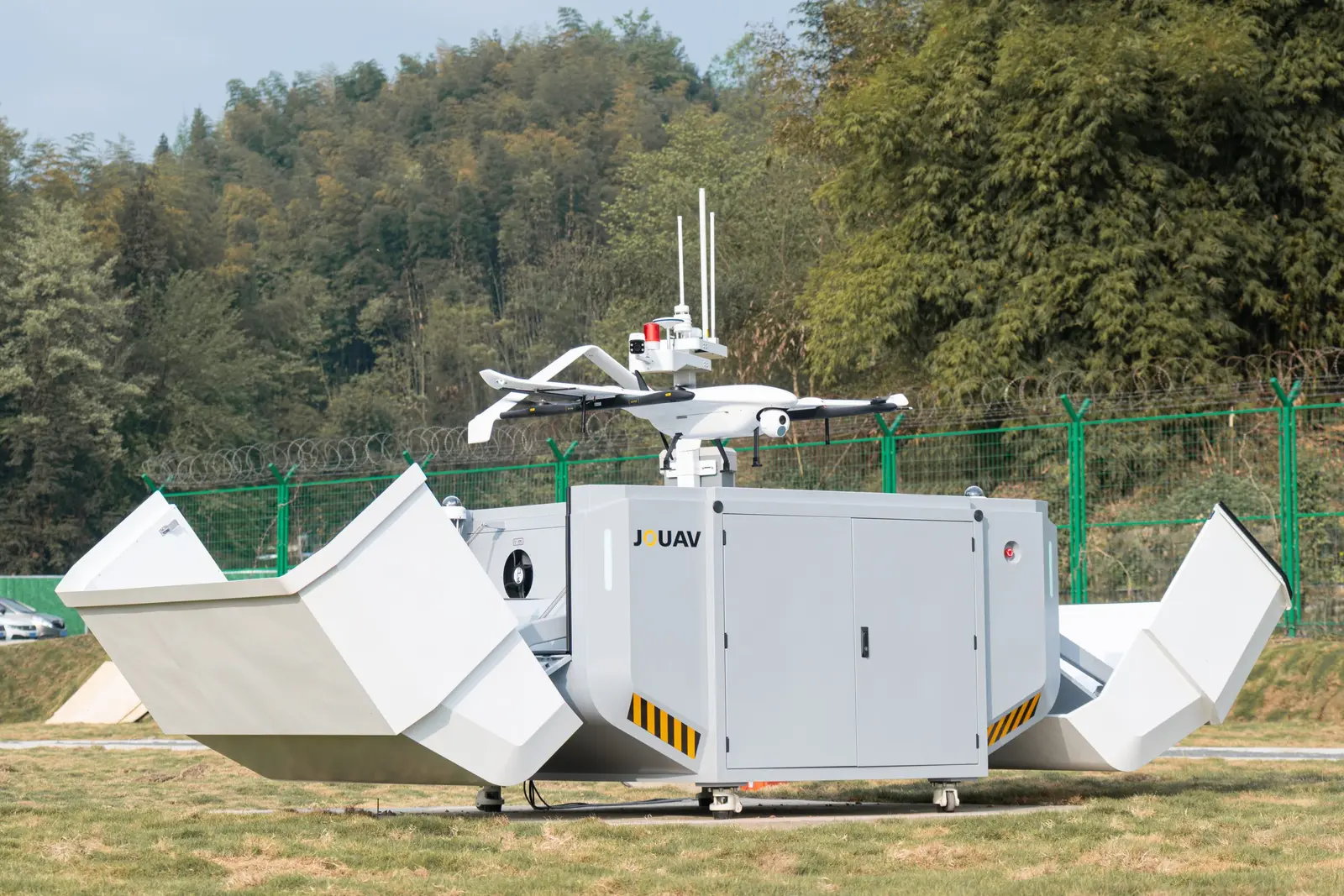
JOUAV VTOL Hangar combines an automated station, a CW-15V aircraft and the JoCloud supervision platform. The station houses the aircraft, prepares the mission, opens for vertical take-off and landing, recharges the battery and transfers data. JoCloud is presented as the layer for flight planning, telemetry, live information and multi-station management.
The CW-15V takes off like a multirotor before transitioning to wing-borne flight. This is the defining difference from an aircraft that remains supported by its rotors throughout the mission. Fixed-wing cruise can cover power lines, pipelines, roads, railways, mines or coastal areas far more efficiently than a local multirotor patrol.
Range does not make the system a permanent airborne guard. The aircraft cannot observe every location continuously, must return for charging and remains dependent on weather, communications, airspace and the approved operating framework. For security, it is a mobile reconnaissance and alarm-verification layer around fixed detection and human-led response.
For a deeper analysis, read Percepto Air Max for autonomous inspection. Review another industrial drone-in-a-box architecture.
JOS-C700 and CW-15V: the specifications JOUAV currently publishes
The table below uses JOUAV manufacturer information available on 9 August 2026. These figures support initial screening, but do not guarantee range, availability or image quality at a particular site.
The public product page also contains inconsistencies. Its technical table states less than 100 minutes to charge from 10% to 90%, while a marketing block states 30 minutes. It lists IP55 in the technical table and IP54 in a paragraph. A buyer should obtain a dated contractual specification for the exact delivered configuration.
JOUAV publicly documents more than one station reference. The current product page presents JOS-C700 with CW-15V. A 2024 release and a 2025 case study describe JOS-C800, also paired with CW-15V. Specifications from these variants must not be mixed. For verification, see JOUAV: JOS-C700 VTOL Hangar and CW-15V product information and JOUAV: JOS-C800 and CW-15V network-inspection case study.
| Item | Manufacturer figure | What the project must validate |
|---|---|---|
| Architecture | JOS-C700 station, CW-15V VTOL aircraft and JoCloud | Exact generation, included software and enabled functions |
| CW-15V performance | 120 min with payload, 72 km/h, maximum 3 kg payload | Endurance with selected sensors, reserve and local weather |
| Published radius | Up to 47 km in the technical table | Communications, terrain, authorised route and return reserve |
| Payloads | Two bays, with visible, thermal, zoom, RGB or LiDAR combinations | Mass, integration, calibration and usable data quality |
| Closed station | 2.45 × 1.9 × 1.9 m and under 900 kg with stated backup power | Foundation, access, drainage, physical security and local permissions |
| Station environment | -30 °C to 50 °C, up to 4,500 m altitude, IP55 in the table | Wind, snow, icing, precipitation and delivered configuration |
| Charging | Less than 100 min from 10% to 90% in the technical table | Resolve the conflict with the 30-minute statement on the same page |
Published performance is not the delivered service
Useful range depends on terrain, payload, wind, communications, regulatory reserve and station placement. A pilot should measure completed missions, time to actionable imagery, interruptions, data quality and manual recoveries.
Credible missions across extended sites and linear infrastructure
The strongest use case is linear inspection. Power lines, pipelines, railways and roads require distance rather than prolonged hovering near one point. Visible cameras can document structures, thermal imaging can identify temperature differences and LiDAR can model geometry or vegetation. JOUAV publishes Chinese power-grid cases using stations distributed across large territories. For verification, see JOUAV: JOS-C700 and CW-15V power-line case study.
A second use case is reconnaissance across a mine, quarry, port, energy estate, forest or coastal area. After an alert, the aircraft can reach a remote sector and return a broad visible or thermal view. It may help distinguish a person, vehicle, fire or technical incident, but cannot replace continuous fixed detection or a prepared intervention procedure.
The third use case is post-event assessment. Storms, landslides, line failures and hazardous access can justify aerial reconnaissance before people enter. Sensor outputs inform a competent team. They do not independently diagnose a fault or decide how to respond.
The economic case is often strongest when inspection and security share the platform. Routine asset missions create regular value, while alarm or emergency flights add resilience. A hangar reserved only for rare intrusions may be difficult to justify.
For a deeper analysis, read Complete guide to surveillance drones. Compare missions, architectures and operating constraints before selection.
JOUAV VTOL Hangar versus DJI Dock 3: different mission scales
Endurance alone does not explain the choice. JOUAV uses a 2.22 m wingspan fixed-wing VTOL and a station weighing close to one tonne. DJI Dock 3 uses a compact multirotor and a 55 kg dock without the aircraft. Both automate launch, return, charging and data, but serve different territories. For verification, see JOUAV: 2024 JOS-C800 VTOL Hangar announcement.
JOUAV is more coherent when the aircraft must travel along a corridor, reach distant assets or move between stations. DJI Dock 3 is much smaller, turns missions around faster and is better suited to local alarm verification or inspection near the dock. Selection should start with the distance between decisions, not the largest headline specification. For verification, see DJI Enterprise: DJI Dock 3 and Matrice 4D official specifications.
| Criterion | JOUAV VTOL Hangar with CW-15V | DJI Dock 3 with Matrice 4D or 4TD |
|---|---|---|
| Aircraft | Fixed-wing VTOL, efficient in cruise | Multirotor, effective for local flight and hovering |
| Published endurance | 120 min with payload | 54 min maximum under DJI test conditions |
| Published radius | Up to 47 km in JOUAV's table | Up to 10 km under DJI's stated conditions |
| Station | Large fixed infrastructure, under 900 kg stated with backup power | Compact 55 kg dock, also designed for vehicle mounting |
| Published charging | Under 100 min from 10% to 90% in JOUAV's table | 27 min from 15% to 95% at 25 °C |
| Natural mission | Corridors, networks and very large territories | Local response, site patrol and nearby inspection |
For a deeper analysis, read DJI Dock 3 for surveillance and inspection. Compare a compact multirotor station for local missions.
In Switzerland, technical range is not an operating authorisation
A remotely launched mission over several kilometres will normally operate beyond the pilot's direct visual line of sight. FOCA states that BVLOS is not permitted in the open category and belongs in the specific category. The operator needs an operating framework and authorisation suited to the actual mission. For verification, see FOCA: drone flight rules and BVLOS operation.
The assessment covers airspace, people, roads, neighbouring infrastructure, loss of communications, weather, energy reserve, maintenance, competencies and emergency procedures. A manufacturer radius of 47 km is neither an automatically usable route nor Swiss approval.
The official pages reviewed do not publicly confirm Swiss commercial availability, local support, European class marking or Swiss approval for the JOS-C700 and CW-15V combination. These points must be verified with JOUAV, a qualified integrator and FOCA before commitment.
Imagery must also comply with data-protection requirements. Routes, camera angles and zoom positions should avoid unnecessary views of homes, roads and public areas. If employees are identifiable, purpose, proportionality, transparency, access and retention require specific review.
Hangar, communications, JoCloud and data determine reliability
The hangar is infrastructure. It needs a foundation, electrical supply, maintenance access, drainage, lightning protection, physical security and clear volume for opening, take-off and landing. Its size and weight distinguish it from a small multirotor dock.
Communications become critical on a long mission. JOUAV lists gigabit Ethernet, fibre, radio equipment and backup power. The project must design primary and backup links, identify coverage gaps and define safe actions after network loss. Returning safely should not depend on a single remote service.
JOUAV presents JoCloud for planning, supervision and processing, while also advertising private deployment and an open SDK. Those statements do not define the delivered architecture. The buyer needs a data-flow diagram, hosting location, subprocessors, support accounts, encryption, logs, APIs, updates and exit procedures.
Security video, maintenance imagery and mapping data should not share identical roles or retention. Incident footage may become evidence, while infrastructure point clouds may reveal sensitive assets. Network segmentation and access controls must be tested during the pilot.
Our assessment: a territory platform, not a simple DJI Dock 3 substitute
JOUAV VTOL Hangar deserves consideration when one operator must observe dispersed assets, follow a corridor or reach remote areas quickly. Fixed-wing cruise, two payload bays and multi-station operation create a distinct proposition from compact multirotor docks. For verification, see FDPIC: photos and video surveillance.
That ambition adds complexity. The station is heavy, the published charging cycle is long, BVLOS operation requires a robust case and the collected data can be sensitive. Inconsistencies across JOUAV's public materials also make a dated contractual configuration essential, including support, parts, software and performance.
For one warehouse, an urban construction site or a perimeter measured in hundreds of metres, DJI Dock 3, Skeyetech or fixed systems may be more proportionate. For power networks, pipelines, mines, forests, coastlines or dispersed infrastructure, CW-15V may justify a dedicated pilot.
That pilot should measure completed missions, actual distance, time to actionable imagery, weather cancellations, sensor quality, manual recoveries, charging, support availability and continuity after failure. The decision concerns an authorisable operating service, not brochure range.
Frequently asked questions
What is JOUAV VTOL Hangar?
It is a drone-in-a-box system combining an automated station, the fixed-wing VTOL CW-15V and JoCloud. It automates mission preparation, launch, return, charging and data handling under the supervision required by the operation.
What endurance does JOUAV state for CW-15V?
The current product page states 120 minutes with payload and up to 47 km radius in its technical table. These manufacturer figures are neither a site guarantee nor permission to operate that distance in Switzerland.
What is the difference between JOS-C700 and JOS-C800?
JOUAV's current product page presents JOS-C700, while publications from 2024 and 2025 describe JOS-C800. Both are paired with CW-15V, but their specifications must not be mixed. The proposed generation and contractual data sheet require confirmation.
Is JOUAV VTOL Hangar better than DJI Dock 3?
It serves a different scale. JOUAV targets corridors and very large territories with efficient fixed-wing cruise. DJI Dock 3 is far more compact, recharges faster and is better suited to local missions around the dock.
Can JOUAV VTOL Hangar operate in Switzerland?
No general product approval authorises a mission. Remote BVLOS operation belongs to the specific category and requires a framework accepted by FOCA. Availability, support, configuration compliance and data handling also require verification.