This page covers the essential concepts and links to more specialised resources. Capabilities, constraints and rules must always be checked against the relevant site and use case.
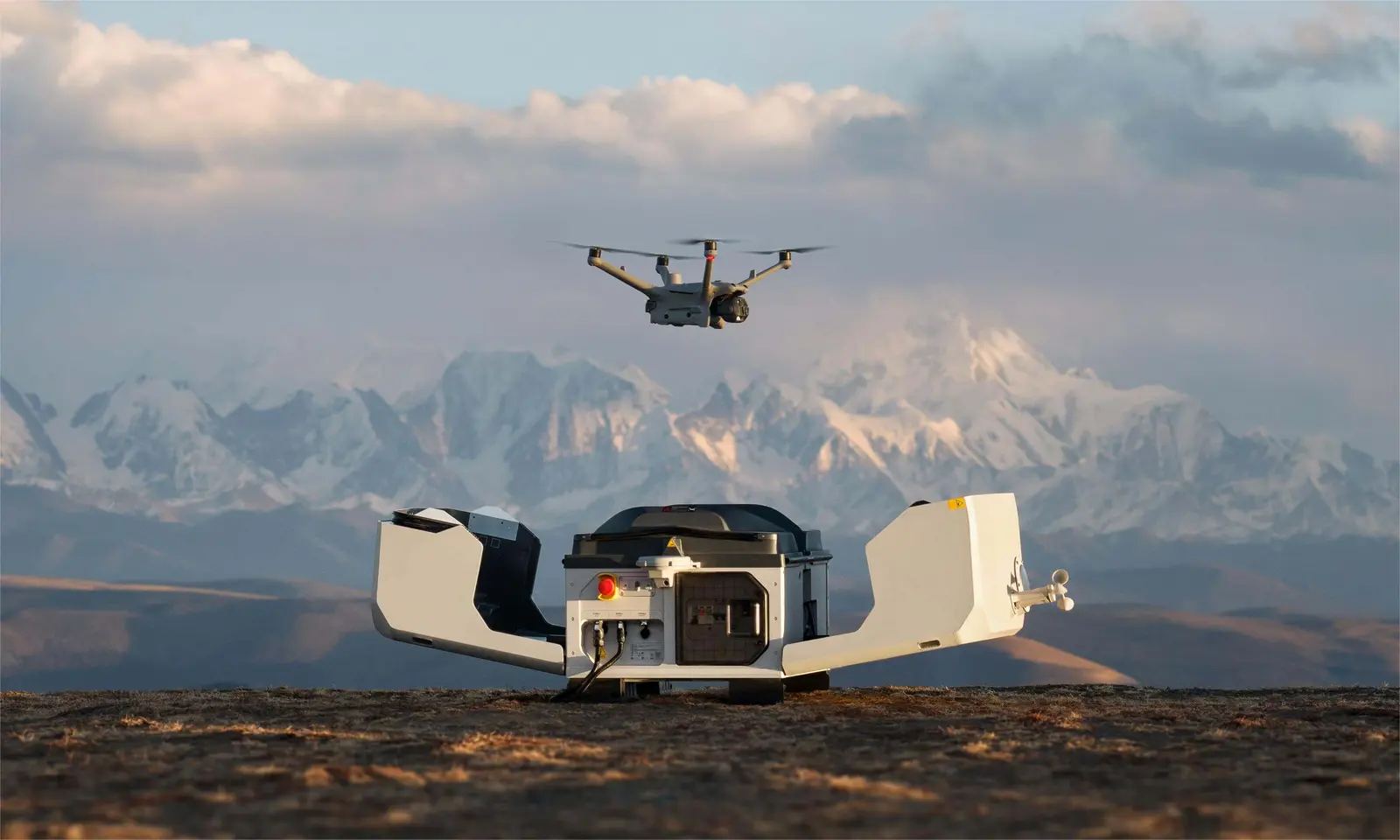
DJI Dock 3 for surveillance and inspection: a docked aircraft ready for a prepared mission
DJI Dock 3 is an outdoor station designed to house, protect, recharge and connect a Matrice 4D or 4TD drone. The drone-in-a-box model keeps the aircraft on site for prepared surveillance, alarm-verification and inspection missions under the supervision required by the operating scenario. For verification, see DJI: official DJI Dock 3 announcement.
For a warehouse, logistics platform, construction site or industrial facility, that availability changes the operating model. A fence alarm can request an aerial observation route, while a planned inspection can document a roof, asset or hard-to-reach area.
DJI Dock 3 is not a complete security system by itself. Fixed sensors detect, software coordinates, an authorised operator supervises the mission and a security procedure determines the response. Its value comes from that complete chain rather than automated take-off alone. For verification, see DJI Enterprise: Dock 3 product information.
For a deeper analysis, read Complete guide to surveillance drones. Compare missions, architectures and constraints before selecting a brand.
Matrice 4D or 4TD: visual or thermal inspection
DJI pairs Dock 3 with Matrice 4D and 4TD aircraft. Both combine several visible cameras and a laser rangefinder. The 4TD adds capabilities including thermal imaging and near-infrared illumination that may support night-time or technical missions. For verification, see DJI Enterprise: Dock 3 and Matrice 4D/4TD specifications.
Thermal imaging can reveal a person-shaped heat contrast or an apparently hot asset. It cannot see through walls and does not prove that a person is unauthorised. Animals, engines, sun-heated surfaces and reflections can create similar signals. Visible context and human verification remain essential.
Zoom helps inspect a gate, roof or distant equipment without flying directly above it. It also increases the possibility of observing beyond the legitimate perimeter. Approved camera positions, geographic limits and privacy masks should prevent unnecessary views of neighbours, roads and employees.
Manufacturer figures for flight time, weather resistance, temperature and transmission range are useful screening criteria. They are not a guarantee on a metal-heavy site, in a valley or during cold wind. The customer must measure availability, signal quality, response time and completed missions under local conditions.
DJI Dock 3 for surveillance and inspection: three realistic scenarios
First, a perimeter sensor activates at night on the remote side of a warehouse. The drone follows an authorised route and provides visible and thermal views. An operator distinguishes an animal, authorised vehicle or credible intrusion and applies the prepared escalation procedure.
Second, a logistics platform has experienced fuel theft from parked vehicles. A drone cannot secure fuel tanks by itself, but it can verify movement in a sensitive parking zone and provide a wider view. Level sensors, access control, lighting and response procedures remain necessary.
Third, an incident affects a roof, pipe or hard-to-reach area. The drone can deliver initial reconnaissance before technicians enter. Combining inspection and security may justify the platform more effectively than a project based on rare intrusions alone.
Each scenario needs a fallback. Wind, maintenance, airspace restrictions or charging may make the drone unavailable. Fixed cameras, ground sensors, robots and human patrols preserve coverage while the aerial layer is out of service.
Installing Dock 3 is an infrastructure project
The station needs a stable, clear and maintainable position. Power, primary and backup communications, lightning protection, drainage, obstacles, turbulence, physical access and vandalism all require review. The return path must remain safe even when part of the network fails.
DJI also presents vehicle-mounted use. Mobility may support temporary operations or large infrastructure networks, but it adds controls around vehicle stability, exact positioning, airspace, communications and pre-launch checks. A mobile dock does not mean that a flight can be improvised anywhere. For verification, see DJI Enterprise: Dock 3 frequently asked questions.
Maintenance covers the aircraft, batteries, station, weather sensors, propellers, software and emergency procedures. A health alert should lead to a clear state: mission permitted, restricted or stopped. Availability is meaningful only when responsibilities and spare parts are prepared.
Site change management matters. New cranes, stored materials, scaffolding or nearby construction can alter the route and risk. Maps and procedures should be reviewed rather than left unchanged after initial commissioning.
Routine remote operation requires Swiss regulatory analysis
An automated flight from a remotely supervised dock will generally take place beyond the pilot’s direct visual line of sight. In Switzerland, BVLOS operation belongs to the specific category. The operator must demonstrate control of risks and obtain the appropriate authorisation from the Federal Office of Civil Aviation. For verification, see FOCA: introduction to the specific category.
The analysis covers airspace, people, roads, neighbouring buildings, technical failure, weather, loss of communication, competencies and emergency response. A closed industrial perimeter may support effective mitigations, but it is not automatically exempt.
Authorisations or waivers obtained in the United States or elsewhere do not transfer to Switzerland. The Swiss legal operator, exact mission and local environment must be documented. Hardware installation should not begin before the operating pathway is credible.
The project should select the smallest routes that answer important decisions. Limiting altitude, distance and exposure can improve both safety and authorisation. A technically possible long route may add risk without providing better security information.
Cybersecurity and data require enterprise controls
A site drone collects detailed imagery, maps, operating patterns and potentially identifiable people. Administrator accounts, communications, APIs, storage and remote support become sensitive assets. Roles should be separated, strong authentication enforced and actions logged.
The project must document where data travels and is stored, which cloud functions are enabled, which subprocessors are involved and how information is deleted. Inspection images, live incident video and evidence provided to authorities may require different access and retention rules.
Software updates should follow a controlled process with testing, maintenance windows and post-change verification. Supplier access needed for support should be time-limited, approved and traceable. The Dock network should not provide a direct path to industrial control systems.
Geographic and camera limits protect privacy. When people are identifiable, Swiss principles of purpose, proportionality, information and security apply. The easiest data to protect is footage the system was never allowed to collect.
Our view: a compelling platform when the operating case is justified
DJI Dock 3 is a strong platform to examine when an organisation wants to combine alarm verification, inspection and incident reconnaissance. The choice between Matrice 4D and 4TD depends on the real value of thermal and night-time capabilities. For verification, see FDPIC: photos and video surveillance.
For a villa or small business, regulatory and operating complexity will often make fixed cameras, radar or a ground robot more proportionate. For a large industrial area, quarry or infrastructure network, rapid aerial access across several zones can create measurable value.
Percepto Air Max offers a different inspection-led architecture, Skeyetech E2 provides a European sensitive-site proposition and Sunflower Labs Beehive focuses on property security. Data requirements, support, authorisation and integration may matter more than camera specifications.
A pilot should measure time to useful video, mission success, confirmed alerts, weather cancellations, operator workload and fallback performance. It should also test a link failure and unavailable aircraft. The project is successful only when the complete security service remains resilient.
For a deeper analysis, read Percepto Air Max for autonomous inspection. Compare an architecture primarily designed around industrial inspection.
For a deeper analysis, read Skeyetech E2 for site surveillance. Review a European drone-in-a-box platform for sensitive sites.
Frequently asked questions
Can DJI Dock 3 be used for surveillance?
Yes, as the aerial layer of a wider security system. It can support planned patrols or alarm verification, but must connect to fixed detection, human monitoring and prepared response procedures.
Is DJI Dock 3 suitable for thermal inspection?
With Matrice 4TD, the system includes thermal imaging and near-infrared illumination. It can help identify and document thermal differences, but results depend on operating conditions and do not replace specialist technical diagnosis.
Can DJI Dock 3 operate remotely in Switzerland?
Remote operation beyond direct visual line of sight belongs to the specific category. It requires an operating framework and FOCA authorisation suited to the mission, site, exposed people and risk mitigations.
Can DJI Dock 3 replace fixed cameras?
No. Fixed systems maintain continuous detection while the drone is charging, under maintenance or unable to fly because of weather, connectivity or operating restrictions.