Perimeter sensors
They monitor entrances, fences and sensitive areas without relying on one camera angle.
Technology building blocks
Understand the role of each technology before adding it to the system.
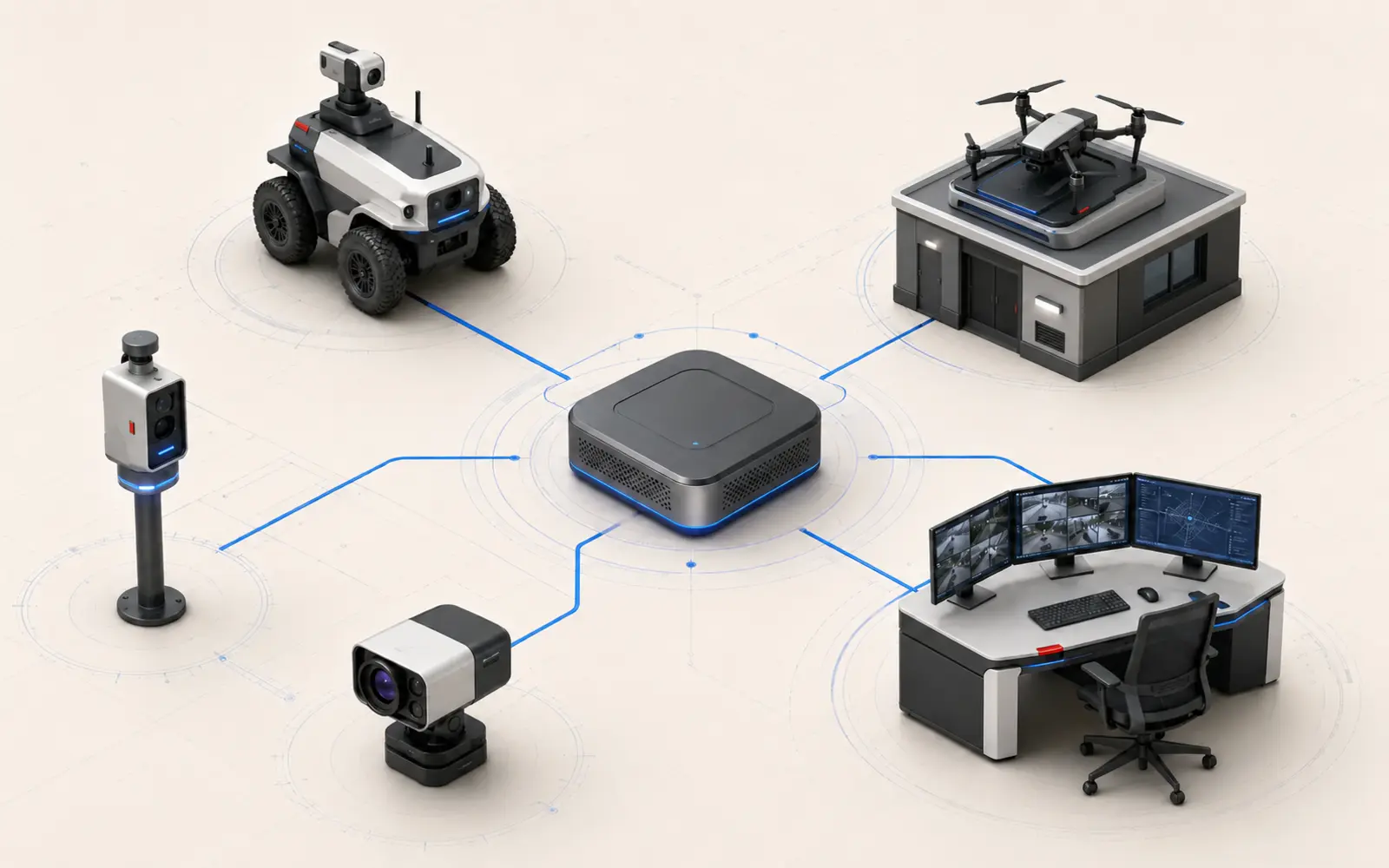
Value does not come from an isolated device. It comes from coordinating detection, mobility, analysis and human oversight.
Key points
A fixed sensor continuously monitors a defined area. A robot carries several sensors towards a point of interest. A drone provides a fast aerial view. The monitoring platform brings the information together and applies the agreed rules.
Every technology also has limits. A robot depends on the terrain, a drone on aviation rules and weather, while a fixed camera remains constrained by its viewing angle. A sound architecture combines their strengths without adding unnecessary equipment.
We select components for reliability, interoperability, maintenance and their ability to operate under real site conditions.
Software quality matters as much as hardware. Alerts, missions, device health and access rights need to come together in a clear, secure system that teams can use every day.
Detect
They monitor entrances, fences and sensitive areas without relying on one camera angle.
Visible-light and thermal cameras provide context by day or night, depending on the use case.
The system correlates signals to reduce false alarms and prioritise relevant situations.
Move
They perform repeatable patrols and travel to an alert area along a validated route.
Industrial use casesThey can provide a rapid aerial view, subject to an operational and regulatory assessment.
See the response chainIt combines data feeds, device health, missions and events in one coherent operational view.
Explore the design principlesFrequently asked questions
No. Gradients, steps, surfaces, narrow passages and weather conditions determine which type of robot can be used.
Not necessarily. The scenario depends on technical feasibility, applicable aviation rules and the selected level of human oversight.
The architecture must include degraded modes, technical alerts and suitable communication redundancy for the level of risk.