Detection
Sensors and video analytics identify unusual activity.
Businesses and retail sites
Verify alerts faster across car parks, entrances and outdoor areas.
Car parks, yards, secondary entrances and delivery areas can be checked through mobile, traceable security.
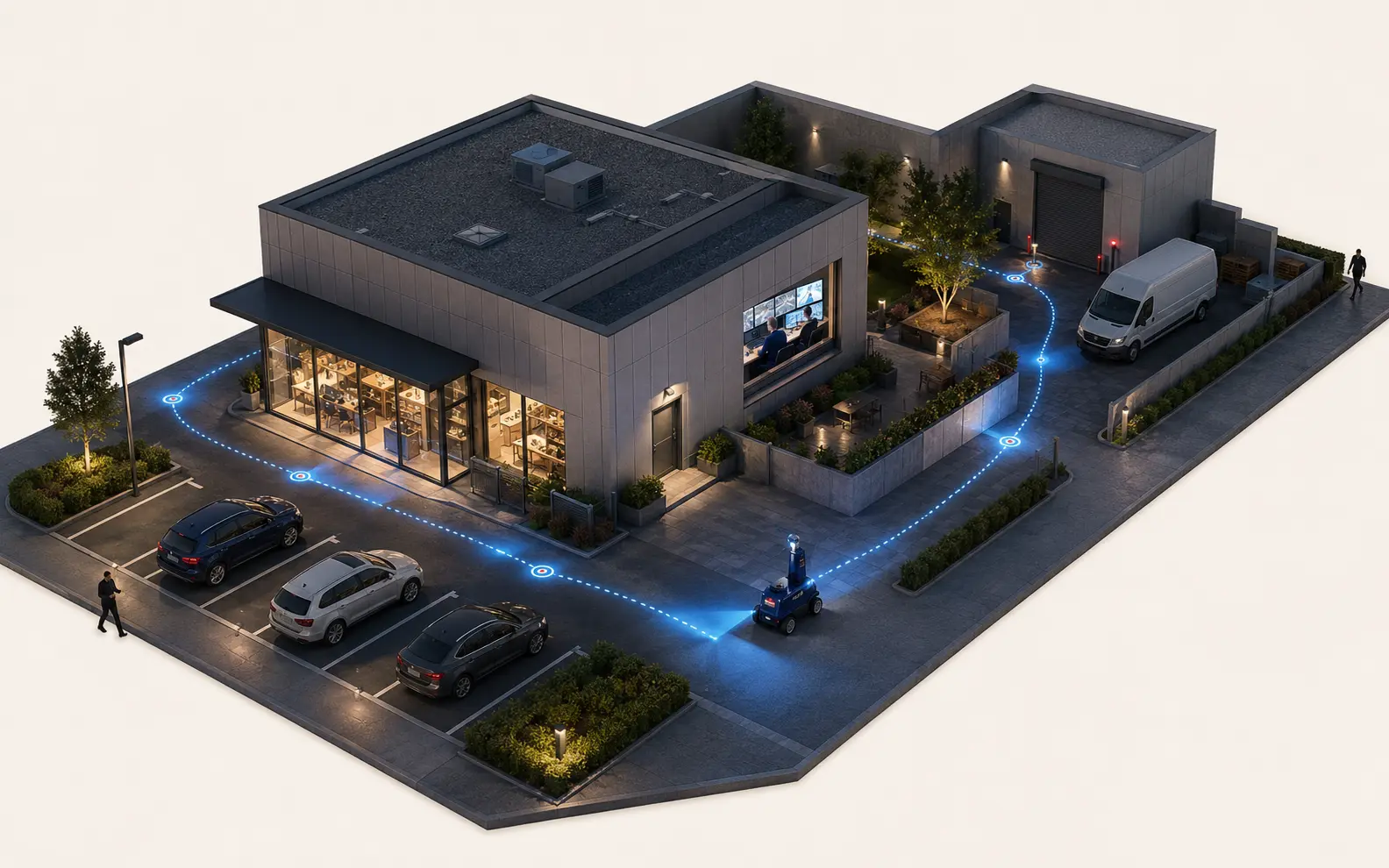
Your objective
Many businesses have strong indoor surveillance but struggle to cover car parks, yards and secondary entrances. Human patrols provide a valuable presence, yet cannot observe every area continuously.
A robot can complete scheduled patrols after closing or move towards a specific alert. It then sends images and sensor data to the monitoring team, which decides whether an intervention is necessary.
The system must fit existing procedures and avoid monitoring employee behaviour. Operating hours, authorised areas and image-access rights are agreed before commissioning.
A project can begin with one exposed car park, yard or entrance. This pilot perimeter makes it possible to compare alert quality, verification times and the workload genuinely removed from security teams.
The challenge
01Outdoor areas are difficult to cover with fixed cameras alone.
02False alarms waste the time of internal teams and service providers.
03Repetitive human patrols are costly and difficult to document consistently.
A purpose-built architecture
Sensors and video analytics identify unusual activity.
The robot follows scheduled routes or moves towards an alert.
Lighting, a siren or a voice message can be activated.
An operator verifies the event and coordinates the appropriate response.
Use cases
Frequently asked questions
Yes, provided routes are safe and the site is organised for supervised autonomous operation.
Yes. The purpose is to integrate detection and mobile alarm verification into the relevant monitoring processes.
Only after assessing pedestrian and vehicle flows, safe navigation, privacy and responsibility for operations.
Pilot programme