This page covers the essential concepts and links to more specialised resources. Capabilities, constraints and rules must always be checked against the relevant site and use case.
What Autel EVO Nest and EVO Max 4T V2 actually provide
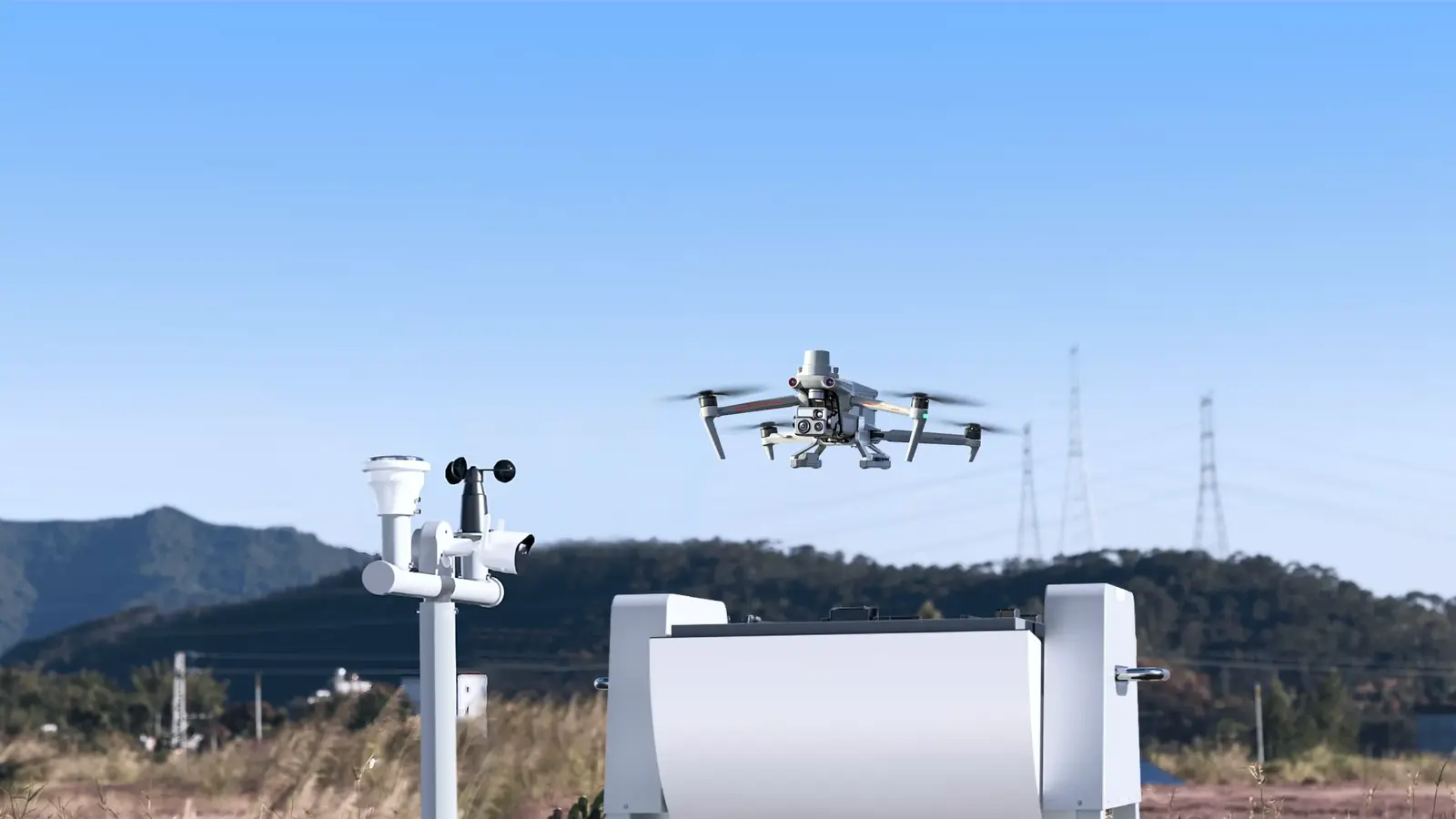
EVO Nest is an outdoor station designed to house, protect, recharge and connect an EVO Max Series aircraft. With the Autel Integrated Command System, or AICS, it creates a drone-in-a-box architecture for route preparation, scheduled missions and remote supervision. For verification, see Autel Robotics: official EVO Nest product information and specifications and Autel Robotics: official EVO Nest FAQ.
As of 9 August 2026, Autel’s current product page presents the EVO Max 4T V2. It combines visible cameras, thermal imaging and a laser rangefinder. The dock does not turn this aircraft into an autonomous security officer. It automates a prepared aerial mission while an accountable operator and response procedure remain responsible for interpretation and action. For verification, see Autel Robotics: official EVO Max 4T V2 information and specifications.
The system deserves consideration for large perimeters, industrial facilities, infrastructure, quarries and technical sites that can share the platform between alarm verification and inspection. For a small site, aviation complexity and operating cost may make fixed cameras or a ground robot more proportionate.
For a deeper analysis, read Skeyetech E2 for sensitive sites. Review a European security and inspection architecture.
Dock, aircraft and software: the specifications worth screening
The figures below come from official Autel pages consulted on 9 August 2026. They support initial screening, not a prediction of site performance. Weather, obstacles, metal structures, network design, firmware and the delivered configuration can change the result. For verification, see Autel Robotics: EVO Max Series documents and EU declaration.
Autel’s online material currently combines some data for the original EVO Max 4T and the V2. It also publishes two different weights for EVO Nest. The exact generation, sensor, battery, certification basis and software release must therefore appear in the supplier quotation and acceptance protocol. For verification, see Autel Robotics: official EVO Max Series firmware release notes.
| Item | Autel-published figure | Project validation |
|---|---|---|
| Dock compatibility | EVO Nest is specified for the EVO Max Series. | Confirm exact V2 model, battery, firmware, payload and accessories. |
| Dock protection | IP55. | Test actual rain, snow, dust, drainage and maintenance exposure. |
| Dock operating temperature | -30°C to 55°C. | Measure availability with local wind, precipitation, sun and freeze cycles. |
| Dock charging | 10% to 90% in 25 minutes under Autel’s stated conditions. | Measure turnaround with hot or cold batteries and the required reserve. |
| Dock weight | The technical table says 132 lb, about 60 kg, while overview copy says 154 lb, about 70 kg. | Confirm delivered weight, dimensions, handling and mounting. |
| EVO Max 4T V2 endurance | Up to 42 minutes in a windless test. | Measure useful time with route, wind, reserve and payload. |
| Fusion 4T V2 sensors | 48 MP 10x optical zoom, 48 MP wide camera, 640 × 512 thermal and 5 to 1,200 m laser rangefinder. | Confirm exact gimbal, night quality, useful range and required detail. |
| EVO Max 4T V2 transmission | Up to 8 km in CE regions without obstruction or interference, according to the aircraft page. | Validate the authorised route, redundancy and lost-link behaviour. |
Documentation discrepancies belong in the procurement process
The EVO Nest page highlights 4.4 miles of operating range, while the FAQ says approximately 12 km in line of sight depending on the environment. The current aircraft page specifies up to 8 km in CE regions. A project should not select one marketing distance. It should define the required route, obtain a written configuration and measure the link along that route. For verification, see DJI Enterprise: official DJI Dock 3 specifications.
The same discipline applies to dock weight and Fusion 4T generations. A signed bill of materials, software versions and contractual values are more useful than a generic product name. For verification, see DJI Enterprise: official DJI Dock 3 FAQ.
Credible surveillance and inspection uses
For security, the main benefit is an aerial point of view that can move to an alarm zone. After a fence or camera alert, a prepared route may show the movement of a person or vehicle and give an operator a second perspective. Fixed detection remains necessary while the aircraft charges, is maintained or cannot fly.
For inspection, visible imaging, zoom, thermal and ranging can document roofs, substations, pipework, façades or hard-to-reach assets. Sharing the platform between security and inspection can strengthen the economic case, provided that every purpose has defined users, retention and interpretation rules.
Thermal imaging measures radiation contrast. It can reveal an apparent hot source or silhouette, but it cannot see through walls or prove an intrusion. Sun, engines, animals, wet surfaces, angle and distance can affect the image. Visible context and human verification remain essential.
Three scenarios worth testing
An industrial perimeter alarm can trigger a short route to a remote fence. A scheduled infrastructure mission can document selected assets without continuously filming staff. After an incident, the aircraft can provide reconnaissance before a team enters a potentially hazardous zone.
- Time from alert to useful imagery
- Share of missions completed without manual recovery
- Visible and thermal quality by day, night and difficult weather
- Alerts confirmed, dismissed or left inconclusive
- Availability of fixed fallback layers while the aircraft is unavailable
For a deeper analysis, read Complete guide to surveillance drones. Place individual models within a comparison of uses, architectures and constraints.
Automated missions and AI recognition need careful language
Autel says AICS can issue missions through wired, 4G or 5G networks and define routes, waypoints, angles, targets, times and frequency. The FAQ says direct communication between Nest and aircraft does not require an internet connection. Remote supervision, cloud functions and integrations still need a separate network and resilience review.
The manufacturer states that EVO Max 4T can identify and lock onto categories including heat sources, moving people and vehicles. The EVO Nest page also names people, vehicles, ships, smoke and fire in the AICS environment. These pages do not publish detection rates, false-positive rates or performance matrices by distance and weather.
Those are manufacturer capabilities to validate, not guaranteed outcomes. A ‘person’ class establishes neither identity, authorisation nor intent. AI may prioritise imagery or track an observable target, but should not make a critical intervention decision by itself.
Autel EVO Nest versus DJI Dock 3
Both systems keep a professional aircraft on site, recharge it, plan missions and connect remote users. They are not interchangeable. Software, local support, aircraft generation, accessories, data controls and integrator experience may matter more than one headline endurance figure.
| Criterion | Autel EVO Nest + EVO Max 4T V2 | DJI Dock 3 + Matrice 4TD | Decision question |
|---|---|---|---|
| Architecture | EVO Nest, EVO Max Series and AICS. | Dock 3, Matrice 4D Series and FlightHub 2. | Which chain can the integrator operate and maintain? |
| Dock protection | IP55 stated. | IP56 stated. | Which local conditions exceed laboratory tests? |
| Dock temperature | -30°C to 55°C stated. | -30°C to 50°C stated. | What availability is demonstrated in winter, sun and rain? |
| Rapid charging | 10% to 90% in 25 minutes under Autel conditions. | 15% to 95% in 27 minutes at 25°C according to DJI. | What is the real mission interval with the planned reserve? |
| Aircraft endurance | Up to 42 minutes stated for EVO Max 4T V2. | Up to 54 minutes stated for Matrice 4D Series. | How much useful time remains on the authorised route? |
| Thermal observation | 640 × 512 thermal, visible, zoom and ranging for the Fusion 4T configuration. | Thermal, multiple visible cameras, near-infrared light and ranging on 4TD. | What detail must be resolved, at which distance and in which weather? |
| Local maturity | Swiss availability, support, spares and service require confirmation. | Swiss availability and service require confirmation for the selected configuration. | Who responds, within which time, with which parts and commitment? |
For a deeper analysis, read DJI Dock 3 for surveillance and inspection. Compare Autel with a major competing drone-in-a-box platform.
Infrastructure, maintenance and cybersecurity determine real value
Autel describes an integrated weather station, RTK base, 110 or 220 V power and the ability to network multiple Nests. The installation must also address foundation stability, drainage, lightning, obstacles, turbulence, physical security, noise, technician access and an alternate landing area.
Maintenance covers the dock, hatch, aircraft, battery, propellers, sensors, storage, updates, calibration and emergency tests. Autel states at least 50,000 hatch cycles, but this does not establish repair time or spare-part availability in Switzerland. Those service levels need contractual confirmation.
Autel states AES-256 image-transmission encryption and encryption options for media and logs. The customer must still map accounts, authentication, APIs, cloud flows, data location, logging, remote support and updates. The dock network should not create an uncontrolled route into industrial systems.
In Switzerland, aviation feasibility comes before procurement
A permanent dock is generally intended for remotely supervised operation beyond the pilot’s direct visual line of sight. In Switzerland, BVLOS belongs to the specific category. The operator must establish the applicable path with the Federal Office of Civil Aviation and demonstrate control of mission, airspace and ground risks. For verification, see FOCA: introduction to the specific category.
An EU declaration, aircraft class or automation feature is not a blanket operating authorisation. Routes, altitude, roads, neighbouring buildings, geographical zones, lost link, weather, competencies and emergency response must be documented. Restricting missions to the few zones that answer important security decisions can improve feasibility.
Cameras must also respect Swiss data-protection principles. Routes and gimbal positions should avoid neighbours, roads and workstations wherever possible. The official pages consulted did not establish a specific Swiss offer, support commitment, spare stock, permitted radio configuration or operating authorisation. Obtain these points in writing before ordering.
Our view: a credible alternative with important conditions to resolve
EVO Nest and EVO Max 4T V2 contain the expected components of an autonomous surveillance and inspection platform: outdoor dock, rapid charging, prepared missions, visible imaging, thermal, zoom, ranging and remote management. On paper, the system is a serious candidate to compare with DJI Dock 3, Percepto and Skeyetech. For verification, see FDPIC: photos and video surveillance.
The main caution concerns what a Swiss project still needs to establish. Public documentation contains generation, weight and range discrepancies. It does not demonstrate AI detection quality on the target site, local support or authorisation for a BVLOS mission.
A pilot should follow written confirmation of configuration, service and the regulatory pathway. It should measure completed missions, time to useful video, real endurance, visible and thermal quality, unwanted alerts, lost-link behaviour, adverse weather, maintenance and fallback coverage. The best system is not the one with the longest range, but the one that provides reliable information within a resilient security service.
Frequently asked questions
Does EVO Nest make EVO Max 4T fully autonomous?
It automates take-off, landing, charging and prepared missions. It does not replace the accountable operator, remote pilot, security team or human decision on an alert.
Which aircraft work with EVO Nest?
Autel specifies the EVO Max Series. Its current page highlights EVO Max 4T V2, but the exact aircraft, battery, payload, firmware and accessories must be confirmed for the proposed dock.
Can EVO Max 4T V2 perform thermal inspection?
Yes. Autel publishes a 640 × 512 thermal sensor for Fusion 4T V2 with radiometric functions. Results still depend on distance, angle, weather, material and the delivered version.
Is Autel EVO Nest better than DJI Dock 3?
There is no universal winner from specification sheets alone. Compare the required mission, sensors, software, integrator, data controls, local support, total cost and regulatory feasibility.
Can EVO Nest be operated remotely in Switzerland?
A remote BVLOS mission belongs to the specific category and requires an appropriate framework with FOCA. A dock or automated mission feature does not create an authorisation.
Is EVO Nest available with Swiss support?
The official pages reviewed do not confirm a specific Swiss offer, parts stock or service commitment. Obtain these points in writing from the seller and integrator before making a decision.