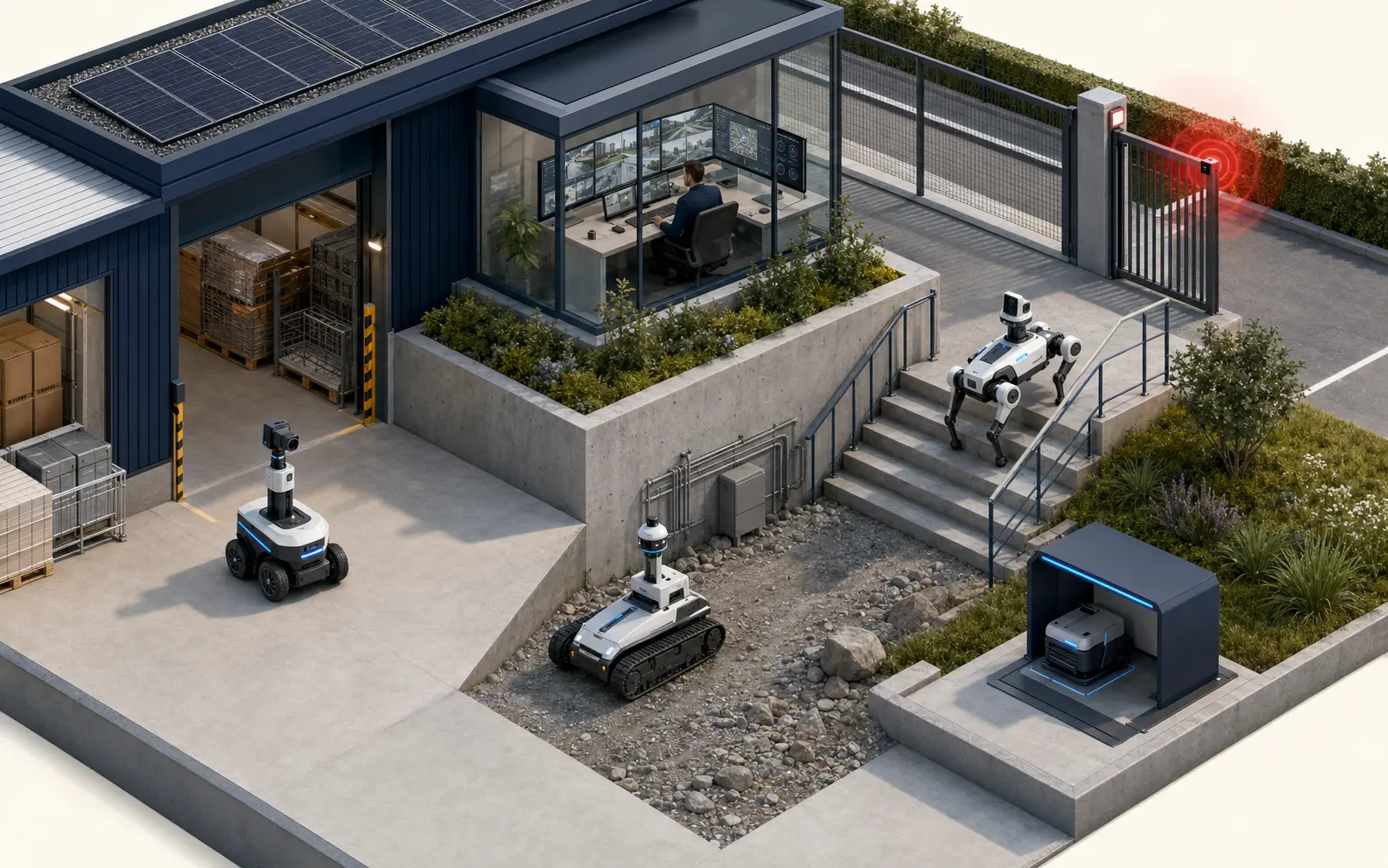
This page covers the essential concepts and links to more specialised resources. Capabilities, constraints and rules must always be checked against the relevant site and use case.
What is a security robot and how does robot guarding work?
A security robot is a mobile sensor platform that patrols an authorised route, checks defined points and sends images, measurements or alerts to a human operator. Robot guarding uses that platform to extend a security team's reach. It does not replace guards or allow a robot to decide how to intervene.
The operating chain is straightforward: the robot observes, software flags a relevant event, an operator verifies the evidence and the agreed response begins. That response may involve remote voice communication, lighting, dispatching a team, informing the owner or calling the appropriate emergency service. Each step remains proportionate and auditable.
A measurable patrol rather than an abstract promise
A fixed camera always sees the same angle. A robot can return to a door, inspect the rear of a building, read an instrument or compare the condition of an area between visits. Every patrol creates a record of the time, route, checkpoints, alerts, interruptions and human interventions. This traceability shows whether the mission was actually completed and provides evidence for improving it over time.
- Repeat scheduled patrols and checks at precisely defined points.
- Document an anomaly from several angles or with several sensors.
- Give a remote operator eyes and ears in a specific area.
- Initiate a predefined human-led procedure.
For a deeper analysis, read Can a humanoid become a security guard?. Separate 2026 evidence from forward-looking demonstrations.
Wheels, tracks or four legs: choose mobility before the camera
The decisive choice is not camera resolution but whether the robot can travel across the site every day. An impressive platform that stops at the first kerb protects nothing. A site survey must identify gradients, steps, thresholds, gravel, grilles, puddles, ramps, lifts, narrow passages and pedestrian or vehicle traffic. Each architecture has a natural operating range, constraints and a different lifetime cost.
| Robot format | Best suited to | Operational strengths | Limits to validate | Examples |
|---|---|---|---|---|
| Purpose-built wheeled | Paved car parks, campuses, warehouses and halls | Efficient patrols, stable sensors and straightforward docking | Steps, deep gravel, potholes and blocked routes | Knightscope K5, SMP Robotics Argus S5, OTSAW O-R3 |
| Wheel-leg hybrid | Structured outdoor routes, industrial terrain and selected obstacles | Efficient rolling combined with greater obstacle tolerance | Every threshold, gradient and transition still requires site testing | Ascento Guard, DEEP Robotics LYNX M20, Unitree B2-W |
| Tracked | Loose, uneven or obstructed ground and specialist inspections | Grip and distributed ground pressure | Energy use, turning, noise and possible surface damage | Specialist inspection crawlers |
| Quadruped | Stairs, industrial plants and obstacle-rich terrain | Access to places that stop most wheeled robots and flexible sensor payloads | Endurance, cost, operational complexity and docking | ANYmal, Boston Dynamics Spot, DEEP Robotics X30, Unitree B2 |
Wheeled robots: simple and efficient on prepared ground
Wheels are well suited to car parks, paved yards, halls, loading bays and reasonably even paths. They usually consume less power than legs and therefore support longer patrols, while their mechanics are easier to maintain. A high threshold, pothole or deep gravel can nevertheless stop them. A wheeled robot is often the rational choice for a well-laid-out logistics site, provided that its routes are kept clear.
- Good energy efficiency on smooth surfaces.
- Stable base for panoramic or thermal cameras.
- Sensitive to steps, abrupt gradients and soft ground.
Tracked robots: greater access at the cost of energy and finesse
Tracks spread the load and provide grip on uneven, loose or obstructed ground. They can be valuable for targeted inspections of service passages, embankments or rubble. Their turning behaviour, noise, consumption and possible effect on delicate surfaces make them less attractive in carefully maintained residential settings or among the public. In practice, tracks often belong to specialised inspection rather than routine daily patrol.
Quadrupeds: stairs and rough terrain, with demanding operations
A quadruped adjusts each foothold, climbs steps and crosses surfaces that would stop a wheeled base. This can open multi-level industrial buildings, technical basements and obstacle-rich sites to mobile inspection. The trade-offs are complex mechanics, shorter endurance for a comparable payload, a higher price and a mission that requires careful preparation. A quadruped is justified where its additional access creates clear operational value. The underlying research is available in ETH Zurich : When high tech goes underground.
For a deeper analysis, read Surveillance drones. Compare aerial mobility with ground patrols.
For a deeper analysis, read Industrial and logistics sites. Cover large perimeters and complex operating areas.
How the robot locates itself, avoids obstacles and returns to its dock
Autonomous navigation does not mean that a robot understands the world as a person does. It combines measurements to estimate its position, create or revisit a map and select a route. LiDAR measures distances, depth cameras describe volumes, an inertial measurement unit follows movement and odometry estimates travel. Fusing these inputs helps the robot remain localised when one sensor temporarily becomes less reliable.
Mapping, localisation and prohibited areas
During commissioning, the integrator maps the site and defines routes, observation points, speeds, directions of travel, exclusion areas and stopping conditions. The robot receives more than a line to follow: it has an authorised operating space and rules. If a pallet appears in its path, it may route around it within approved limits, wait or request assistance. A sensitive area can remain completely prohibited even when it appears physically accessible.
Navigation sensors and mission sensors have different jobs
Navigation sensors prevent collisions and help the machine move. Mission sensors look for the required information: a visible image, heat signature, mechanical noise, gas, temperature, radiation or the state of an asset. A camera used to drive may not be suitable for identifying a person or documenting a leak. Keeping these functions distinct avoids over-reading a specification sheet and makes maintenance easier.
- Visible-light camera for context and alarm verification.
- Thermal imaging to flag a presence or abnormal heating, without independently establishing the cause.
- Microphones or industrial acoustics only where lawful, proportionate and technically relevant.
- LiDAR and depth sensing for geometry, mapping and avoidance.
- Specialist sensors for gas, temperature, humidity or process parameters.
For a deeper analysis, read Swiss regulations. Deploy robots and sensors within a compliant framework.
Real endurance, charging and communications: every patrol starts at the dock
A manufacturer's stated battery life is a reference point, never an operating schedule. Real duration depends on terrain, temperature, speed, stops, communications and payload power draw. Boston Dynamics, for example, states about 90 minutes for the base Spot platform while noting that payload and environment change that figure. ANYbotics also states 90 minutes for ANYmal and gives a walking range under its own reference conditions. The stated specifications are detailed in Boston Dynamics : Spot specifications.
Connectivity is critical, but the robot must cope safely without it
Wi-Fi, mobile networks or private radio carry alerts, video and commands. Coverage that looks adequate in an office may fail behind a metal façade or underground. Signal strength must be measured along the route, communications encrypted and offline behaviour defined. Depending on the risk, the robot may complete a safe local task, return to base or stop in a designated place. It must never invent a new mission because the monitoring centre no longer responds. The applicable guidance is set out in Swiss Federal Office for Cybersecurity : Cyber resilience of digital products.
Sellafield's experience illustrates the importance of this architecture. In March 2025 the UK operator documented a trial in which a quadruped at the nuclear site was teleoperated from outside the perimeter through secure virtual access and a video feed. This was a controlled trial, not unsupervised autonomy. It shows why operating distance, cybersecurity and supervision must be designed together. The applicable guidance is set out in Sellafield Ltd : How are robot dogs helping clean up Sellafield? and Sellafield Ltd : Off-site teleoperation trial.
For a deeper analysis, read Intelligent video surveillance. Understand video analytics, performance and limitations.
Rain, snow, stairs and people: test the real world
Demonstration videos rarely show wet leaves, compacted snow, a shiny metal grille or a lorry crossing the planned route. Yet these details determine availability. An ingress-protection rating describes standardised resistance to dust and water; it does not cover grip, visibility or ageing. The assessment must also examine operating temperature, drainage, minimum lighting and the effect of weather on every payload.
In Zurich, ANYbotics reports testing ANYmal on long-duration outdoor patrols at an ewz substation, including rain and snow. This is useful evidence for the product's claimed robustness, but it comes from the manufacturer and relates to a prepared site. It cannot guarantee identical performance on every property. The practical lesson is to reproduce the seasons, working hours and obstacles of the future route during the pilot. The stated specifications are detailed in ANYbotics : Long-term outdoor trials at ewz.
Zurich's sewer trial: shared autonomy and prudent control
Another Swiss project adds valuable context. In 2018 ETH Zurich followed an ANYmal trial in the city's sewers: wet and slippery ground, darkness, hazardous access and an environment still unknown to the robot. For the first mission the team retained partial control as a precaution, although the platform had autonomous capabilities. Later research describes shared-autonomy missions used to assess the condition of the concrete. The underlying research is available in ETH Research Collection : Inspecting sewer concrete with ANYmal.
This was not residential surveillance and does not prove universal suitability for security work. It demonstrates something more useful: on unfamiliar ground, progressing in stages and retaining the ability to intervene are signs of lasting operational maturity.
Build a test matrix before any night-time operation
Measure every outcome: mission completed, safe stop, assistance required, image quality, alert delay and reason for failure. One successful patrol is not enough. Tests should be repeated at different times, with the agreement of affected people and without disabling existing site safeguards. Each shortfall then becomes an improvement action: move the dock, trim vegetation, add a fixed camera, change an exclusion zone or abandon a passage.
Which security robot models are genuinely available?
The market includes robots designed explicitly for security and inspection platforms configured to observe a site. Comparing their silhouette is misleading. Assess the permitted terrain, payloads, dock, operator interface, data hosting, integration options, local maintenance and supplier longevity. A capable model with no nearby support can cost more in downtime than a less ambitious platform.
Wheeled patrol platforms
Ascento Guard, developed by an ETH Zurich spin-off, combines two large wheels with legs to negotiate selected irregularities. The manufacturer positions it for door and window checks, people detection and thermal anomalies. Knightscope's range includes the K5, a wheeled platform for structured environments such as car parks or campuses, with panoramic video and communication functions. Each offer still needs to be assessed against Swiss law, network coverage and locally available service. The stated specifications are detailed in Ascento : Ascento Guard.
Configurable quadruped inspection platforms
ANYbotics' ANYmal and Boston Dynamics' Spot can carry different payloads. ANYmal specifies 360-degree LiDAR, depth cameras, Wi-Fi and mobile connectivity, a docking station and the ability to operate without connectivity. Spot specifies a top speed of 1.6 metres per second, a maximum payload of 14 kilograms and an average runtime of about 90 minutes. These figures become comparable only after sensors, route, temperature and mission have been defined. The stated specifications are detailed in ANYbotics : ANYmal specifications.
Homes, businesses and industry require three different missions
At a villa, a robot might check a driveway, secluded façade, garage or gate at night, then provide a mobile viewpoint when an alarm occurs. Quiet operation, appearance, privacy and coexistence with residents matter. In an illustrative scenario, a sensor detects movement in the garden. The robot does not chase anyone; it moves to an authorised observation point, sends a short sequence to monitoring and waits for a decision.
In a shop or SME, missions often cover entrances, car parks, delivery doors and the perimeter outside opening hours. The robot must accommodate staff working late, contractors and vehicles. At a warehouse, loading bays, trailers, outdoor stock and long façades create a wider route. Alarm verification must connect mobile imagery with opening sensors, fixed video surveillance and access control.
Industry adds inspection to security
On an industrial site, the same patrol may inspect a door and look for overheating, a leak or unusual noise. Security alarms and process anomalies must have different recipients and priorities. Explosive, radiological or regulated zones demand specialist equipment and procedures; a general certification for the robot is not enough. Security, operations and IT owners must design the mission together.
Sellafield provides a documented example of reducing human exposure. The UK nuclear operator reports that a quadruped performed repeated inspections, mapping and radiological characterisation in restricted-access areas. In 2026 it also documented a trial of a remotely controlled sampling tool. These operations do not show that a robot prevents intrusion. They show that a mobile platform can collect data in a dangerous environment when it is configured, controlled and governed for that task. The applicable guidance is set out in Sellafield Ltd : Robotic sampling-tool trial.
At an airport, the right robot may be very small
Changi Airport introduced tracked robots in 2025 to inspect spaces above ceilings. They transmit high-resolution images to identify sagging, leaks or cracks in areas that are hard to reach. The project began with prototypes and trials in several terminals. It is a useful reminder that a precise requirement may call for a specialist robot rather than one large general-purpose machine. Selection starts with the mission, available access and the required evidence. The applicable guidance is set out in Changi Airport Group : Above-ceiling inspection robots.
For a deeper analysis, read Robotic security for businesses. Protect entrances, car parks, commercial premises and staff.
Functional safety, privacy and cybersecurity are non-negotiable
A mobile robot is simultaneously a machine, an IT system and a sensor platform. Safety must cover collision, trapping, falls, unintended motion, loss of communications and predictable human behaviour. Limited speed, separation distances, emergency stops, signalling, exclusion areas and recovery procedures all belong in the design. ISO 3691-4:2023 covers some driverless industrial trucks, but not every security robot or environment; a specific risk assessment remains essential. The applicable guidance is set out in ISO : ISO 3691-4:2023, driverless industrial trucks.
A moving camera creates no exemption from data-protection law. In Switzerland, a private person may not generally film public space for their own security, and neighbouring properties must be protected. Limit angles, mask irrelevant areas, inform affected people, define who can access footage and how long it is retained. The presence of employees creates additional obligations. The dedicated legal guide explains these rules in more depth than a simple notice sign can. The applicable guidance is set out in FDPIC : Video surveillance of public spaces by private individuals.
Treat the robot as connected operational technology
The robot has accounts, software, keys, interfaces and often remote access. A compromise may expose images, interrupt patrols or enable unauthorised commands. NIST's operational-technology guidance recommends an approach that reflects both availability constraints and physical safety. In practice, use a segmented network, a unique identity for each device, strong authentication, encryption, protected logs, planned updates and supplier access that expires. The applicable guidance is set out in NIST : Guide to Operational Technology Security.
- Separate the robot network from guest Wi-Fi and unnecessary systems.
- Apply least privilege to operators, technicians and suppliers.
- Test safe stopping, network loss and restoration after an incident.
- Log commands, mission changes and access to data.
For a deeper analysis, read Robotic security for villas. Adapt technology, discretion and procedures to a private property.
Run a successful pilot: measure useful patrols, failures and human response
The project starts with an operational question, not a brand: what must be checked, how often, under which conditions and what happens when an anomaly appears? An over-broad mission may produce an impressive demonstration but cannot be evaluated. The first pilot should use a limited route, a few checkpoints and a small set of objectively measurable scenarios.
Useful indicators go beyond distance travelled. Track completion rate, human interventions, immobilisations, relevant alerts, false positives, verification time, dock availability and maintenance effort. A silent failure is worse than a shortened patrol that is reported correctly. The pilot must test graceful degradation: when something fails, does the organisation know and does protection remain in place?
Keep people in the loop from day one into routine operations
An operator must understand why the robot alerted, reach the relevant evidence quickly and take control without being a robotics specialist. Responsibilities must be explicit: who authorises a new route, acknowledges an alert, dispatches a response or immobilises the machine? Night procedures must remain workable when no technician is available. Interface design, training and exercises matter as much as the platform.
Maintenance includes cleaning cameras and LiDAR, inspecting wheels or feet, batteries, seals, the dock, maps and software. Schedule it around the real environment and observed use. Plan spare parts, support times and alternative protection during downtime. A promise of consistent patrols is credible only when daily operations have an owner, budget and service levels.
Decide on evidence, then expand gradually
My Robot Guard structures this process around site assessment, compatible technology selection, controlled deployment and defined supervision. The aim is not to move a robot around for show, but to achieve repeatable patrols, actionable alerts and a clear human response. The initial assessment may find that a robot is appropriate, or that fixed sensors, a drone or a different operating model answers the need more effectively. The stated specifications are detailed in Knightscope : K5 Autonomous Security Robot.
For a deeper analysis, read Robotic security: complete guide. Build protection with robots, drones, sensors and supervision.
For a deeper analysis, read AI and surveillance. Assess detection, bias, false positives and human control.
Nine robot platforms worth comparing
Real products make general selection criteria easier to understand. Ascento Guard and OTSAW O-R3 focus directly on security patrols. Knightscope K5 and SMP Robotics Argus S5 use substantial wheeled bases for regular routes. ANYmal, Boston Dynamics Spot and DEEP Robotics X30 address difficult terrain through footed mobility. DEEP Robotics LYNX M20 and Unitree B2-W add wheel-legged movement for mixed routes. The applicable guidance is set out in NIST : Mobility Performance of Robotic Systems.
These platforms are not interchangeable. Compare the complete operating service: route completion, payloads, dock or charging, software, integration, local support, data governance and total cost. Our detailed profiles separate manufacturer claims from the capabilities that a customer should validate during a site pilot.
For a deeper analysis, read X30 vs B2 vs ANYmal vs Spot. Compare four industrial quadrupeds using operational criteria.
Frequently asked questions
What is a security robot?
It is a mobile platform that follows defined routes, collects images or measurements and sends relevant events to a monitoring service. It may carry visible and thermal cameras, LiDAR, microphones or specialist sensors. It is not an agent making intervention decisions alone: it extends a team's observation capability through limited, tested and auditable missions.
Can a security robot replace a security officer?
It can automate some repetitive patrols and let an operator inspect an area remotely, but it cannot replace judgement, dialogue, management of unexpected situations or physical intervention. A sound architecture states what the robot detects, what a person verifies and who responds. The benefit is more consistent instrumented presence while people focus on decisions.
Is a wheeled robot or a quadruped better?
Wheels are usually more efficient, simpler and suited to car parks, halls and even paths. A quadruped can negotiate steps and more complex ground but costs more and is more demanding to operate. The necessary route should decide. On a flat site, a wheeled base complemented by fixed cameras may be more dependable than an underused quadruped.
How long can a security robot operate?
Runtime varies considerably with the platform, sensors, temperature, terrain and communications. Some commercial quadrupeds state about 90 minutes under reference conditions, while specialised wheeled robots may support longer cycles. Measure endurance on site, preserve a safe return reserve, test docking and fit charging into the real patrol schedule.
Can a robot patrol in rain or snow?
Some models are designed and certified for defined outdoor conditions, but an IP rating does not guarantee grip, visibility or success on every surface. Water, snow, ice, leaves and reflections may affect mobility and perception. Test the route in expected conditions and define safe behaviour for loss of localisation or an unsuccessful return.
Are security robots legal in Switzerland?
There is no single authorisation covering every robot. Use must comply with requirements including personal safety, data protection, neighbour rights and, in workplaces, employee protections. A mobile camera may not freely film public space. Configuration, angles, retention, notices and access controls must be assessed for each site.
How should a security robot be protected against cyberattack?
Treat it as critical operational equipment: segment networks, use named accounts and strong authentication, encrypt data, control updates, time-limit supplier access and protect logs. Test behaviour when connectivity is lost. Contracts should also define security-support periods, data location and secure erasure when equipment is replaced or service ends.
How much does a security-robot project cost?
The robot's purchase price is only one component. Budget for sensors, dock, network, integration, mapping, monitoring, maintenance, spares, storage and interventions. Start with a bounded pilot and clear success criteria. It reveals the cost per useful patrol, downtime and the actual human workload before expansion.