This page covers the essential concepts and links to more specialised resources. Capabilities, constraints and rules must always be checked against the relevant site and use case.
What does the Knightscope K5 autonomous security robot actually do?
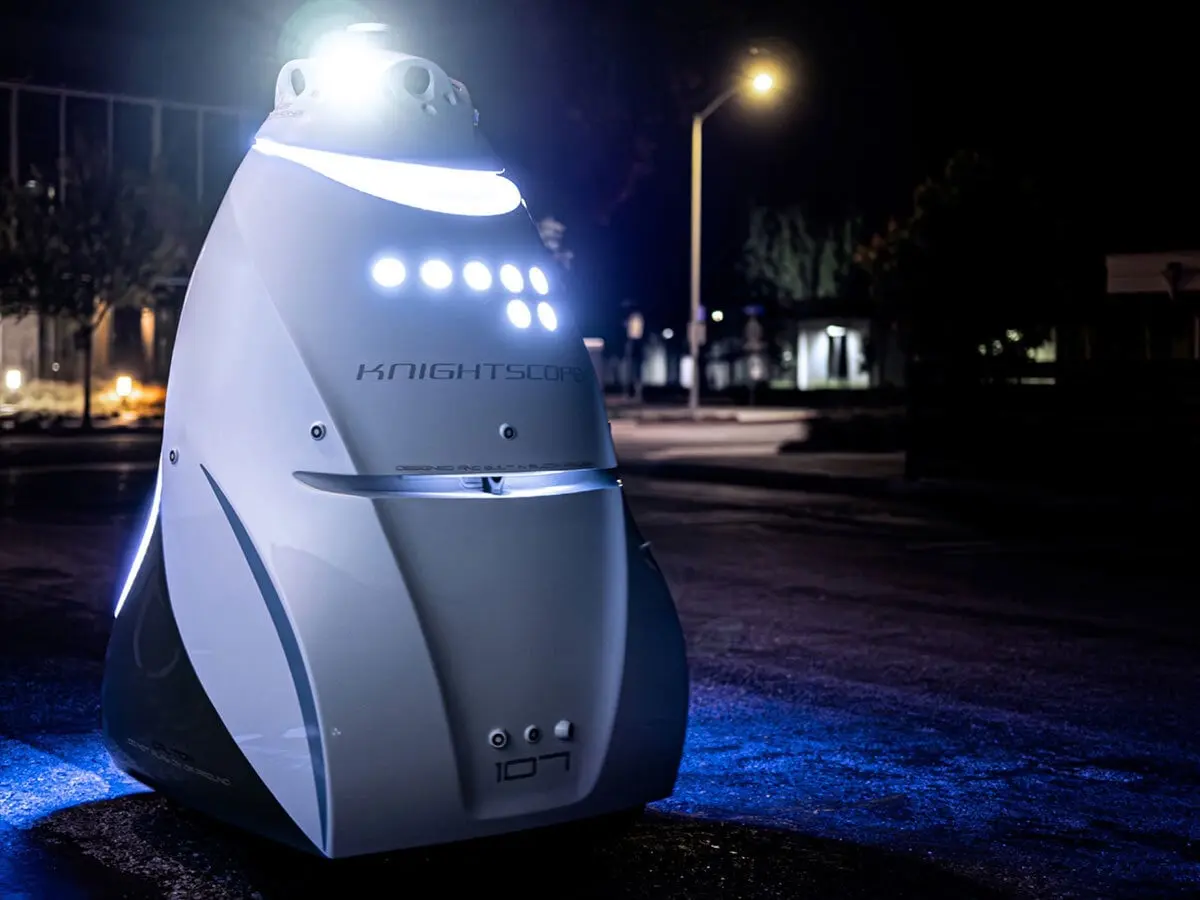
The Knightscope K5 is a large wheeled autonomous security robot designed for outdoor patrols on structured sites. Knightscope lists it as available for deployment in car parks, campuses and walkways. Its official page specifies 360° high-definition video, thermal imaging, detection of people, devices and licence plates, two-way audio, broadcast messaging, strobe lights and custom patrol paths. The stated specifications are detailed in Knightscope: investor information and deployment indicators.
The K5 does not decide how to intervene. It patrols, collects information, flags selected events and sends relevant evidence to people. In 2026, Knightscope presents it within a wider service combining robots, orchestration software, remote command and security agents. A Swiss customer would still need to confirm which functions, services and support levels are actually available locally. The stated specifications are detailed in Knightscope: official K5 functions and K1, K5 and K7 status.
Its conspicuous design can contribute to a visible security presence, but appearance alone does not prove deterrence or fewer incidents. Manufacturer results should be tested against pre-agreed measures such as incidents, useful alerts, human interventions, immobilisations and downtime.
For a deeper analysis, read Ascento Guard. A Swiss robot designed around outdoor security patrols.
What documented K5 deployments can demonstrate
Knightscope presents the K5 for pedestrian-speed outdoor patrols in car parks, campuses and walkways. Its stated functions address visible presence, mobile observation, communication, selected-event detection and incident documentation. The company also reports several million autonomous hours across its full machine fleet in 42 US states, without publicly isolating the K5 share.
These figures and use cases come from the supplier. A customer should compare incident patterns, useful alerts, calls for service and staff observations before and during the pilot. Site design, other security measures, operating hours and incident definitions all affect the result.
The platform can provide a mobile viewpoint where fixed cameras leave gaps and preserve a record of its route. It cannot replace strategically placed fixed cameras, which remain continuously available and often provide more stable evidence. Results from US sites also do not prove that the same service will transfer to Switzerland, where support coverage, privacy expectations and legal conditions differ.
For a deeper analysis, read Security-robot project. Compare platforms and organise a pilot suited to the site.
K5, K1 and K7 should not be confused
As of 9 August 2026, Knightscope lists K5 among the machines available for deployment. The K1 family contains stationary devices for entry points, emergency communication and selected observation areas. K7, intended for larger outdoor sites and light-duty off-road patrols, remains listed as under development and its roadmap may change.
Product status and specifications should therefore be dated. K7 claims must not be attributed to K5, and a buyer should request the current technical specification and service scope for the exact product. Knightscope also states that its autonomous-security-robot cloud service is FedRAMP Moderate authorised. This is a US federal cloud-security status, not Swiss certification or general approval to deploy K5 in Europe. The stated specifications are detailed in Knightscope: cybersecurity and FedRAMP status.
Payloads and analytics also vary. Capabilities such as licence-plate recognition, thermal sensing or communication may depend on configuration, jurisdiction and software. Every required function should appear in the acceptance test and contract.
This distinction is particularly important for an international deployment. The equipment certified, supported and connected in the United States may not be offered identically in Europe. Import, radio, electrical, insurance and maintenance arrangements need confirmation.
Would K5 suit a Swiss business?
The most credible Swiss environment would be a large, smooth and controlled property: a private car park, business campus, shopping area outside busy hours or logistics yard. The route should avoid steep slopes, stairs, narrow passages and unpredictable traffic.
A pilot needs to test braking, obstacle detection, behaviour around wheelchairs and trolleys, night visibility, weather and deliberate interference. The robot’s size can create presence but also increases the importance of collision prevention and accessible emergency stops.
The operator model must be clear. If an alarm is generated at night, a named person needs enough context and authority to act. A voice channel may allow a remote operator to address someone, but scripts, identity and escalation limits should be defined in advance.
Support is a major question. A service that works well near the manufacturer’s operations may become fragile if recovery, parts and trained technicians are not available locally. The Swiss customer should identify the contracting party and guaranteed response times before considering scale.
Privacy, workplace use and image retention
A K5 can record people from multiple directions while moving through a site. Swiss deployment would require a defined security purpose, proportionate camera coverage, clear information and restricted access. Recording neighbouring land or public space should be avoided wherever possible.
In a workplace, the robot must not become a means of continuously monitoring employee behaviour. Routes outside opening hours are easier to separate from daily work. If the machine operates while staff are present, observation zones and the handling of recordings need particular care. The applicable guidance is set out in FDPIC: video surveillance in the workplace.
Licence-plate recognition or other identification functions require a specific necessity and governance. The fact that a feature is technically available does not make it proportionate. A simple presence alert may be enough for the intended decision.
Retention should differ between ordinary patrol footage and a confirmed incident. Routine material can be deleted quickly, while evidence may be preserved under an authorised process. Access and exports should be logged, and people must know how to exercise their rights.
Our view: an international reference to compare with European options
Knightscope K5 belongs in any serious market review because it is purpose-built for security and has accumulated operating experience. It illustrates the strengths of a large visible wheeled robot: efficient travel on regular surfaces, sensor integration, communication and a service-oriented model.
It also illustrates the limits. The platform cannot climb stairs, needs well-managed routes and may create privacy or acceptance concerns in public-facing locations. Local support in Switzerland must be demonstrated rather than assumed.
Ascento Guard offers a Swiss security-focused alternative with hybrid wheel-and-leg mobility. SMP Robotics Argus S5 and OTSAW O-R3 provide other wheeled approaches. The best comparison includes mission completion, alarm quality, service coverage, data governance and total cost, not simply physical dimensions.
A Swiss pilot should begin on a controlled route with measurable outcomes: completed patrols, useful alerts, avoided call-outs, manual recoveries, downtime and user feedback. If the service cannot meet those indicators locally, the K5’s international visibility is not enough to justify deployment.
For a deeper analysis, read Security robots. Compare formats, capabilities and operating limits.
Frequently asked questions
What is Knightscope K5 designed to do?
It is designed for visible autonomous patrols, mobile observation, communication and event reporting on structured sites.
Can K5 operate outdoors?
It has been deployed in outdoor environments such as car parks, but the exact weather, surface, slope and route require validation.
Is Knightscope K5 available in Switzerland?
Commercial availability, certification and local support should be confirmed directly for a Swiss project before relying on the platform.
Does K5 replace fixed cameras?
No. It adds a mobile viewpoint and visible presence, while fixed sensors and cameras maintain continuous coverage.
Is the brand Knightscope or Nightscope?
The manufacturer is Knightscope, with an initial k. The spelling Nightscope sometimes appears in searches, but it does not refer to another company or a different K5 robot.