This page covers the essential concepts and links to more specialised resources. Capabilities, constraints and rules must always be checked against the relevant site and use case.
A Swiss robot designed specifically for outdoor patrols
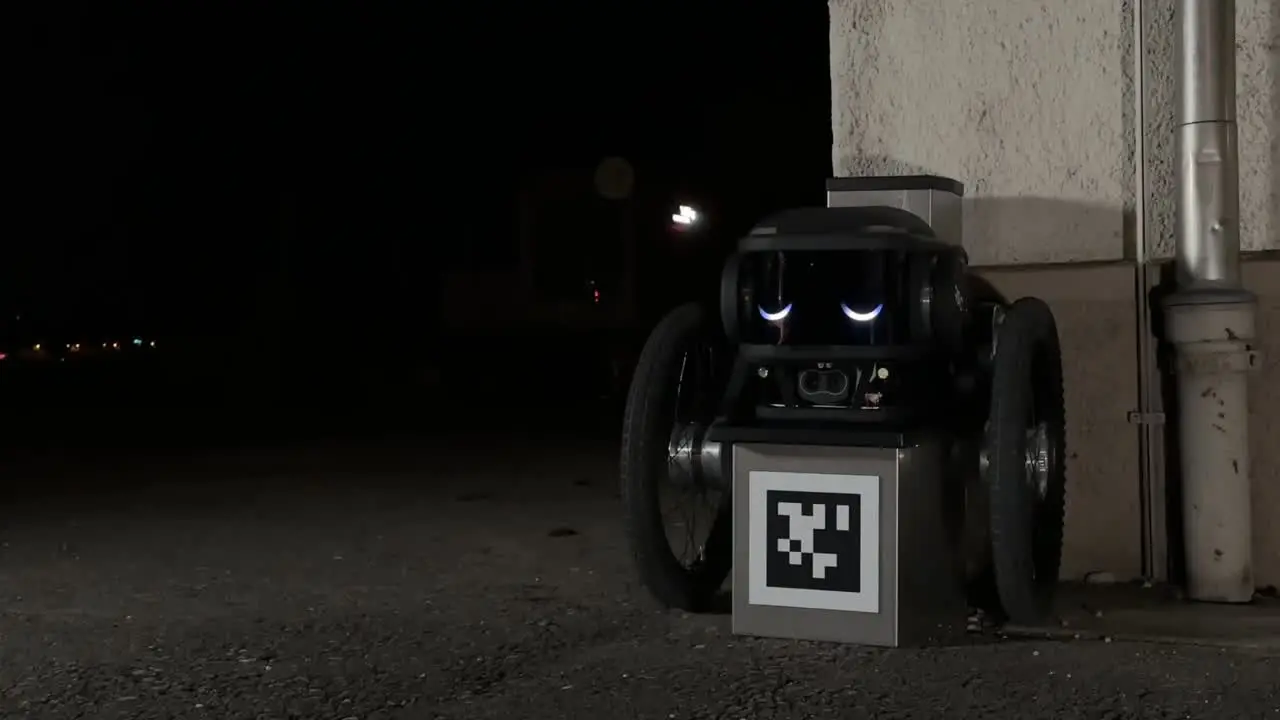
Ascento Guard is unusual because security is not a secondary application added to a general-purpose research robot. The Swiss company presents the platform as a service for recurring outdoor patrols, alarm verification and remote observation. Its two large wheels provide efficient movement on regular surfaces, while articulated legs help it negotiate certain kerbs, slopes and uneven transitions. For verification, see Official Ascento Guard presentation (Ascento).
The system combines the mobile robot, visible and thermal cameras, navigation, a charging station, fleet software and remote operational support. That complete service matters more than the robot’s appearance. A useful patrol requires scheduled missions, reliable return to the station, event transmission, maintenance and a person who can interpret what the machine observes.
Ascento emerged from the robotics ecosystem around ETH Zurich and has a natural relevance for Swiss buyers. Local roots do not automatically prove that every site is suitable. They can, however, make discussions about support, climate, data handling and operational responsibilities more concrete than with a product offered only through a distant distributor.
For a deeper analysis, read Business security. Connect mobile patrols to a complete response.
What the manufacturer states and what a customer must measure
Ascento highlights autonomous patrols, person detection, perimeter monitoring, thermal anomaly detection, two-way communication and operation in adverse weather. These functions describe a credible modern platform. They should be treated as capabilities to validate, not as a guaranteed result for every route and every security scenario.
The first measure is mission completion. The robot must leave its station, reach every useful checkpoint, avoid temporary obstacles and return without frequent assistance. The second is alarm quality. A person detector must be tested at the intended distance, at night, in rain, around vegetation and alongside authorised staff, animals and vehicles.
Thermal imaging can reveal a warm object or unusual apparent temperature, but it does not identify intent and cannot see through walls. An engine, reflection, animal or heated surface may explain the signal. The operator therefore needs the visible image, location, time and recent context before deciding whether an incident is credible.
Battery figures also require field testing. Temperature, slopes, payload, stopping time and wireless conditions influence practical endurance. A pilot should record completed rounds, charging time, manual recoveries, false alarms, useful events and total downtime over several weeks.
Where Ascento Guard appears most relevant
The strongest use case is a structured outdoor site with long but repeatable routes: a logistics yard, car park, industrial perimeter, solar facility, construction compound or business campus. These environments contain gates, fences, doors and equipment that benefit from regular observation, yet can take a human officer considerable time to reach.
A realistic workflow starts with either a scheduled patrol or an alarm from a fixed sensor. The robot moves to a predefined observation point and transmits a second view. A remote operator decides whether the event is harmless, requires a local check or justifies escalation. The machine shortens the information loop; it does not make the final security judgement.
For a villa, Ascento may be relevant only on a sufficiently large and accessible property. Gravel, narrow passages, swimming-pool edges, steps, children, pets and neighbours change the risk. A smaller property can often achieve better coverage with well-positioned sensors and cameras without introducing a mobile machine.
For a site open to the public, speed, stopping distance, visibility and interaction rules become decisive. The robot should announce its presence without intimidating people, maintain safe separation and follow routes that minimise unexpected encounters.
For a deeper analysis, read Industrial sites. Design security for large outdoor perimeters.
The limitations should be stated before deployment
A robot cannot guarantee a patrol in every condition. A blocked route, damaged surface, unexpected cable, snow accumulation or network outage may stop the mission. Critical detection must therefore remain available through fixed sensors, cameras and human procedures while the robot is charging or unavailable. For verification, see Photos and video surveillance (FDPIC).
Mobile observation does not equal physical intervention. Ascento Guard can provide light, video, audio and a remote voice channel, but it should not chase or confront an intruder. The safer role is to observe from an appropriate distance, preserve evidence and guide trained responders.
The route itself may need modifications. Kerbs, doors, drainage channels and wireless blind spots that appear trivial to people can reduce repeatability. Budgeting should include civil works, connectivity, signage, maintenance access and the charging location rather than treating the purchase price as the entire project.
The service model must also be understood. Customers should ask who monitors technical alerts, who retrieves a stranded robot, how quickly replacement parts arrive, which software functions are included and how the service continues if a component or supplier becomes unavailable.
For a deeper analysis, read Security robots. Compare platform types before selecting a model.
Privacy, workplace monitoring and cybersecurity in Switzerland
A mobile camera can observe people from changing angles. The patrol should therefore be limited to necessary areas and times. Fields of view must avoid neighbouring properties and public space where possible. Retention periods, access rights and the purpose of each recording need to be documented.
On a workplace, security cannot become continuous behavioural monitoring of employees. Night-time patrols on a closed site are generally easier to justify than a robot circulating constantly beside workstations. Employees and contractors need clear information about the purpose, schedule, sensors and people authorised to view recordings. For verification, see Video surveillance in the workplace (FDPIC).
Cybersecurity covers the robot, charging station, operator console, wireless links, cloud services and supplier access. The deployment should use named accounts, strong authentication, network segmentation, controlled updates and protected logs. Remote support must be authorised and traceable rather than permanently open.
The contract should state where data is processed, which subcontractors can access it, how footage is exported, how an incident is handled and how information is deleted at the end of the service. A Swiss provider relationship may simplify these discussions, but the actual technical and contractual arrangements still need verification.
Our view: a natural candidate for a well-scoped Swiss pilot
Ascento Guard is one of the most relevant products to examine when a Swiss organisation wants recurring outdoor security patrols. The platform is designed around this mission, the hybrid mobility is distinctive and the service approach addresses more than the robot itself.
It is not automatically the best choice for stairs, very rough industrial interiors or highly unstructured terrain. ANYmal, Spot, DEEP Robotics X30 or Unitree B2 may offer other mobility and integration options, while wheeled robots such as Knightscope K5 or OTSAW O-R3 address more regular environments.
A good pilot selects one route and two or three events: an open gate, a person detected near a fence and a thermal anomaly at a defined asset. Success criteria should cover availability, alarm quality, operator response time, manual interventions and acceptance by staff.
The purchase decision should follow evidence from that pilot. If the robot repeatedly reaches the right place, produces information that changes decisions and can be supported at a predictable cost, it becomes a useful security tool. If it merely repeats a demonstration route, the project has not yet proved operational value.
Frequently asked questions
Is Ascento Guard a Swiss robot?
Yes. Ascento is a Swiss robotics company originating from the ETH Zurich ecosystem and develops its security-robot service from Switzerland.
Can Ascento Guard replace a security officer?
No. It can automate selected patrols and transmit observations, while people remain responsible for interpretation, decisions and intervention.
Can it operate outdoors in bad weather?
The manufacturer designs it for outdoor use. The exact route, temperature, rain, snow and wireless conditions must still be validated during a site pilot.
Which sites are most suitable?
Structured outdoor sites with long, repeatable routes and clearly defined checkpoints are the strongest candidates.