This page covers the essential concepts and links to more specialised resources. Capabilities, constraints and rules must always be checked against the relevant site and use case.
A hybrid robot designed for difficult terrain
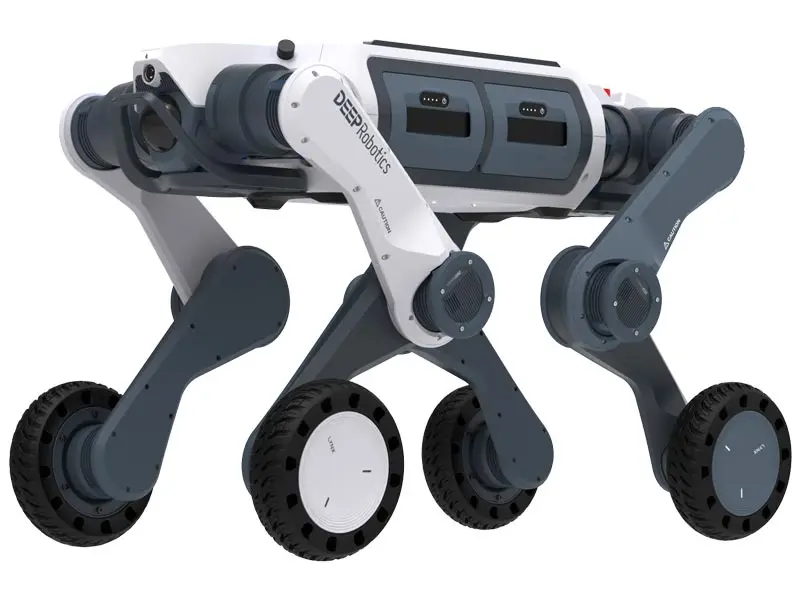
DEEP Robotics launched LYNX M20 in May 2025 as a mid-sized industrial platform for difficult terrain and hazardous environments. The robot rolls where the surface permits, then uses articulated legs to change posture, negotiate obstacles and move across irregular ground. For verification, see DEEP Robotics: official LYNX M20 launch announcement.
The architecture addresses a practical trade-off. A wheeled robot covers long aisles efficiently but may stop at steps, rubble or major transitions. A footed quadruped handles these obstacles more naturally but may be less efficient over a long flat route. LYNX M20 aims to combine both modes.
For security, its most credible roles are technical patrols, remote reconnaissance after an alarm and inspection of areas that fixed cameras cannot cover. The base robot is not a complete guarding system. Mission cameras, analytics, alert management, docking, connectivity and human response depend on the selected configuration.
All numerical values below are manufacturer specifications for the base LYNX M20. They require confirmation in the delivered offer and validation with the final payload, terrain and software. Use-case, limitation and pilot recommendations are My Robot Guard analysis.
For a deeper analysis, read Industrial sites. Design the mission around terrain and operations.
LYNX M20 specifications published by DEEP Robotics
The current product page includes several series variants. This table uses only the first specification block for the base LYNX M20 and does not mix in the higher figures displayed later for Pro or S variants. For verification, see DEEP Robotics: official LYNX M20 product page.
The original launch article stated 33 kg, while the current product page states 35 kg including battery. We use the current 35 kg value. The discrepancy is a useful reason to attach the exact configuration and guaranteed performance to any quotation.
| Specification | Published value | Project verification |
|---|---|---|
| Standing dimensions | 820 × 430 × 570 mm | Doors, corridors, turning and recovery space |
| Weight with battery | 35 kg | Handling, falls, recovery and safety near people |
| Payload | 15 kg; stated maximum load 50 kg | Endurance and stability with the final payload |
| Unloaded endurance | 3 h or 15 km | Stops, cold, lighting, communications and test conditions |
| Endurance with 15 kg | 2.5 h or 12 km | Number of useful checkpoints completed |
| Single-battery charge time | 1.5 h | Optional docking availability and duty-cycle design |
| Speed | 2 m/s operating maximum; 5 m/s laboratory maximum | Safe speed around people and vehicles |
| Terrain | 25 cm continuous stairs; 80 cm single step; 45° slope | Repeatability on site materials, moisture and payload |
| Environment | IP66; -20 °C to 55 °C | Protection of the complete configured system |
| Navigation perception | 2 LiDAR units; 96 lines and 360° × 90° field stated; 2 wide-angle cameras | Blind spots, darkness, reflections and thin obstacles |
| Interfaces | 72 V power input and Gigabit Ethernet | APIs, formats, licences and integration ownership |
For a deeper analysis, read DEEP Robotics X30. Compare a footed industrial quadruped.
What wheel-legged mobility changes on a real site
On a mixed route, LYNX M20 may roll through a yard or gallery, slow before a damaged section, change posture and continue. DEEP Robotics highlights approximately 50 cm corridor clearance, alternative leg configurations and terrain-responsive posture control.
This flexibility is relevant to tunnels, power facilities, water plants, mines, construction sites and rubble. It may also suit a large logistics site combining long lanes, kerbs, ramps and multiple levels.
Published mobility does not prove that the route will be autonomous every day. Metal grating, cables, puddles, mud, snow, vegetation, doors and moving vehicles create edge cases. A pilot must record stops, manual recovery, localisation loss and failed returns, not only the best run.
Laboratory maximum speed is not a patrol target. Near people or vehicles, restricted speed, exclusion zones and verified stopping distance matter more than spectacular motion.
Credible inspection and security use cases
DEEP Robotics documents LYNX M20 in power substations. With a visible and thermal pan-tilt camera and suitable instruments, a configured solution can read gauges, inspect equipment, look for apparent thermal anomalies and approach a fault area. These are system-level capabilities, not features of the bare chassis. For verification, see DEEP Robotics: LYNX M20 power-substation inspection example.
The manufacturer also presents a water-utility solution combining the robot with dual-sensor imaging, depth vision, gas sensing, audio and a management platform. Published tasks include instrument reading, equipment-state checks, liquid accumulation, abnormal heat, smoke and patrol of critical passages. For verification, see DEEP Robotics: water-utility inspection solution.
For security, LYNX M20 may travel to an area where fixed detection or access control produced an alarm. It supplies a mobile viewpoint before a person enters. Thermal contrast can help in darkness, but it does not prove intrusion or danger. A trained operator still interprets the scene.
A flood-prevention exercise in China used an equipped LYNX M20 platform with dual-spectrum imaging, 5G and edge computing. This is evidence of a specialised configuration, not a standard capability guaranteed on every unit.
Suitable first-pilot missions
A first pilot should use a short, measurable and reversible mission rather than a general promise of autonomous guarding.
- Verify an alarm in a difficult-to-reach zone.
- Repeat equipment observations from consistent viewpoints.
- Cover an outdoor route with slopes, steps and irregular ground.
- Send images and measurements before a technician enters.
- Compare real robot availability with the existing patrol process.
Why LYNX M20 is not an autonomous security officer
The manufacturer lists autonomous navigation, omnidirectional obstacle avoidance, point-cloud viewing, front and rear lighting, RF image transmission and remote software updates. These functions help the robot move and carry data. They do not define a security policy or incident response.
A guarding system still needs relevant event detection, evidence behind each alert, false-positive control, accurate location and routing to the correct operator. Procedures must also cover network loss, charging and blocked routes.
LYNX M20 should not chase, block or intimidate people. Its value lies in observation, alarm verification and remote data collection. Intervention remains with trained people and competent services.
Autonomous charging is presented as optional. Buyers need to confirm its availability for the ordered variant, installation conditions and behaviour after a docking failure.
Limitations and risks to validate
A 35 kg moving device can collide, fall or create pinch hazards. Risk assessment should cover stairs, people, vehicles, payload security, speed, emergency stopping and recovery of an immobilised robot. An empty-route demonstration is insufficient for an occupied site.
The 3-hour unloaded and 2.5-hour loaded endurance figures are manufacturer data. Lighting, onboard computing, communications, cold, mud, slopes and observation time may reduce useful operation. Count reliable completed checks and return margin, not headline runtime alone.
OTA updates and RF image transmission make cybersecurity material. Before the device reaches a sensitive network, obtain data-flow inventories, identity controls, logs, patching arrangements and offline behaviour. Manufacturer and integrator access should be authorised and recorded.
The consulted official sources do not by themselves prove Swiss distribution, spare-parts stock or local service. Confirm the contracting entity, repair time, trained support, software-support period and ownership of the complete solution before deployment.
Turn the pilot into an acceptance test
My Robot Guard recommends converting each promise into a test. Run the route under representative conditions and record manual interventions, stops, missed alerts and unusable data, including unsuccessful results.
Fixed video, access control and alarm systems should continue independently. LYNX M20 adds mobile verification instead of becoming a single point of failure.
| Area | Test | Useful measure |
|---|---|---|
| Mobility | Complete route by day, at night and on wet ground | Mission completion without manual recovery |
| Inspection | Repeat the same equipment checks | Share of usable images or measurements |
| Security | Verify several alarm scenarios | Response time, false positives and decision quality |
| Endurance | Run with the final payload | Completed checks and return margin |
| Resilience | Lose network, block route and fail docking | Safe stop, recovery and continuity elsewhere |
| Support | Simulate a fault and request help | Diagnosis, parts and restoration time |
LYNX M20, X30 or Unitree B2-W: which platform deserves a test?
LYNX M20 and Unitree B2-W combine wheels and legs, while DEEP Robotics X30 uses feet. Selection should follow route, payload, software, docking, support and the integrator’s ability to deliver a maintainable service, not an obstacle-course video.
This table is My Robot Guard positioning, not a performance ranking. Verify the exact version and country-specific ecosystem before shortlisting.
| Platform | Mobility | When to assess it | Main check |
|---|---|---|---|
| DEEP Robotics LYNX M20 | Mid-sized wheel-legged platform | Long rolling sections combined with steps, slopes or debris | Payload configuration, optional dock and local support |
| DEEP Robotics X30 | Footed quadruped | Industrial inspection on irregular ground and technical passages | Endurance, payload and mission integration |
| Unitree B2-W | Wheel-legged integration platform | Large sites needing rolling speed and obstacle negotiation | Development effort, safety and support accountability |
For a deeper analysis, read Unitree B2 and B2-W. Review another industrial integration platform.
Data and Swiss deployment
A mobile robot can record employees, visitors, screens, number plates and sensitive installations from changing angles. Purpose, routes, times, camera direction and retention should be limited, and affected people need appropriate information.
On a workplace, the camera must not become permanent behavioural monitoring. Routes can avoid fixed workstations, rest areas and unrelated spaces. Technical inspection and security imagery may also require different recipients and retention periods. For verification, see FDPIC: video surveillance in the workplace.
A Swiss project should document data flows, hosting, remote access, subprocessors and end-of-contract deletion. It must also verify occupational and machinery-safety requirements for the final configuration and place of use.
Our view: relevant when the terrain justifies the complexity
LYNX M20 is one of the most relevant Chinese robots for My Robot Guard because its hybrid mobility addresses a real operational problem. It may cover more varied terrain than a purely wheeled base and travel favourable long sections more efficiently than a footed quadruped.
Commercial value still needs proof. Obtain a written configuration, test the payload, verify interfaces, identify support and measure repeatability. Maximum obstacle figures do not guarantee daily availability or trustworthy data.
We would shortlist it for power and water infrastructure, mines, tunnels, selected construction sites and facilities combining distance with obstacles. A flat warehouse or simple route may remain easier for a wheeled robot. Inspection-led projects should also compare X30, ANYmal and Spot according to the required ecosystem.
The sensible next step is not a direct purchase. It is a closed, instrumented and reversible pilot with one priority mission and pre-agreed stop criteria.
Frequently asked questions
Is DEEP Robotics LYNX M20 a security robot?
It is an industrial wheel-legged platform. It can support patrol and alarm verification when equipped with appropriate sensors, software, integration and procedures.
How does LYNX M20 differ from X30?
LYNX M20 combines wheels and legs, while X30 is a footed quadruped. The better choice depends on route, mission, payload and support.
What endurance does DEEP Robotics claim?
The manufacturer states 3 hours or 15 km unloaded, and 2.5 hours or 12 km with a 15 kg payload. Final configuration testing is required.
Can LYNX M20 climb stairs?
DEEP Robotics states 25 cm continuous stairs and an 80 cm single obstacle. Repeatability depends on geometry, material, moisture and payload.
Is LYNX M20 supported in Switzerland?
The consulted official sources do not confirm a complete local service arrangement. Distribution, parts, repair, warranty and software support need verification.
Can LYNX M20 replace a security officer?
No. It can execute selected routes and transmit observations. People still validate events, decide and intervene.