This page covers the essential concepts and links to more specialised resources. Capabilities, constraints and rules must always be checked against the relevant site and use case.
Surveillance AI does not replace security: it delivers the right signal
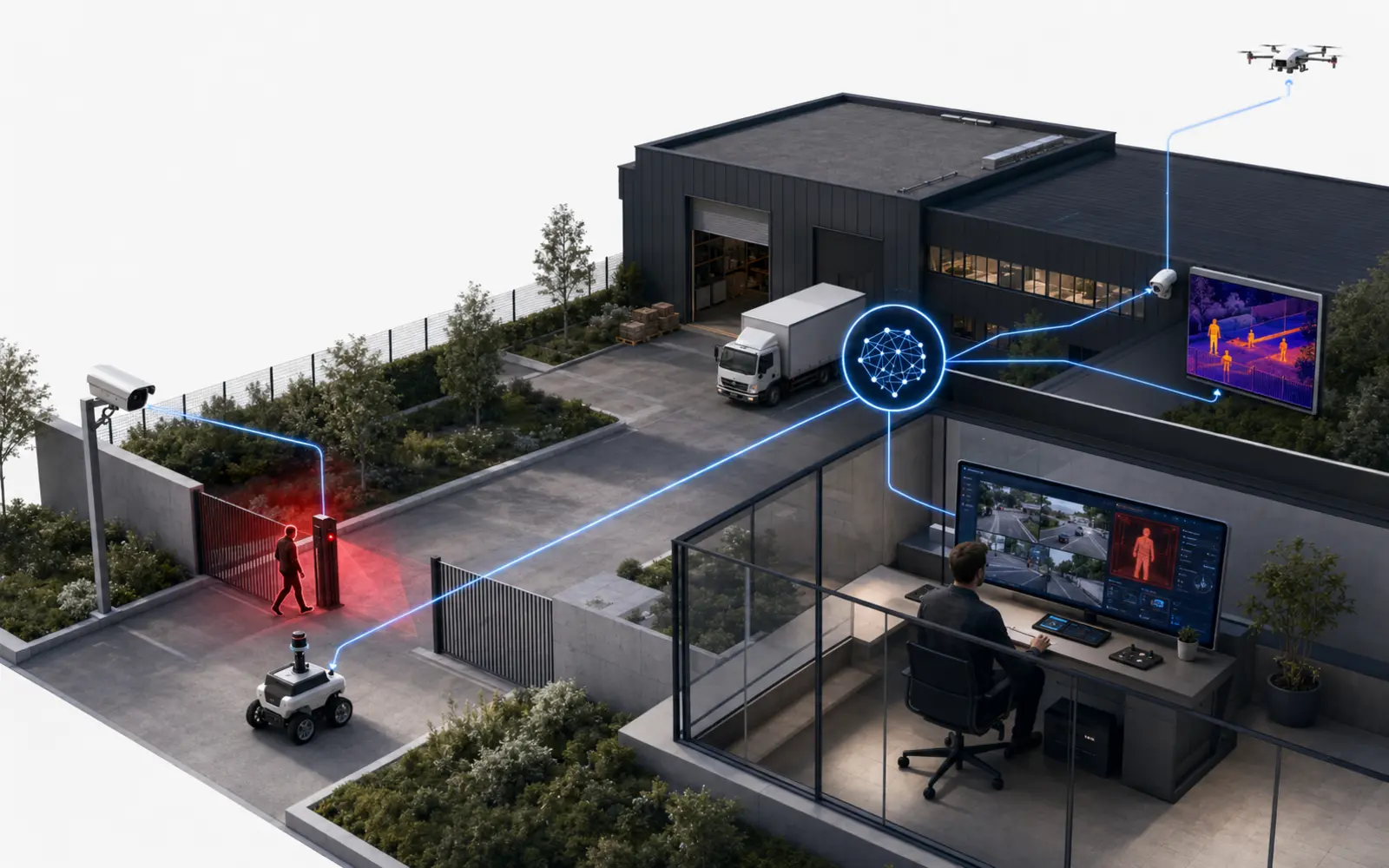
A camera records and a sensor signals. Surveillance AI turns those feeds into events that people can use: it detects a presence, classifies an object, connects several clues and puts the most urgent alert in front of an operator. Its value is not that it understands everything, but that it shortens the time between an observable event and a proportionate human response.
Designed well, this analytical layer helps a team cover a wider perimeter without watching every screen. It might distinguish a person from an animal or correlate a door opening with a thermal detection. It still knows neither a person's intention nor what lies outside the frame. It produces a scored hypothesis, not a verdict.
An operational chain, not a magic feature
A useful system starts with a specific risk: night-time intrusion, unauthorised access, an emerging fire, a fall or an abandoned object. The team then chooses sensors, rules, confidence levels and procedures. AI can pre-qualify an event; an operator verifies the alarm, checks the context and decides whether to contact an owner, dispatch an officer or take no action. Automating the chain before responsibilities are defined only makes confusion arrive faster.
- Documented fact: current systems can extract objects, trajectories and anomalies within a defined scope.
- Realistic capability: combine several clues into a contextualised alert.
- Limitation: high probability proves neither identity, intent nor an offence.
- Illustrative scenario: video is checked after a person is detected outside opening hours, before any response.
Detect, classify, correlate and prioritise: four distinct algorithmic jobs
A spectacular demonstration can conceal the wrong question. To assess a system, break down its work. Detection locates an event; classification assigns a category; correlation connects it to other signals; prioritisation determines what an operator sees first. Each step has separate errors, thresholds and reference data.
From raw pixels to a verifiable alert
A camera may produce dozens of frames each second, but an operator needs a structured event: area, time, proposed class, trajectory, confidence level and video immediately before and after. Temporal tracking prevents one person from generating twenty alerts in twenty seconds. Business rules add context: a delivery at 14:00 is normal; the same movement behind a closed gate at 02:10 deserves checking.
Correlation is decisive on complex sites. One video detection might be a reflection. Combined with a gate contact and radar event in the same time window, it becomes more credible. Conversely, a valid access credential might reduce its priority. A sound architecture retains contradictory evidence rather than forcing artificial certainty. The applicable guidance is set out in Artificial intelligence regulation in Switzerland (Federal Chancellery).
- Detect: find a presence, crossing, apparent smoke or unusual variation.
- Classify: propose person, vehicle, animal, parcel or another defined class.
- Correlate: connect video, thermal, access control, radar, acoustics and robot or drone position.
- Prioritise: apply severity, confidence, time, zone and team availability.
Identification is a separate decision
Recognising a category is not identifying an individual. Face recognition and number-plate reading introduce different technical and legal questions. NIST continues to measure demographic differences between face-recognition algorithms and notes that image quality, lighting and angle affect false negatives. For many private-security requirements, detecting an intrusion and checking the scene is sufficient; collecting identity would be disproportionate.
Visible images, thermal data and anomalies: different views support better decisions
No sensor works universally. Visible-light cameras provide colour, texture and detail for verification. Thermal cameras capture differences in radiated heat and work without light, but are less suited to identification. Radar, LiDAR, technical microphones, opening contacts and environmental sensors complete the picture. AI becomes valuable when it respects these specialisms instead of claiming one feed replaces every other source.
Computer vision: objects, zones and trajectories
Computer vision can detect people and vehicles, track movement, count crossings or identify a boundary breach. Performance depends on field of view, pixels on target, occlusion, weather and lighting. A strong model may disappoint when the camera is too high, vegetation moves constantly or reflective clothing confuses the image. Site design remains decisive.
Anomaly analysis learns or formalises what is usual and flags deviations. It might reveal movement at an unusual time or a vehicle travelling against the normal flow, but rare does not mean dangerous. An unscheduled maintenance contractor is a legitimate anomaly. These systems are most useful for discovery and prioritisation, backed by careful human verification.
Thermal imaging and multi-sensor fusion
Thermal imaging is valuable for finding a warm signature in darkness, light mist or a low-contrast scene. Manufacturers such as Axis position it for perimeter detection while noting that thermal images do not provide the same identifying detail as visible cameras. Warm surfaces, thermal reflections, animals and seasonal variation still require local calibration. An operator may call up an optical camera aimed at the same zone to assess the alert. The stated specifications are detailed in Q2111-E thermal camera for perimeter detection (Axis Communications).
Fusion may happen early, by combining raw data, or late, by correlating events generated by individual sensors. Late fusion is often clearer and more resilient in security operations: if one sensor fails, the others continue and the evidence behind an alert remains visible. A good system shows this provenance instead of one opaque score.
- Visible-light imaging: contextual detail for verification, sensitive to image conditions.
- Thermal imaging: day-and-night detection and low visual contrast, with limited identity detail.
- Radar or LiDAR: distance, direction and motion, without independently explaining the scene.
- Access sensors: precise events, but credentials may still be lent or stolen.
Edge, cloud or hybrid: place intelligence where the risk requires it
Where computation happens changes latency, resilience, privacy and maintenance. At the edge, inference runs in a camera, robot or local server. Cloud services simplify multi-site consolidation and updates but depend more heavily on connectivity and may transfer more data. A hybrid architecture handles urgent events locally and centralises only the metadata and clips that are needed. The applicable guidance is set out in Regulation (EU) 2024/1689 on artificial intelligence (European Union).
Make the trade-off scenario by scenario
For a perimeter alert, seconds matter and an intermittent connection can be critical, so local detection, an encrypted buffer and a degraded mode are preferable. For trend analysis across several warehouses, a central platform may be appropriate. Power, model maintenance and bandwidth matter alongside licence price.
Test degraded operation. What happens when the internet link, GPS, analytics server or network clock fails? Sensors should report their own unavailability, critical events should remain recorded and the team needs an alternative procedure. AI that explicitly says it cannot reach a conclusion is safer than a silent failure.
Minimise before transmitting
Cropping to the useful area, masking neighbouring spaces, converting video to metadata or promptly deleting irrelevant feeds reduces exposure. Local processing does not automatically make a system compliant or secure: a poorly administered edge device remains a connected computer. Inventory equipment, control access, encrypt communications and govern updates. The applicable guidance is set out in Artificial Intelligence Risk Management Framework 1.0 (NIST).
Training data never looks exactly like your site
A model learns patterns in historical data. A specification sheet therefore cannot guarantee performance in Jura snow, against a glass façade, inside a crowded depot or when a contractor wears unusual protective clothing. Document data origins, classes, represented conditions and exclusions, then validate on the site using both ordinary and difficult scenes.
Build defensible ground truth
Ground truth is the human label used to judge a model. It must define what really counts: is a silhouette behind a fence an intrusion if the person remains on the pavement? Two annotators may disagree; those disagreements often expose an ambiguous operating rule. Resolve them before deployment instead of hiding uncertainty in a score.
The validation set should cover day, night, seasons, rain, snow, backlighting, protective equipment and people with different sizes and mobility. Rare cases deserve controlled tests: a simulated intrusion, an open door or a partly obscured camera. Recordings of people must remain necessary, proportionate, secured and subject to a retention limit.
Drift: the world changes after acceptance testing
A new fence, moved camera, growing vegetation, software update or changed operating pattern may alter inputs and results. Monitoring server availability alone is insufficient. Track the distribution of alerts, resample negative cases, compare performance by camera and revalidate after material change. Model updates should be versioned and reversible. The applicable guidance is set out in AI Act application timeline (European Commission).
False positives, false negatives and bias: measure the cost of each error
A false positive raises an alert without a relevant event; a false negative misses what the system should detect. Lowering a threshold may reduce misses while increasing noise. The right value depends on severity, base rate and processing capacity. Potential fire and movement near a secondary door cannot share the same tolerance.
A global accuracy figure hides the useful problems
Accuracy without context says little. Ask for the confusion matrix, alert precision, event recall and results by camera, time and condition. With a rare event, even a low false-positive rate may produce more false than true alerts. Alerts per shift and the human time they consume describe operational impact more clearly.
Bias can enter through data, optics, annotation, thresholds or the context of use. NIST face-recognition evaluations show demographic differentials and the influence of image quality. The answer is not a claim of a neutral model, but targeted evaluation, limited use of sensitive functions and a means of challenge where results affect people. The underlying research is available in Face Recognition Technology Evaluation: demographic effects (NIST).
Explain enough to act and audit
In security operations, a useful explanation need not be a mathematical derivation. An operator needs the triggered zone, proposed class, corroborating sensors, contextual clip, applied threshold and model version. A manager should be able to reconstruct why an alert was escalated or dismissed. A heat map may help but does not replace documentation and testing.
- Set error tolerances by scenario and severity.
- Segment tests by relevant conditions instead of relying on one average.
- Regularly sample rejected alerts to look for missed events.
- Log model version, threshold, rationale and human action.
Human supervision turns an alert into a proportionate response
The human is not a token safeguard added at the end. People design the rules, verify ambiguous events, choose actions and drive improvement. An interface that floods the operator, hides uncertainty or requires six screens weakens oversight. Cognitive load, shift patterns, skills and the authority to stop automation all form part of system performance.
A short procedure for every alert
Each scenario should define who receives the alert, what evidence they check, the response time, who can be contacted and when escalation is justified. The interface should show the relevant seconds before and after the event, a site plan and nearby sensor states. During uncertainty, the operator should be able to mark the result indeterminate rather than force it into a harmless or malicious category.
Sensitive decisions should not be triggered by a single probability. A robot can move to an authorised observation point, lights can come on or a remote announcement can be made, but dispatching an officer or calling public authorities requires contextual verification. Urgent safety procedures may be more automated only where they are risk-assessed, tested and designed with safe fallback.
Train people to challenge the AI
Automation bias encourages people to accept a system's suggestion, while alert fatigue encourages them to dismiss repeated alarms. Training must cover both. Operators should recognise confidence levels, sensor limitations and out-of-distribution scenes, and be rewarded for documenting a justified disagreement. Those disagreements are valuable data for calibration and governance.
For a deeper analysis, read Intelligent video surveillance. Choose cameras, analytics and procedures that turn images into verifiable alerts.
For a deeper analysis, read Robotic security for businesses. Connect sensors, patrols, supervision and response with business processes.
Cybersecurity: protect the model, sensors and evidence
A surveillance AI system expands the attack surface through IP cameras, cloud accounts, gateways, robots, APIs, datasets and the update chain. Compromise may interrupt alerts, disclose images or alter outputs. ENISA and NIST also describe machine-learning threats such as data poisoning, adversarial evasion and model or data extraction. For verification, see Adversarial Machine Learning: attacks and mitigations (NIST) and Securing Machine Learning Algorithms (ENISA).
Layered security remains the strongest defence
Segment the security network, disable unnecessary services and protect administration with strong authentication. Encrypt communications and backups and limit rights by role. Maintain an inventory of devices, firmware, models and dependencies with owners, versions and end-of-support dates. Test signed updates before deployment and preserve rollback.
Logs should reveal a disabled camera, changed threshold, bulk export or unusual connection. Important clips need verifiable integrity. Conventional penetration tests remain necessary, complemented by robustness tests: partial camera masking, misleading patterns, out-of-distribution data and alert flooding. No defence is absolute, so the incident plan must cover isolation, continuity, notification and restoration.
- Unique identities, least privilege and regular access reviews.
- Network segmentation, encryption and device monitoring.
- Model and data provenance, signatures and controlled updates.
- Tested backups, degraded operation and a cyber-response procedure.
Swiss law, Europe and governance: innovate within a controlled scope
As at 27 July 2026, Switzerland has no single general AI Act. The Federal Act on Data Protection, in force since September 2023, applies directly when AI processes personal data. The FDPIC emphasises purpose limitation, proportionality, transparency and impact assessments for high-risk processing. Employment law adds constraints on monitoring employee behaviour. The applicable guidance is set out in Current data-protection law applies directly to AI (FDPIC) and Video surveillance by private individuals (FDPIC).
The Coop case: functional limits can protect people
In October 2025, the FDPIC completed its preliminary review of intelligent cameras used by Coop at certain self-checkouts. After examining their operation, it found that they neither performed face recognition nor analysed purchasing behaviour and concluded that the processing complied with the FADP without creating an increased risk to affected people. This documented case does not approve every AI camera. It shows the value of a bounded objective, clear information and expressly excluded functions. The applicable guidance is set out in Preliminary Coop review: intelligent cameras at self-checkouts (FDPIC) and Video surveillance in the workplace (FDPIC).
For private projects, restrict coverage to the property, generally avoid public space, inform people, set necessary retention and protect data. In a workplace, security filming must not become continuous behaviour monitoring. Impact assessments, privacy masks and independent validation are design tools, not paperwork to complete after installation.
Prepare for the EU without confusing legal regimes
The EU AI Act enters its general application phase on 2 August 2026, with separate dates for some obligations and high-risk systems. It places strict controls on several biometric uses. A Swiss company supplying or deploying a system in the EU must determine its role and use case. Even where the Act does not apply directly, documenting risks, data, performance, supervision and changes supports trust and international readiness.
Voluntary frameworks complement legal duties. The NIST AI RMF organises governance around Govern, Map, Measure and Manage, while ISO/IEC 42001 defines a management system for continuous improvement of AI. Neither replaces law or context-specific legal analysis, but both give security, IT, management, suppliers and privacy professionals a shared vocabulary. The applicable guidance is set out in Switzerland signs the Framework Convention on AI (Council of Europe) and ISO/IEC 42001:2023, AI management systems (ISO).
For a deeper analysis, read Swiss robotic-surveillance regulations. Frame data protection, filming locations, drones, responsibilities and notices.
Move from pilot to useful system: real evidence, KPIs and procurement
A successful pilot is not a demonstration video. It compares a baseline, target scenario and acceptance criteria over several weeks and operating conditions. The US Federal Railroad Administration offers an instructive example: a team used AI to analyse more than 27,000 hours of live video and 1,176 hours of recorded video across eleven sites, detecting over 29,000 railway trespass events. Every result was manually validated before entering the database. The underlying research is available in Development of Railroad Trespassing Database Using AI (Federal Railroad Administration) and Railroad Artificial Intelligence Intruder Learning System (Federal Railroad Administration).
This documented case demonstrates a transferable practice, not a performance guarantee elsewhere: automate the triage of volumes people cannot review, retain human validation to establish reliable data, then use trends to target measures. The FRA also describes RAIILS as research into real-time detection, reinforcing the difference between proof of concept, evaluation and an operational product.
Measure impact end to end
Read technical and human KPIs together: recall, alert precision, indeterminate rate, availability, presentation delay, verification time and action time. Add alerts per operator hour, silent failures and differences by condition. A flattering rate cannot compensate for a late alert.
Measurement must lead to a decision: maintain, recalibrate, expand, reduce or stop. Before wider deployment, require ownership and export of logs, a retention policy, performance by scenario, Swiss support, reversibility and accountability for errors. Reject guarantees of zero false positives and models that change without history.
- 1. Map risks, zones, affected people and possible responses.
- 2. Define ground truth, thresholds, edge cases and stopping criteria.
- 3. Test in real conditions, including outage, weather and contradictory scenarios.
- 4. Train operators, document decisions and audit exceptions.
- 5. Expand only after operational gain and risk control are demonstrated.
What My Robot Guard contributes
My Robot Guard can bring sensors, cameras, robots, drones, analytics and human supervision together around your actual scenarios. The aim is not to put AI everywhere, but to create an explainable chain: what signal is captured, how is it qualified, who verifies it and what action becomes possible? Depending on the site, the best answer may be a simple rule, multi-sensor fusion or a targeted mobile patrol.
A rigorous assessment starts with the premises, movement flows, feared incidents and data-protection constraints. It produces an architecture, tests and indicators that security, IT and management teams can challenge. That is how AI moves from an abstract claim to a measurable decision-support tool.
For a deeper analysis, read Industrial and logistics site security. Deploy resilient detection across large perimeters and complex flows.
Frequently asked questions
What can surveillance AI genuinely detect today?
Within a defined field of view and operating conditions, it can detect and track people or vehicles, boundary crossings, immobility, abandoned objects, apparent smoke or deviations from a routine. Capability depends on data, optics, placement and calibration. It cannot reliably infer intent and must not turn a probable class into an accusation.
Can AI replace a security operator?
It can reduce passive monitoring and present priority events, but an operator supplies context, checks conflicting evidence and chooses a proportionate response. Ambiguous cases, failures and out-of-distribution situations require oversight. The useful objective is measurable cooperation: less noise, faster verification and a better-informed human procedure.
What is the difference between detection, classification and face recognition?
Detection locates an object or event; classification proposes a category such as person or vehicle; face recognition attempts to link a face to an identity. The last uses biometric data and significantly increases risks of error and harm to rights. Many security scenarios work without identification through contextual detection followed by human verification.
Should I choose a thermal or visible-light camera?
Thermal cameras detect heat contrast and remain useful in darkness or visually low-contrast scenes. Visible cameras provide more detail for understanding and verification. They often complement one another: thermal flags, optical qualifies. The choice depends on distance, weather, field of view, target and the detail genuinely required.
How can false positives be reduced without missing real alerts?
Set thresholds by scenario, improve framing, exclude disruptive areas, track objects over time and correlate sensors. Measure day, night, weather and each camera separately. Simply reducing alerts is not enough: also sample rejected events to find false negatives and validate changes against ground truth.
Does edge AI automatically protect data?
No. Edge processing can reduce transfers, latency and dependence on connectivity, but the local camera or server still requires security, updates, segmentation and administration. Compliance also depends on the area filmed, purpose, notices, access rights and retention. The strongest design is often hybrid and founded on data minimisation.
Is AI surveillance legal in Switzerland?
It is neither universally permitted nor universally prohibited. The FADP applies when AI processes personal data, making purpose, proportionality, transparency, security and—in high-risk cases—impact assessment central. Other rules apply in workplaces, drone operations and public space. Each function, zone and data flow must be assessed.
Which KPIs should be requested before buying?
Ask for alert precision, recall on tested events, results by condition and camera, alerts per operator hour, notification delay, verification time and availability. Add silent failures, model versions, threshold changes and the rate of genuinely useful actions. Results should come from a pilot at your site, not just a supplier benchmark.