This page covers the essential concepts and links to more specialised resources. Capabilities, constraints and rules must always be checked against the relevant site and use case.
A capable robotic base, not a ready-made guarding solution
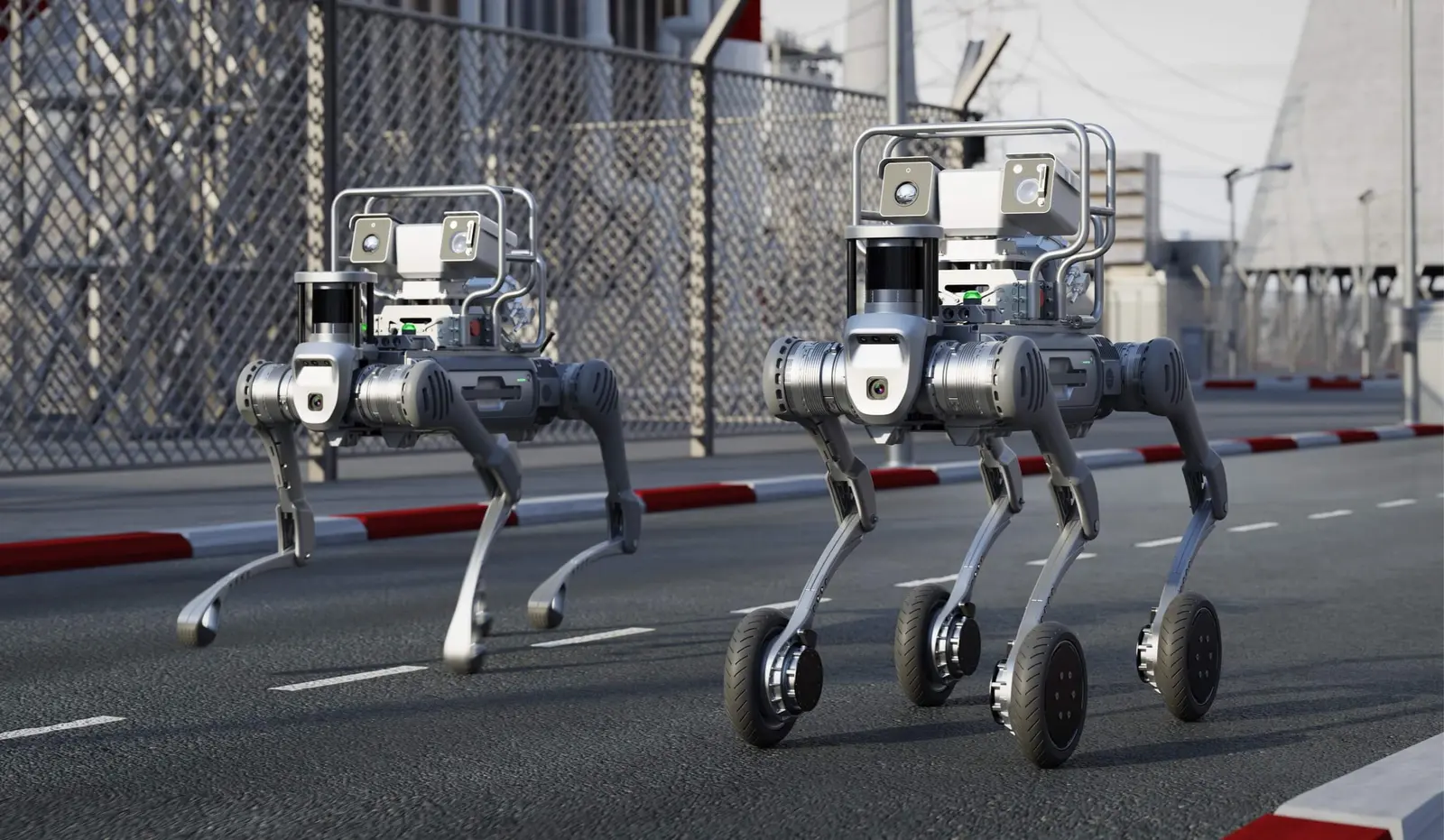
Unitree B2 is an industrial quadruped platform developed by Unitree Robotics. The manufacturer positions it for varied terrain, payload transport and functions built by customers or integration partners. The B2-W version adds wheels at the ends of its legs to combine rolling speed with obstacle negotiation. For verification, see Official B2 presentation (Unitree Robotics) and Official website (Unitree Robotics).
This flexibility can interest logistics platforms, factories, energy sites and construction areas. The robot may carry visible or thermal cameras, lidar, gas sensors, communications or other instruments and send information to a remote console after the integration work is completed.
It would be misleading to describe B2 as an autonomous security officer out of the box. Intrusion detection, alarm management, compliant recording, docking, remote operation and response rules need to be selected or developed. Unitree itself indicates that some functions require secondary development.
The platform should be evaluated against a defined mission. If an integrator already understands its software and payload interfaces, B2 may provide an attractive base. If the customer expects a complete managed service, the engineering and support gap may be significant.
For a deeper analysis, read Industrial sites. Start with risks and operations.
B2 or B2-W: legs alone or hybrid mobility
The standard B2 walks on four legs. This suits irregular ground, steps and missions where stable positioning matters. B2-W rolls on favourable surfaces and uses articulated legs to absorb irregularities or negotiate selected obstacles, potentially covering a large site more quickly.
Demonstration videos show impressive movement. They do not automatically represent daily operation with a heavy camera, on wet ground, among pallets and people. Speed, payload and endurance figures are manufacturer claims that need verification in the purchased configuration.
Wheels add safety questions. Higher speed increases stopping distance and contact energy. In an area shared with employees, visitors or forklifts, the project should impose appropriate speed, circulation zones, right-of-way rules and accessible emergency stops.
Maximum speed is not always the useful metric. Alarm verification values travel time, while inspection values stable measurements and repeatable viewpoints. The test should measure the complete mission, including hesitation, manual recovery and return.
Credible security and inspection use cases
On a logistics platform, B2-W could travel through outdoor lanes, check doors and reach a zone where a fixed sensor detected movement. Thermal imaging may help locate a heat contrast at night. A person still needs to distinguish an animal, authorised employee or credible intrusion.
On an industrial site, the robot can combine security observations with asset inspection. It may photograph an instrument, compare an apparent temperature and observe an access point during one route. Shared use improves utilisation but requires clear data recipients and retention.
Inside a warehouse, a robot is not a complete theft-prevention strategy. Night-time theft may exploit keys, loading processes, routines or insiders. The quadruped supplements access control, alarms, fixed video and procedures; it does not repair weak governance.
After a safety alarm, the platform can provide reconnaissance before a person enters. Gas, fire or structural concerns still require specialist instruments and emergency authority. A camera feed does not declare an area safe.
Integration determines whether the system is credible
A project selects sensors, power, physical mounting and calibration. It then synchronises images, measurements, position and time. A useful event contains context: checkpoint, reference, measured value, confidence and source data.
Navigation needs restricted zones, door logic, intersections and fallback behaviour. The robot should stop safely during a network loss. Outdoor missions also require reliable return, weather rules and a protected charging strategy.
Alarm integration should remain decoupled. The central system may request a mission and display video without depending entirely on B2. If the robot is charging or unavailable, fixed detection continues. This avoids making one mobile device a single point of failure.
A software-development kit does not equal a production integration. Before purchase, the customer should verify the exact APIs, export formats, update compatibility, licences and engineering ownership. Acceptance tests should cover every promised function.
For a deeper analysis, read Spot. Review a broad integration ecosystem.
Support, parts and total cost require early answers
The robot price is only one part of the budget. Payloads, computing, charging, software, development, training, connectivity, maintenance, batteries, parts and support all contribute to the total cost.
Before a Swiss deployment, the buyer should identify the contracting entity, accountable integrator, available spare stock, repair time and expected software-support period. Warranty treatment for third-party payloads should be explicit.
A pilot needs exit criteria: minimum availability, maximum manual interventions, detection quality, practical endurance and time to restore service. If objectives are not met, the customer should be able to stop without losing essential data or depending on unrecoverable proprietary work.
The service organisation matters particularly for a platform with fewer established local deployments. Strong locomotion cannot compensate for weeks of downtime or unclear responsibility between manufacturer and integrator.
Cybersecurity, supply chain and data control
B2 is a connected system with cameras, computing, networks, software and updates. On a sensitive site, it should be treated as a privileged operational device. Network segmentation, port inventory, identity management, logs and remote-access controls are required.
Component origin and update supply chain may form part of an operator’s procurement requirements. This should be handled through factual analysis rather than assumptions based on the manufacturer’s country: architecture, data flows, deployed code, update mechanisms, contracts and testing.
Images and maps can reveal infrastructure, schedules and vulnerabilities. The customer must decide whether processing is local, remote or hybrid, where data is retained and who can extract it. Identifiable-person footage invokes Swiss purpose, proportionality, information and security principles.
Software changes should follow a controlled process. Supplier support sessions need authorisation and logs. The project should test behaviour without cloud connectivity and ensure that credentials can be revoked when staff or providers change.
Physical safety must guide the settings
A heavy, fast robot should not circulate among staff without a formal risk assessment. Collisions, pinching, falls, payload security and emergency stopping must be covered. Zones, speeds and operating times should reduce unexpected encounters. For verification, see Video surveillance in the workplace (FDPIC).
Employees need information about the camera purpose. Continuous behavioural monitoring cannot be justified by technical convenience. Routes and camera angles can avoid fixed workstations, rest areas and screens containing personal or confidential information.
Lights or audio can announce the robot’s approach and deliver a simple approved instruction. They should not intimidate or imitate human authority. During an intrusion, the safer approach is usually remote observation and guided professional response.
Safety performance should be tested with representative people and vehicles, not only an empty route. Near misses, unexpected stops and manual interventions should be recorded and reviewed before expansion.
Our view: an integrator’s platform that demands disciplined testing
Unitree B2 and B2-W offer interesting capabilities for teams able to build and maintain a solution around the platform. B2-W appears particularly relevant to large sites combining long distances and obstacles. That flexibility should not obscure the integration effort.
ANYmal provides an offering more directly organised around industrial inspection. Spot has a broad ecosystem and documented integrations. DEEP Robotics X30 is another industrial option. B2 may be competitive where the integrator already masters its interfaces and the customer accepts structured validation.
We would recommend a closed, progressive and measurable pilot. The robot begins away from the public, then encounters increasingly realistic obstacles, people and incidents. Every step has an acceptance criterion and safe fallback.
The final decision rests on completed missions, safety, availability, alert quality and support. A specification sheet describes potential; sustained operation demonstrates a service.
For a deeper analysis, read DEEP Robotics X30. Compare another industrial quadruped.
Frequently asked questions
Is Unitree B2 sold as a complete security robot?
No. It is an industrial quadruped platform. Sensors, analytics, charging, alarm integration and procedures depend on the project.
What is the difference between B2 and B2-W?
B2 walks on legs, while B2-W adds wheels to roll quickly while retaining articulated obstacle-negotiation capabilities.
Are manufacturer specifications enough to choose?
No. They need validation with the final payload, terrain, climate, software and mission schedule.
Can B2 operate in an occupied warehouse?
Potentially, after risk assessment, speed and route controls, staff information and representative safety testing.