This page covers the essential concepts and links to more specialised resources. Capabilities, constraints and rules must always be checked against the relevant site and use case.
A mobile platform for environments where wheels reach their limits
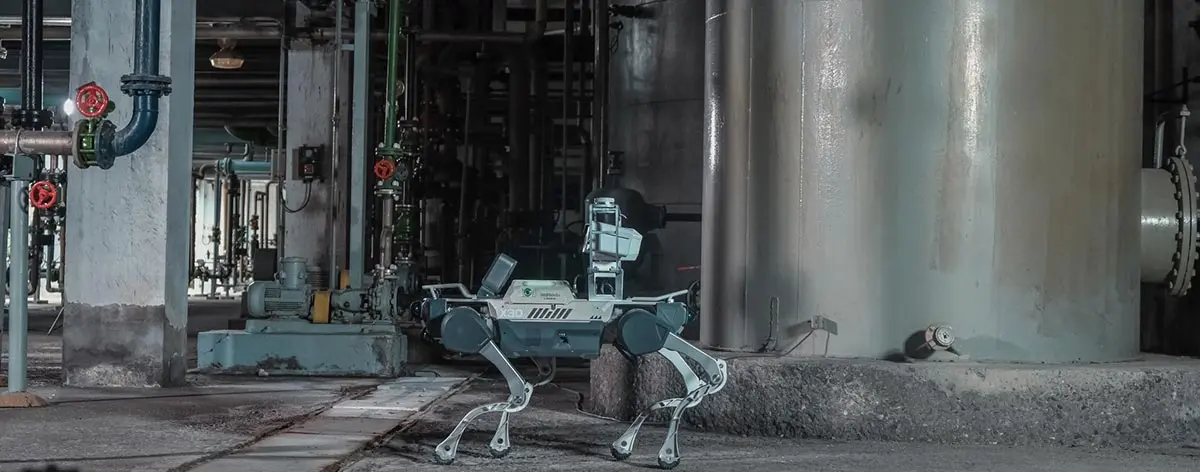
DEEP Robotics presents X30 as an industrial quadruped for inspection in demanding environments. Four articulated legs allow it to negotiate stairs, uneven ground and transitions that a wheeled platform may not reach reliably. Potential sites include power facilities, factories, tunnels, galleries and multi-level infrastructure. For verification, see Official X30 presentation (DEEP Robotics) and Industrial deployment example (DEEP Robotics).
X30 is not a complete security camera system ready to replace an officer. It is a robotic carrier that can support visible, thermal, acoustic, gas and other sensors. Navigation, analytics, supervision, charging, maintenance and response procedures must be built around the platform.
The correct question is not whether the robot looks advanced. It is whether it reaches poorly covered areas, collects repeatable information or reduces human exposure. If the route is flat and simple, a wheeled platform may remain less costly, more efficient and easier to support.
Security can share the robot with inspection. A route may read equipment, observe an access point and provide remote reconnaissance after an alarm. This combined use can improve utilisation, provided the data and responsibilities remain clearly separated.
For a deeper analysis, read Industrial sites. Design a system around terrain and operations.
Read the specification as a test programme, not a guarantee
The manufacturer highlights industrial protection, broad operating temperatures, environmental perception and adaptation to difficult surfaces. These characteristics are useful when selecting candidates for dust, moisture or cold. They remain manufacturer claims to verify with the exact payload and accessories.
Onboard perception supports localisation, obstacle avoidance and movement planning. Navigation autonomy is not the same as security decision autonomy. The robot may reach a checkpoint and capture a measurement; the solution still needs to determine what counts as an anomaly and who validates it.
Stair and obstacle performance should be tested on the real site: metal steps, grating, cables, wet floors, reflective surfaces, doors and narrow passages. One successful demonstration does not prove daily repeatability. A pilot records stops, slips, manual interventions and returns to charge.
Useful endurance depends on payload, speed, terrain, temperature and observation time. The relevant metric is the number of high-value checkpoints completed reliably, not the maximum runtime quoted under reference conditions.
Payloads turn the robot into an operational tool
A thermal camera can look for apparent heating, an acoustic payload can compare sound signatures and a gas detector can measure selected substances. Each sensor has its own range, calibration, uncertainty and environmental limits.
The integration should associate every observation with position, asset, time and reference. A useful anomaly record contains the source image or measurement, threshold, confidence and history. The robot should not be presented as diagnosing a fault on its own.
For security, visible and thermal cameras may verify an access point or person alert. The system should preserve distance, avoid pursuit and allow a human operator to decide. Two-way audio can provide information, but it should not turn the platform into an intimidating remote enforcement device.
A single robot can serve maintenance, safety and security teams. Rights should route results to the correct recipients. A thermal equipment anomaly and identifiable employee video should not automatically share the same audience or retention period.
Human supervision remains essential
A quadruped may lose localisation, meet an unexpected obstacle or suffer a technical fault. The console should show position, battery, connection and payload health. An operator needs the ability to stop the robot, take control and abandon the mission.
Staff must understand the robot’s routes, signals and emergency stop. Visitors should not unexpectedly encounter a moving quadruped in a narrow or stressful environment. Speed and path planning need to reflect people, vehicles and the consequences of a fall.
A safe security response focuses on observation. The robot can illuminate, transmit an approved message or hold a position at a safe distance. Chasing or confronting a person creates unnecessary risk for people and equipment.
The procedure should define who receives technical and security alerts, how uncertainty is shown and when a human patrol or emergency service is requested. Automation improves response only when those decisions are prepared.
Integration, charging and continuity of service
Regular patrols require a charging or battery strategy that matches the site. The home position needs protection, communications and maintenance access. Cold, payload power and difficult terrain can reduce practical endurance.
Alarm integration should remain decoupled. A central system may request a robot mission and receive video, but fixed cameras and access control must continue independently. If X30 is charging or unavailable, core detection and escalation remain active.
Interfaces determine long-term value. Before purchase, the customer should verify how to retrieve video, measurements, logs and position, and which functions require secondary development. A published SDK is an integration opportunity, not a finished production connection.
Local service needs verification. Parts, trained technicians, warranty arrangements, software support and recovery times in Switzerland can be as important as locomotion. The contract should identify who is accountable for the complete configured system.
Data, cybersecurity and workplace use in Switzerland
A mobile robot can record employees, screens, documents and sensitive installations from changing angles. Routes should avoid unnecessary observation, retention should be limited and people informed. Security must not become permanent behavioural monitoring. For verification, see Video surveillance in the workplace (FDPIC).
Cybersecurity covers administrator accounts, communications, updates, operator stations, storage and cloud interfaces. X30 should be placed in a controlled network segment. Supplier or integrator access needs approval, time limits and logs.
The contract should state data ownership, hosting, subprocessors, support, patches, spare parts and end-of-service deletion. The customer needs usable exports of measurements and incidents rather than permanent dependence on a proprietary dashboard.
Operational maps and inspection results may reveal vulnerabilities. Access should follow job roles, and security events should be separated from technical inspection data where purposes differ.
X30, ANYmal, Spot or Unitree B2: compare the service
ANYmal has a strong industrial-inspection position and an ecosystem built around autonomous operations. Spot offers broad integration and documented deployments. Unitree B2 presents an adaptable platform with competitive performance claims. X30 joins this group with an industrial design and ambitious terrain capabilities.
The selection depends on payload, software, interfaces, required certification, local support and total cost. Similar specification sheets can produce very different outcomes once docking, navigation, integration and maintenance are included.
X30 deserves a pilot on sites with stairs, uneven surfaces or hazardous zones. That pilot should last long enough to encounter weather, route changes, people and network incidents, and should include a safe recovery exercise.
The decision should rest on availability and trusted data rather than the success of a prepared obstacle course. A platform that reliably completes useful missions and can be supported locally is more valuable than one that demonstrates greater theoretical agility.
For a deeper analysis, read ANYmal. A platform specialised in industrial inspection.
For a deeper analysis, read Spot. A quadruped with a broad integration ecosystem.
Frequently asked questions
Is DEEP Robotics X30 a security robot?
It is an industrial quadruped platform that can support security when equipped and integrated with appropriate sensors, software and procedures.
Can X30 climb stairs?
The manufacturer presents stair and obstacle capabilities, which must be verified on the exact surfaces and payload of the intended route.
Does X30 replace a security officer?
No. It can collect observations and execute selected rounds, while people validate events, decide and intervene.
What should a buyer verify?
Route performance, payloads, charging, interfaces, cybersecurity, local support and total operating cost should all be validated.