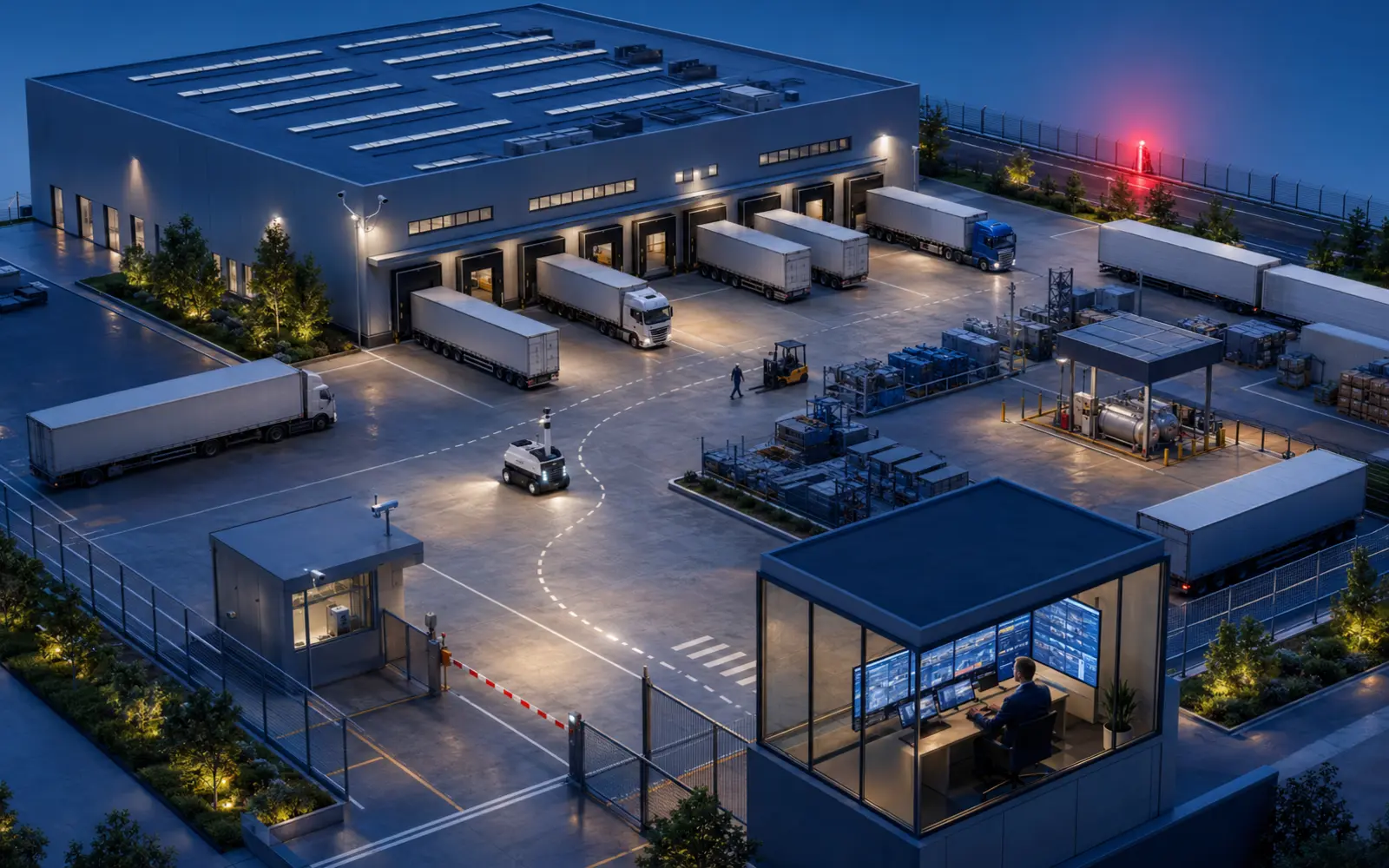
This page covers the essential concepts and links to more specialised resources. Capabilities, constraints and rules must always be checked against the relevant site and use case.
A large site cannot be protected like a large building
Industrial and logistics security means detecting a relevant event early enough, assessing it and triggering an appropriate response while employees, drivers, contractors and goods continue to move. A fence, a few cameras and a separate alarm are not enough. Protection needs a coherent chain from the property boundary to the stock and equipment whose loss or shutdown would disrupt production.
The challenge is spatial as well as organisational. One warehouse may have kilometres of boundary, intermittently occupied loading bays, detached trailers, a charging station, fuel area, car parks and poorly lit pockets. Flows change by shift and season. The useful question is therefore not “which robot should we buy?” but “which scenarios must we see, verify and handle, and when?”
Map assets, flows and consequences
Mapping starts with people and continuity: pedestrian routes, crossings with forklift trucks or HGVs, exits, isolated zones, electrical rooms, utilities, refrigeration, servers, production controllers and control points. Next come attractive assets: electronics, regulated products, tools, metals and copper, raw materials and vehicles. For each zone, describe the feared event, the time before damage occurs and the authorised response.
- Access: gates, pedestrian entrances, badges, intercoms, keys and delivery windows.
- Perimeter: fences, embankments, vegetation, railway lines, watersides and adjacent public areas.
- Operations: loading bays, trailers, yards, car parks, fuel, waste and returns.
- Criticality: high-value stock, energy, cold chain, data and irreplaceable machinery.
Separate security, occupational safety and quality control
A thermal camera may help reveal a presence in darkness, a robot may record an abnormal surface temperature and a sensor may report an open door. Yet these uses do not share the same thresholds or accountable teams. Security deals with intrusion, theft and malicious acts; occupational safety protects people; condition inspection monitors equipment. Bringing them into one monitoring interface is useful only when the procedures remain explicit.
For a deeper analysis, read Surveillance drones: complete guide. Aerial uses, flight constraints and fallback solutions.
What real thefts reveal: time, concealment and broken chains
Documented incidents are not proof that any particular technology works. They are useful for testing assumptions: does the alarm really detect a cut fence, who checks the image, can a patrol inspect the correct trailer, and how long remains before the vehicle leaves? None of the cases below establishes that a robot would have prevented the theft.
In Nantes, Europe 1 reported on 10 February 2025 that intruders had allegedly cut through fencing at a logistics warehouse overnight, bypassed an alarm that did not activate and emptied two HGVs carrying cigarettes, with the loss put at €3 million. A shadow had attracted attention on camera, but verification and patrols did not locate the activity in time. The lesson concerns continuity between detection, context and a targeted inspection. This case is also reported in Three million euros of cigarettes stolen from a Nantes warehouse (Europe 1).
A warehouse may be attacked after its safeguards are disabled
In December 2025, Le Progrès, carrying AFP reporting, described the overnight theft of more than 50,000 electronic devices from a warehouse in Dugny, with the loss then estimated at €37 million. According to the preliminary information cited, video surveillance had been disabled and the alarm was not operating. A system must report its own loss of availability: video loss, an opened enclosure, a severed link, low battery or an unreachable server. This case is also reported in 50,000 devices stolen from a warehouse in Dugny (Le Progrès).
Fuel disappears quickly, sometimes among parked lorries
On 7 February 2025, Le Progrès documented an intrusion at around 11 pm in a company car park in Vaulx-en-Velin. After an alarm activated, police arrested a man and found a hose and around ten containers holding approximately 200 litres of diesel taken from several lorries. In this instance the sequence of alarm, transmission and response produced a concrete result; it does not establish which sensor suits another site. This case is also reported in 200 litres of diesel siphoned in Vaulx-en-Velin (Le Progrès) and 700 litres of fuel stolen in Dracé (Le Progrès).
At Dracé on the A6 motorway, the same newspaper reported that 700 litres had been siphoned from two HGVs during the night of 3–4 March 2025 while the drivers slept. Law enforcement was informed in the morning. An open motorway parking area and a business yard have different legal and operational settings, but the scenario raises the same questions: vehicle location, background noise, detection time, personal safety and usable evidence.
Industrial metals are stock in their own right
In Switzerland, Tribune de Genève, drawing on an ATS report, stated in November 2016 that 4.5 tonnes of nickel had been stolen from a foundry in Emmenbrücke between Saturday and Sunday morning. Police were looking in particular for a van seen near the warehouse. Although older, this documented case shows why metals, copper, cables and semi-finished parts require monitoring by zone, volume and means of removal, not only by accounting value. This case is also reported in 4.5 tonnes of nickel stolen in Emmenbrücke (Tribune de Genève / ATS).
For a deeper analysis, read Intelligent video surveillance. View design, detection and alert verification.
Defend the perimeter without creating a blind fortress
A robust architecture combines layers that corroborate one another. Lighting makes a scene legible; a fence channels movement; a contact or sensor detects; a camera provides context; a patrol observes from another angle; an operator decides; a responder acts. Redundancy is not an accumulation of identical hardware: two cameras connected to the same unprotected switch share one point of failure.
Zoning makes alerts intelligible. Instead of “yard intrusion”, the monitoring centre should locate an event at a gate, behind a row of trailers or approaching the fuel area. Schedules, authorised registrations, planned operations and temporary works can improve the decision, provided their purposes are legitimate and the data strictly necessary.
Loading bays and trailers: secure the interfaces
A loading bay is a moving boundary between building, vehicle and service provider. Risks include a door left open, the wrong trailer, a person in a loading lock, unauthorised collection or a broken seal. A combined workflow may correlate door status, transport booking, authorised identifier reading, contextual video and human checks. Sensors must never override vehicle restraints, dock lights or traffic rules that protect people.
Fuel, copper and critical equipment: detect before damage
Fuel areas require controlled access, clear visibility, level thresholds consistent with normal withdrawals and a procedure for leaks; an algorithm cannot always distinguish theft, maintenance and a technical incident. For cables, metals and sensitive parts, secure cages, inventories and seals complement perimeter measures. For a transformer, compressor or cold room, the priority may instead be a technical alert and continuity.
Do not turn a security alert into a collision risk
A robot, mobile camera or guard must not emerge into the path of a forklift truck or HGV. Routes, speeds, priorities, stopping areas and patrol windows are designed with operations and prevention teams. Suva recommends separating pedestrian and transport routes where possible. On an active site, the best surveillance route is first and foremost one compatible with occupational safety. The applicable guidance is set out in Safe traffic routes within businesses (Suva).
Robotic patrols increase frequency, not replace human judgement
A ground robot provides a repeatable mobile presence in prepared areas. It can follow a route, revisit a viewpoint, transmit images, listen for a sound where equipped or capture thermal data. It is particularly useful when distance makes foot patrols infrequent, the same checks require a traceable record or an initial remote observation reduces a guard’s exposure.
Its limitations are physical: slope, kerb, displaced pallet, plastic film, rain, snow, dust, closed door, unstable network or inaccessible charging station. Its camera sees from one height and angle; a trailer may hide an entire area. A pilot must reproduce the real site at night, during operations, in poor weather and with ordinary obstacles.
Design missions triggered by risk
A planned patrol checks stable points: secondary gate, line of doors, north fence, electrical room or tank. A dynamic mission starts with an event such as a fence sensor, out-of-hours door, lost camera or unusual fuel level. The robot then travels to a safe observation point and sends several views to an operator. It does not pursue a person or block a vehicle; its mission is to improve the information behind a decision.
- Opening or closing patrol with a defined checklist.
- Visual verification after an alarm, without confrontation.
- Comparative readings of a gauge, visible leak or door state.
- Automatic return or a safe stop when conditions leave the validated operating domain.
A drone is conditional equipment, not the default automatic patrol
A drone can rapidly inspect a roof, distant fence or inaccessible zone, but a logistics environment combines people, cranes, lines, traffic, neighbours and sometimes proximity to an aerodrome. In Switzerland, FOCA rules include registration and qualifications where applicable, respect for geographical zones, a maximum altitude of 120 metres in the open category, and landing when emergency services are operating nearby. Flights beyond visual line of sight fall within the specific category or controlled scenarios. The applicable guidance is set out in Rules applicable to drone flights (FOCA) and Standard scenarios for drones (FOCA).
Before integration, the operator must show that the drone contributes more than a fixed camera or ground robot, obtain required authorisations, and define weather limits, visibility, the ground area, remote pilot, maintenance and privacy. Wind, icing, fog, exceptional activity or an airspace restriction means refusing the mission. Fixed cameras, a ground robot and human patrol then provide the fallback.
For a deeper analysis, read Robotic security: complete guide. Principles for an architecture coordinating sensors, mobility and people.
For a deeper analysis, read Robotic security for villas. Another scale for understanding perimeters and privacy.
Thermal imaging, sensors and AI: three tools, three levels of evidence
A thermal camera represents infrared radiation received from surfaces. It may reveal a presence in darkness or a warmer area, but does not see through walls or automatically measure the internal temperature of equipment. Distance, angle, rain, fog, reflections, emissivity and calibration change the interpretation. A security thermal alert must never be confused with a maintenance diagnosis.
Simple sensors remain valuable: door contact, vibration, beam, level, leak, temperature or power state. Their value comes from context and maintenance. Algorithmic analysis may correlate several signals, classify a shape as consistent with a person or flag a deviation, but it establishes neither intent nor guilt. Thresholds must be tested locally and important events validated by an operator.
Human oversight should receive a situation, not an avalanche
A useful interface groups the alarm, zone, time, before-and-after images, other sensor states, robot position and instructions. It also shows uncertainty and unavailable resources. The operator can request another view, contact the site, start a patrol or escalate. Automation carries out reversible, prepared actions; a decision that exposes people, calls police or stops production remains governed by a human procedure.
Measure missed events as well as false alarms
Reducing alarms by sharply lowering sensitivity may create a quieter dashboard while opening a blind spot. Monitoring distinguishes false positives, useful alerts, late alerts, duplicates and simulated events that were missed. It also measures presentation time and image quality. Any change to fencing, lighting, traffic, vegetation or storage triggers a new check.
For a deeper analysis, read Artificial intelligence and surveillance. Performance, uncertainty and human oversight.
From alarm to response: write the scenario before installation
An alarm without an available recipient is simply a recorded event. For every scenario, the operating card specifies who receives it, within what time, with which images, how to verify and when to escalate. It distinguishes an authorised person, early driver, animal, technical fault, leak, suspected fire and confirmed intrusion. Contacts, plans, emergency access and reception instructions must remain available when the central system is down.
The response remains proportionate. Under established criteria, an operator may activate lighting or a prerecorded message allowed by site policy, inform a manager, dispatch a guard or call emergency services. A robot does not confront an intruder. Its value lies in reducing uncertainty and providing current context, without delaying an emergency call when a person, fire or leak presents immediate danger.
Preserve traces without promising perfect evidence
Consistent timestamps, access logs, controlled exports and an evidence-handling chain support post-incident analysis. Useful images must be protected from modification and improper viewing. An obscured camera or a robot arriving late cannot reconstruct what is missing. Teams must also learn to preserve the scene, avoid touching potential evidence and promptly provide material to authorities and insurers under the agreed procedure.
Make continuity a measurable objective
Incident cost is not limited to stolen stock. A forced door, contamination, lost cooling, stranded lorry or investigation can delay dispatches. The plan defines priority assets, maximum tolerable time without surveillance and recovery measures. Security thus contributes to the continuity plan without replacing the responsibilities of production, maintenance, HSE, IT, insurance and management.
Swiss law: protect the site without monitoring employees
The presence of employees, drivers and visitors makes data protection central. The FADP requires, among other principles, lawfulness, good faith, proportionality, a recognisable purpose, and deletion or anonymisation when data is no longer needed. Article 26 of Ordinance 3 to the Employment Act prohibits systems intended to monitor workers’ behaviour at work. A system needed for security must be designed and positioned so that it does not impair their health or freedom of movement. The applicable guidance is set out in Ordinance 3 to the Employment Act, Article 26 (Fedlex).
In practice, document the purpose for each zone, constrain fields of view, exclude changing rooms, toilets and rest spaces, clearly inform people and limit access. The FDPIC generally recommends deleting workplace video recordings within 24 to 72 hours, depending on purpose; this is not a universal period authorising all retention. Any different period must be justified, protected and reassessed. The applicable guidance is set out in Video surveillance in the workplace (FDPIC).
Stay within the property and respect public space
Fixed, mobile and onboard cameras must target the necessary perimeter. The FDPIC notes that private parties may not generally monitor public space, apart from narrowly defined exceptions. At a site boundary, privacy masks, low angles and exclusion zones avoid sustained filming of a road, pavement or neighbouring property. The same principles apply to robot footage and, with additional constraints, drone images. The applicable guidance is set out in Video surveillance of public space by private parties (FDPIC).
Govern data before commissioning
The record identifies controllers, processors, hosting locations, data categories, recipients, periods, access rights and the incident process. Roles are separated: live viewing, exporting, administration and changing a rule do not require the same permissions. A data protection impact assessment may be necessary when processing presents a high risk. Staff and their representatives are involved early enough to correct an intrusive camera or ambiguous purpose before the pilot. The applicable guidance is set out in Federal Act on Data Protection (Fedlex).
For a deeper analysis, read Robotic security for businesses. Governance and organisation of business surveillance.
For a deeper analysis, read Swiss regulations. FADP, employment law, responsibilities and drones.
Cybersecurity and degraded modes: the system must fail safely
IP cameras, robots, stations, sensors and the monitoring platform are IT systems. A shared account, exposed interface, unsupported software or over-privileged supplier may disable security or disclose images. The architecture segments networks, restricts flows, requires named accounts and strong authentication, applies suitable encryption and organises updates, backups, logging and access revocation.
Cybersecurity includes suppliers: support period, vulnerability disclosure, software components, maintenance access, hosting, data export and reversibility. Since 1 April 2025, affected Swiss critical-infrastructure operators must also report certain cyberattacks to the NCSC within 24 hours. This specific duty replaces neither incident response nor any other notification that may apply. The applicable guidance is set out in Duty to report cyberattacks on critical infrastructure (NCSC).
Prepare for loss of network, power, positioning and sensors
A degraded mode is decided in advance. If communications fail, the robot stops in a safe area or returns only if that function has been validated; it does not continue blindly. Backup power maintains priority functions for the designed period, while an independent channel reports critical faults. Loss of GNSS, an obscured camera, inaccessible station or low battery produces a technical alert distinct from an intrusion.
- Paper or offline list of contacts, instructions and emergency access.
- Replacement human patrol and points for manual checking.
- Periodic power, network and monitoring outage tests.
- Controlled recovery with review of accumulated events.
Test silent failures too
The danger is not only a black screen; it is a green screen while a sensor no longer covers its zone. Tests inject a known event and check its arrival, correct instruction, acknowledgement and log. They also examine tampering, system time, full storage and the real availability of images. A dependency matrix exposes equipment sharing the same power, network, server or provider.
Pilot and ROI: prove value on the ground before expansion
A serious pilot covers a limited but representative perimeter: for example, a row of loading bays, a trailer area and a length of fence including a difficult corner. It starts with a measured baseline: current patrols, incidents, verification time, outages, journeys and interruption costs. It then defines test scenarios, stop criteria and a person authorised to accept or reject the result.
Return on investment combines prudently assessed avoided losses, genuinely saved operating time, improved coverage, speed of assessment, technical availability and total cost. Purchase or subscription, integration, network, works, licences, monitoring, maintenance, batteries, parts, training and compliance all belong in the calculation. One successful demonstration on a quiet evening cannot be extrapolated across several sites.
Indicators should reveal limits as clearly as progress
The dashboard tracks control-point coverage, mission completion, human interventions, false alarms, missed test events, presentation time, decision time, availability by component and maintenance hours. Traffic incidents and near misses remain disqualifying criteria. Results are segmented by night, weather, season and site load so that an attractive average does not conceal a recurring weakness.
Expand in modules, with a viable exit
After acceptance, expansion proceeds zone by zone using a configuration model, acceptance tests and training. Data and logs remain exportable; the contract defines service levels, updates, reversibility and processor responsibilities. A committee representing security, operations, HSE, IT, data protection and employees follows changes. This governance prevents a loading-bay solution that works well from becoming intrusive or dangerous elsewhere.
For a deeper analysis, read Security robots: complete guide. Capabilities, limitations and selection criteria for ground platforms.
Frequently asked questions
Does a security robot replace guards on an industrial site?
No. It may repeat selected patrols, reach an observation point and provide images or readings, but it cannot understand every situation and must not confront anyone. Guards and operators remain responsible for assessment, decisions, intervention and exceptions. Good design reallocates repetitive or exposed tasks and always provides a replacement human patrol.
How should trailers parked overnight be protected?
Start with a dependable inventory of trailers, their locations, status and authorised collections. Add lighting, access control, maintained fencing, suitable seals, zoned detection and contextual video. A robotic patrol may inspect rows and respond to an alarm, but changing layouts and blind spots between vehicles require testing. The response procedure must be faster than the likely removal of the goods.
Which sensors help prevent fuel siphoning?
There is no universal sensor. Depending on the tank or lorry, combine access control, hatch state, level change, vibration, lighting and thermal or visible video. Model legitimate withdrawals, vehicle movement and physical variations to reduce false alarms. Detection must lead to safe verification without delaying the response to a leak or fire risk.
Can thermal imaging detect an emerging fire or failure?
It may identify an unusual surface temperature when the camera, distance, angle and thresholds are suitable. It does not see through enclosures, and results depend on emissivity, reflections and the environment. An anomaly needs confirmation under a maintenance or emergency procedure. A security camera does not automatically become a certified diagnostic instrument.
Can a drone fly automatically above a Swiss warehouse?
Not on a technical decision alone. The operation must be classified under FOCA rules according to its category, drone class, people present, geographical zone and whether visual contact is maintained. Beyond-visual-line-of-sight operations fall within the specific category or controlled scenarios. Privacy, weather, traffic and emergency-service operations also require management, and a ground fallback is needed whenever flight is refused.
How long should a logistics site retain video?
Retention follows purpose and necessity, not habit. For workplace video, the FDPIC generally recommends deletion within 24 to 72 hours while requiring storage to be as short as possible. A different need must be documented and proportionate. Incident sequences can be isolated with restricted access for the relevant procedure and deleted once no longer necessary.
What should happen during a network or power outage?
The system should report the outage through an available channel, maintain priority functions for the designed period and place mobile equipment in a safe state. The plan activates a human patrol, offline contacts and manual checks. Outages and recovery are tested periodically. Continuing without communications or dependable positioning is rarely acceptable in a yard with moving vehicles.
How is the ROI of industrial robotic security calculated?
Compare a baseline with a measured pilot: coverage, verification time, completed missions, missed alerts, availability, journeys and interventions. Include all life-cycle costs, including integration, network, monitoring, maintenance, licences and compliance. Do not count a hypothetically avoided theft as certain. Expansion depends on results observed under varied conditions and an accepted residual risk.