This page covers the essential concepts and links to more specialised resources. Capabilities, constraints and rules must always be checked against the relevant site and use case.
A European system designed for sensitive sites
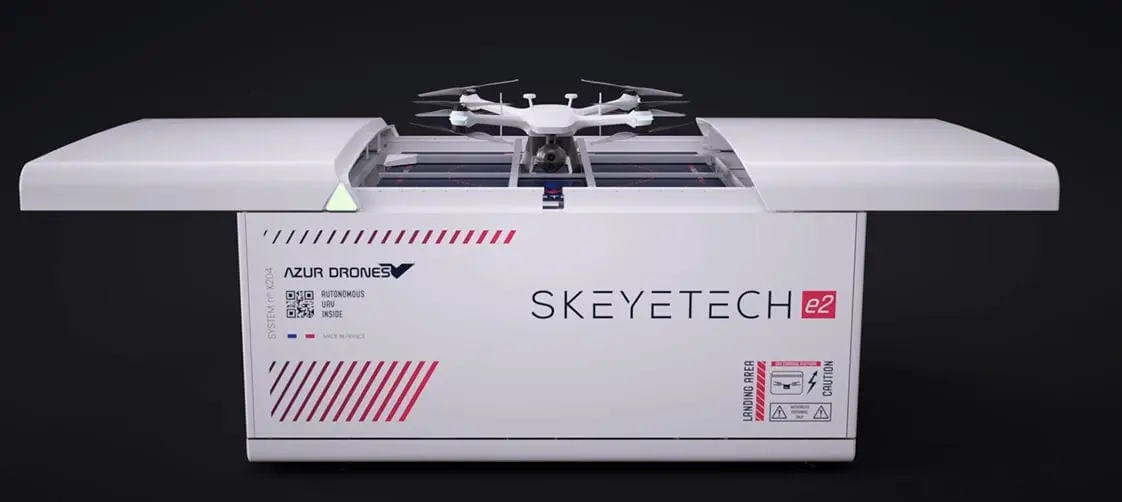
Skeyetech E2 is developed by the French company Azur Drones as an autonomous drone-in-a-box solution for security, safety and industrial inspection. The aircraft remains in a permanent station, can execute prepared missions and returns for protection and charging. For verification, see Official Skeyetech information (Azur Drones).
The system targets industrial facilities, energy infrastructure, critical sites and other large properties where a rapid aerial view can improve alarm verification or incident awareness. Its European origin and focus on sensitive operations are relevant to customers concerned about support, data governance and regulatory dialogue.
The drone, station, command software, communications and operational organisation form one system. A customer should not compare the aircraft alone with another drone’s camera specification. Availability, mission authorisation, weather limits and integration with the control room determine the actual service.
Automation does not remove human responsibility. A remote operator remains responsible for supervising the mission under the approved concept, while security professionals decide how to respond to the information.
For a deeper analysis, read Surveillance drones. Understand technologies, permissions and limits.
Patrol, alarm verification and crisis management
A scheduled patrol can capture recurring views of a fence, roof, storage zone or remote asset. The strongest security use is usually alarm verification: a fixed sensor identifies an event, and the drone provides an additional angle before a person enters the area.
During a fire, leak or other emergency, an aerial view can help teams understand access, smoke, movement and the wider perimeter. It may reduce unnecessary exposure during the first assessment. The video does not certify safety and must be combined with specialist instruments and emergency procedures.
The workflow should state who may request a flight, who validates it, which route is used and who receives the video. A drone that can launch technically but waits for unclear approval does not improve response time.
Critical security should never depend on flight availability. Wind, precipitation, maintenance, airspace restrictions or a technical fault can ground the system. Fixed cameras, perimeter sensors, terrestrial robots and human response provide continuity.
For a deeper analysis, read Industrial solutions. Connect aerial and terrestrial security layers.
Inspection and gas detection should not be oversold
Industrial drones can carry visible and thermal cameras to inspect roofs, pipes, electrical equipment and other assets. Repeatable routes may improve comparison over time. Thermal measurements remain influenced by emissivity, angle, distance and environment and require competent interpretation.
Some configurations and industry use cases include gas-detection or gas-imaging capabilities. These tools apply to defined substances and conditions. They do not detect every leak and should not be presented as a universal replacement for regulatory or fixed safety instrumentation.
A gas mission requires a protocol covering the substance, sensor, calibration, weather, route, threshold, confirmation and emergency action. The operator must understand the uncertainty and keep source data available for review.
Combining security and inspection can improve utilisation, but purposes and access rights need separation. A maintenance image and footage of an identifiable person may have different retention, recipients and legal basis.
BVLOS operation belongs to the specific category in Switzerland
A permanent system controlled remotely will generally operate beyond the direct visual line of sight of the pilot. In Switzerland, BVLOS operation falls within the specific category. The operator must obtain the appropriate authorisation and demonstrate control of the operational risk. For verification, see Introduction to the specific category (FOCA).
The assessment includes airspace, ground risk, neighbouring activity, weather, communications, technical failure, pilot competency and emergency procedures. A mission over a closed industrial perimeter differs from a route near homes or public roads, but neither is automatically authorised.
European approvals, manufacturer experience and standard scenarios can inform the project, yet they do not replace the Swiss process. The legal operator, actual routes and local mitigations must be clear before routine use.
A feasibility study should begin with the few flight segments that create the most value. Reducing distance, altitude and exposure can simplify the risk case. Designing the largest possible mission first often creates unnecessary regulatory complexity.
Sensitive data, sovereignty and cybersecurity
A drone over an industrial site may collect detailed views of processes, assets, security arrangements and people. The project should document where live video, flight logs, maps and analytics are processed, which companies can access them and how long they remain available.
European product positioning can support sovereignty requirements, but location claims must be verified contractually and technically. Hosting, remote support, subcontractors and update services can involve different jurisdictions.
The station and flight system require network segmentation, named identities, strong authentication, logging and controlled updates. Connections to operational technology should be mediated so that a compromise of the drone environment cannot lead directly into industrial control systems.
When people are identifiable, fields of view should minimise unnecessary recording. Employees and contractors need information, routine footage should be deleted promptly and incident exports should follow an authorised evidence process. For verification, see Photos and video surveillance (FDPIC).
Our view: a European reference for industrial buyers to examine
Skeyetech E2 is a relevant reference for European industrial and sensitive-site projects. Azur Drones presents an integrated drone-in-a-box rather than an isolated aircraft, and the security, safety and inspection positioning reflects real operational needs. For verification, see Security and safety applications (Azur Drones).
DJI Dock 3 offers a broad ecosystem and competitive hardware options. Percepto Air Max is strongly oriented towards recurring industrial inspection and analytics. Sunflower Labs Beehive focuses more directly on large-property security. The choice depends on mission, authorisation, payload, data and service coverage.
A pilot should measure launch availability, time to useful video, mission completion, data quality, operator workload, weather cancellations and recovery from communication loss. Technical performance should be reviewed alongside the progress and conditions of the Swiss authorisation.
Skeyetech E2 creates value when a site has enough scale and recurring need to justify a managed aerial capability. For a small perimeter or occasional inspection, a manually operated drone or additional fixed sensors may provide a simpler and more proportionate answer.
For a deeper analysis, read Industrial security. Design layered protection around site operations.
Frequently asked questions
What is Skeyetech E2 designed for?
It is designed for automated aerial security, safety and industrial inspection missions from a permanent station.
Can Skeyetech E2 fly autonomously in Switzerland?
Automated remote BVLOS use generally belongs to the specific category and requires an appropriate Swiss authorisation and operating organisation.
Can the system detect gas leaks?
Selected payloads may support defined gas-detection use cases, but substances, conditions, performance and confirmation methods must be validated.
Does the drone replace fixed security cameras?
No. It provides a mobile aerial view while fixed detection and fallback procedures maintain continuous coverage.