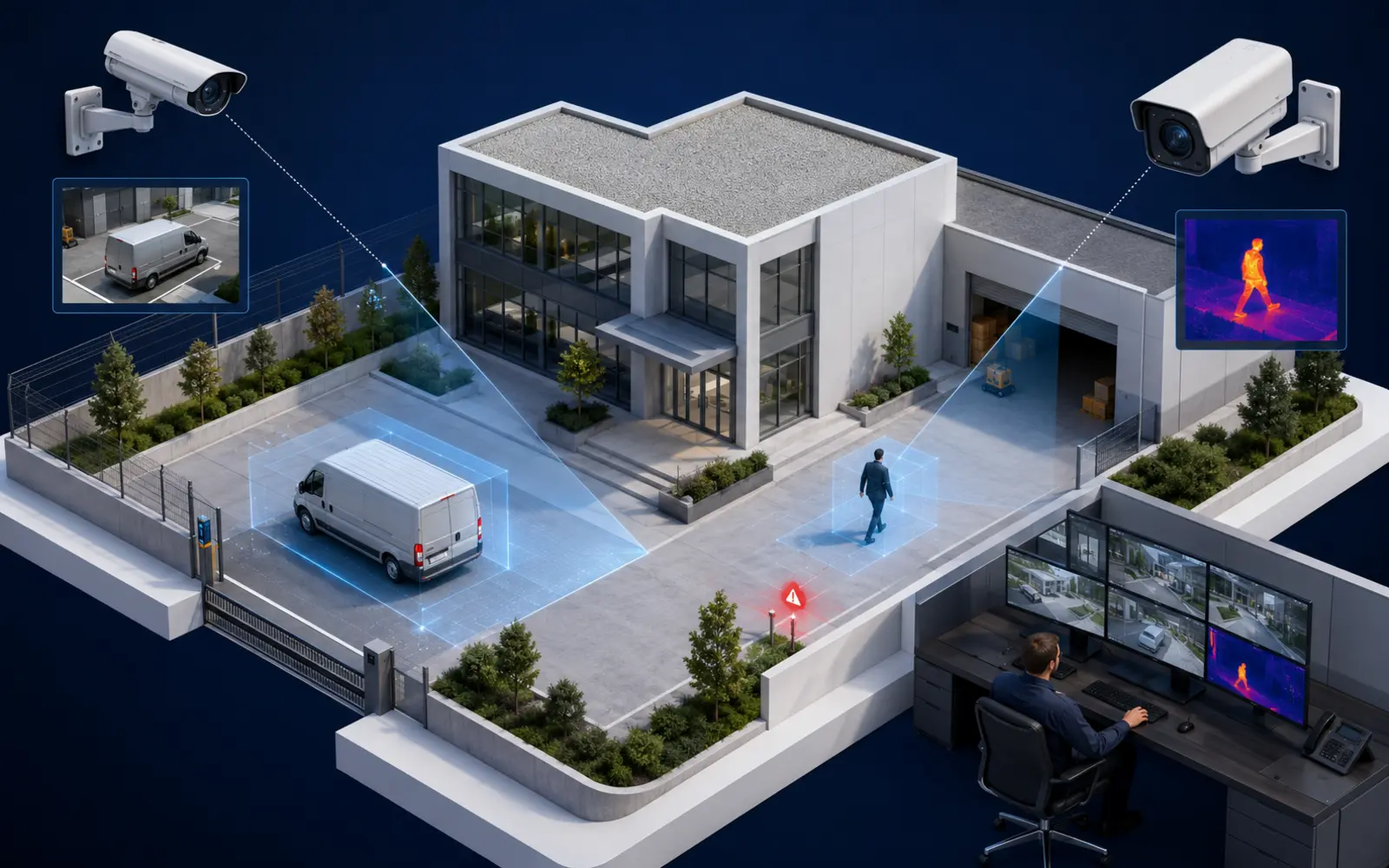
This page covers the essential concepts and links to more specialised resources. Capabilities, constraints and rules must always be checked against the relevant site and use case.
What is intelligent video surveillance?
Video surveillance becomes intelligent when it does more than record images: it analyses scenes, extracts useful events and presents them to a person able to decide. The goal is not to replace human judgement. It is to shorten the time between a weak signal—boundary crossing, unusual presence, abandoned object or apparent smoke—and an appropriate action.
The chain matters more than the camera. It links sensors, software, site rules, transmission, storage, supervision and intervention. A standalone 4K camera can create attractive archives without warning anyone; a more modest system can send the right sequence to the right operator with enough context to verify the alarm.
See, interpret and alert: three different functions
The camera captures, the algorithm tests for a condition and the operator interprets. A box drawn around a silhouette is not proof of intrusion; a model classified a shape at a given threshold. Time, credentials, trajectory, sensors and adjacent views supply missing context.
- Observe: provide usable imagery in the site's real operating conditions.
- Detect: flag a configured rule or anomaly.
- Qualify: compare the alert with several pieces of evidence.
- Decide: apply an instruction approved by an authorised person.
- Document: retain only what is necessary and auditable.
One security layer, never an absolute guarantee
A meta-analysis covering forty years of evaluations associates CCTV with a modest but significant reduction in crime, more pronounced in car parks and residential areas. Active monitoring and complementary measures improve outcomes. No one can promise that a camera will prevent a break-in; a targeted, integrated and evaluated system is a defensible proposition. This case is also reported in CCTV Surveillance for Crime Prevention: 40-year meta-analysis (Office of Justice Programs).
For a deeper analysis, read Intelligent video surveillance and data protection. Apply proportionality, transparency, access control and retention.
Optical, thermal and hybrid cameras: give each the right role
Camera selection starts with the scenario, not the megapixel count. Define the area, distance, lighting, obstacles, target speed and required detail. An overview intended to detect presence needs a different lens and position from an entrance view intended to distinguish a vehicle or document an incident. Backlighting, rain, insects, vegetation, headlights and snow all affect useful quality. Day, night and bad-weather trials are more revealing than a specification sheet.
Visible-light cameras: detail, colour and understanding
A visible camera contributes colours and detail: an open door, clothing, direction of travel, a carried object and perhaps a number plate if framing permits. Lighting, contrast and shutter speed matter as much as resolution. A wide angle covers more ground but leaves fewer pixels on each target.
- Fixed dome for a stable, discreet view.
- Bullet camera to make direction and perimeter apparent.
- Multi-sensor camera for several angles with fewer blind spots.
- Motorised PTZ for investigating events, without replacing fixed views.
- Near infrared at night, with attention to reflections and insects.
Thermal cameras: detect contrast, not a face
Thermal imaging represents infrared radiation from surfaces and may reveal a person or vehicle in darkness. Rain, fog, warmed surfaces, reflections, vegetation and apparent target size still influence the result. It may show that a person-like shape is moving without revealing who they are. Where presence alone matters, that limitation can protect privacy. A visible camera or second sensor can then provide the detail required for verification. The stated specifications are detailed in Q1972-E thermal camera and edge analytics (Axis Communications).
Visible and thermal together, supported by complementary sensors
Along a dark fence, thermal imaging triggers while optical imaging qualifies. At a gate, access control explains a presence; on a loading bay, a sensor confirms the trajectory. The point is to cross-check independent signals, not accumulate devices.
For a deeper analysis, read Swiss robotic-surveillance regulations. Explore the legal framework for sensors, cameras and autonomous systems.
Detection, classification and identification: do not confuse the promises
Detection establishes that a presence or movement exists. Classification assigns a category such as person, vehicle or animal. Recognition refines a type. Identification aims at a particular entity—a person, number plate or registered vehicle—and requires much greater detail, justification and control. An alert saying person after 22:00 claims neither identity nor intent. It supplies a hypothesis. Suspicious behaviour is too vague without observable criteria such as crossing, extended presence, travel against a defined direction or an object remaining beyond a set period.
Detect an event without profiling a person
Protecting a perimeter rarely requires knowing who walks beside a fence. Temporary local classification can simply open a clip. Swiss Federal Railways illustrates minimisation in another context: its 3D footfall sensors transmit density, speed and dwell-time measurements without images or individual tracking. This is not security surveillance, but it is purpose-led design.
Biometric identification creates another level of risk
Comparing a face with a database is not an innocuous extension. The FADP classifies biometric data that uniquely identifies a person as sensitive personal data. Necessity, proportionality, notices, errors, security and alternatives require careful assessment. A badge, zone rule and human verification are often sufficient.
Video analytics and AI: reduce false alerts without creating blind spots
Analytics applies rules for movement, direction, duration or crossing; machine learning improves some classifications. Neither is infallible. A false positive reports an irrelevant event, while a false negative misses the target. Reducing one may increase the other. Measure detected and missed events, useful alerts, verification time and seasonal variation by scenario. NIST recommends governing, mapping, measuring and managing AI risk throughout the lifecycle. For verification, see Artificial Intelligence Risk Management Framework 1.0 (NIST) and Loitering Guard and false-alert reduction (Axis Communications).
Why cameras make mistakes
Vibration, rain, spiders, shadows, reflections, animals, tarpaulins, obstruction and low contrast explain many errors. A model may also encounter a scene absent from training: a crouching person behind a pallet does not resemble an unobstructed pedestrian.
- Poor angle or a target too small in the image.
- Analysis area including a road, trees or reflective surface.
- Threshold too sensitive or a minimum size inconsistent with perspective.
- Infrared lighting attracting insects and revealing dust or precipitation.
- Changed surroundings after works, vegetation growth or stock movement.
Calibrate on site, then maintain the model
Commissioning tests distances, speeds and clothing by day and night. Exclusions, perspective and schedules are adjusted. Alerts are labelled useful, unwanted, uncertain or missed. Critical tests are repeated after updates, camera movement or seasonal changes. Analytics may run in the camera, on a local server or in the cloud. The choice should reflect latency, network, data location, reversibility, updates and outage behaviour.
A golden rule: no sensitive action on one probability alone
An alert may switch on lighting or display a camera. Accusing someone, imposing a lasting restriction, sharing an image or calling authorities requires context and procedure. The more serious and irreversible the action, the stronger the validation must be. AI prioritises; a person decides.
Alarm verification and human supervision are the heart of the system
Verification turns a technical notification into an understandable situation. The operator reviews the pre-alert clip, live view, a second camera, alarm status and, where relevant, access-control events. They are not seeking abstract certainty but gathering the evidence defined for selecting a response level. Human supervision is not decoration added to an autonomy claim. It needs usable images, a unified interface, written instructions and a means of action. A wall of unprioritised screens creates fatigue; a contextualised alert supports decisions.
From signal to response in five steps
A robust procedure defines who receives an alert, target handling time, mandatory checks, contacts and escalation conditions. It also covers ambiguity. If an image is obscured or connectivity fails, the operator should not improvise: degraded-mode instructions say whether to contact someone on site, a patrol or the responsible manager.
- Receive: one located, timestamped incident.
- Qualify: contextual clip, live image and associated sensors.
- Decide: level set by the escalation matrix.
- Act: voice message, lighting, call, intervention or authorities according to the facts.
- Close: record observations and outcome without speculation.
Illustrative scenario: a logistics bay at 02:14
A thermal camera classifies a shape as a person outside a closed warehouse. The visible camera shows someone near the loading bay, but their face is neither necessary nor usable. The system confirms that no credential opened the access and displays the adjacent view. The operator observes a fence crossing, calls the on-duty contact and follows the intervention instruction. This scenario is illustrative: it shows a possible sequence, not a real incident or a promise that the system would prevent intrusion.
Test people and procedures as well
A quarterly exercise can measure handling time, interface comprehension, contact availability and log quality. Harmless mistakes are treated as improvement signals. Security comes from the complete loop: a strong algorithm cannot compensate for an obsolete on-call number, and an excellent team cannot compensate for a camera blinded by a floodlight.
For a deeper analysis, read Artificial intelligence and surveillance. Understand models, limitations, governance and human oversight.
Villas, businesses and industry: three architectures, three priorities
The same analytical function has different value in different places. At a villa, discretion, property boundaries and simplicity come first. In retail, customer flows and employees make proportionality central. Across a large industrial site, distance, hazardous zones and continuity requirements justify more redundancy.
Useful sizing starts with a few high-value incidents: a night-time fence crossing, entry into a closed yard, presence in a plant room, a vehicle stopped at a loading bay or apparent overheating. Each case receives a zone, schedule, confirmation source, responsible person and action. Remove functions that have no defined action.
Villas and private property
Cameras cover access points, not neighbours' windows or pavements. Physical angles and privacy masks constrain the view. Person detection may operate around the gate or an outbuilding at appropriate times. A verified alert can trigger lighting, a message or a call. On a large property, an authorised drone or ground robot may provide another angle, although fixed cameras usually remain the most predictable foundation.
Shops, offices and SMEs
Priorities may include out-of-hours entrances, stockrooms, tills or a car park. Staff must be informed, and continuous monitoring of employee behaviour is prohibited in principle. Break areas, workstations and spaces with no security need should not be filmed for convenience. A precise rule such as presence in an armed stockroom is more defensible than general behaviour analysis.
Warehouses, industry and large perimeters
Visible and thermal cameras can cover fencing, vehicle compounds, loading bays and outdoor equipment. Network redundancy, backup power and degraded operation become essential. Cameras work with perimeter sensors, access control and, where useful, mobile systems. A critical site must connect this design to business continuity, cyber-incident response and sector-specific requirements.
Three documented cases: deployment, limits and minimisation
Real cases explain choices; they do not guarantee the same result elsewhere. The first concerns behavioural analytics in Swiss retail. The second shows the risk of disproportionate biometric identification at work. The third demonstrates that an intelligent function can sometimes be delivered without imagery.
Coop: AI-enabled cameras in several Swiss stores
In February 2025, Watson, citing an investigation by Le Temps, reported that Coop used cameras with AI software in several stores, including one in Lausanne, to identify behaviour considered suspicious, notably around self-checkouts. The FDPIC told the publication that any video surveillance had to respect transparency and proportionality. The case documents a current detection capability and the debate it creates; public information does not establish its error rate or effectiveness. For verification, see Video surveillance in the workplace (FDPIC) and Coop uses intelligent cameras in several stores (Watson).
Serco Leisure: biometrics were not necessary
In 2024, the UK Information Commissioner's Office ordered Serco Leisure and associated organisations to stop using face recognition and fingerprints to monitor attendance by more than 2,000 employees at 38 leisure centres. The ICO found that necessity and proportionality had not been demonstrated when cards or badges were less intrusive alternatives. UK law differs from Swiss law, but the design lesson transfers: biometric identification needs far stronger justification than convenience. The applicable guidance is set out in Enforcement against Serco Leisure over employee face recognition (ICO).
SBB: measuring footfall without capturing images
Swiss Federal Railways explains that 3D footfall sensors in stations measure movement, density, dwell time and speed, then transmit only those measurements. They do not capture, record or transmit images and cannot track an individual. This is not security video surveillance. It is valuable because it reverses the question: instead of asking how to film lawfully, first ask whether the desired outcome requires filming at all. The applicable guidance is set out in Passenger flows in railway stations (SBB).
Privacy in Switzerland: design compliance before installation
In Switzerland, filming an identifiable person is processing personal data. The FDPIC states that a private camera's field of view should remain within the property, surveillance must be justified, proportionate and recognisable, and image access must be restricted. Retention depends on purpose; the FDPIC generally mentions deletion after 24 hours for private surveillance and 24 to 72 hours in workplaces. The applicable guidance is set out in Video surveillance by private individuals (FDPIC).
AI creates no legal vacuum. In 2025 the FDPIC confirmed that the FADP, in force since September 2023, applies directly to AI-based processing. It includes data protection by design and by default. A data-protection impact assessment must be completed before processing likely to pose a high risk to personality or fundamental rights. The applicable guidance is set out in Federal Act on Data Protection (Fedlex), Current data-protection law applies directly to AI (FDPIC) and Guidance on data-protection impact assessments (FDPIC).
The practical compliance file
Before procurement, the controller describes the purpose, zones, affected people, schedules, data categories, recipients, storage and retention. Less intrusive alternatives are documented. A notice should be visible before someone enters the field of view and identify the controller. Tested procedures should cover access requests, deletion, extracts for authorities and data breaches.
- Limit each camera's field physically and digitally.
- Disable microphones unless strictly necessary.
- Mask zones, faces or feeds where identification is unnecessary.
- Use named permissions and log viewing.
- Set automatic deletion with a controlled hold after an incident.
- Assess overseas transfers and cloud processors.
Employees require greater care
Employment law adds its own limits. The FDPIC says systems intended to monitor employee behaviour are prohibited and continuous surveillance may harm health. Security cameras may be possible at selected entrances, car parks, halls, hazardous areas or valuable stock where a less intrusive measure cannot meet the purpose. Inform employees before commissioning and keep their appearance in frame as exceptional as possible.
Lawful does not automatically mean acceptable
A system may meet formal duties yet remain poorly understood. Explaining what is and is not detected, who watches, how long data exists and how an error can be challenged builds trust and often reveals unnecessary settings. Transparency is an operational-quality measure: a purpose that cannot be explained simply is probably still too broad.
Cybersecurity and deployment: a camera is also a networked computer
An IP camera has an operating system, accounts, network services and sometimes third-party applications. Excellent images cannot compensate for a shared password, unsupported firmware or exposed remote access. Cybersecurity is part of physical security: a camera that is unavailable, hijacked or viewed without permission compromises both site protection and privacy.
NIST recommends trusted onboarding for connected devices with unique device identities and lifecycle management. For a camera estate, that means an exact inventory, per-device authentication, network segmentation, encrypted communications, a patch policy and a known end-of-support date before purchase. The applicable guidance is set out in Secure Onboarding of IoT Devices to Networks (NIST).
The minimum technical baseline
Place cameras on a dedicated network separated from office systems and industrial controls. Disable unused services and manage devices through controlled paths, ideally with strong authentication. Remove generic accounts. Send access and configuration logs to monitoring. Encrypt configuration backups and test restoration.
The contract should say who fixes vulnerabilities, within what time, for how many years and how third-party components are governed. Secure boot and signed software strengthen the trust chain but do not replace updates or hardening. Supplier departure, camera replacement and end of life should include access revocation, data erasure and evidence that the asset left the inventory.
- Unique identity and separate secret for every device.
- Dedicated VLAN or segment with only required network flows.
- Encrypted streams and lifecycle-managed certificates.
- Patches, vulnerability monitoring and a support deadline.
- Tests of restoration, network loss and backup power.
- No direct internet access to camera administration.
A four-decision roadmap
First, prioritise three to five incident scenarios and their actions. Second, test sensors on site against measurable criteria: coverage, useful-alert rate, missed events, verification time and availability. Third, approve the legal, cyber and organisational file before full deployment. Fourth, operate through regular reviews of alerts, site changes, software versions, permissions and exercises.
The useful return indicator is not camera count. Combine avoided patrols, verification speed, evidence quality, system availability and genuinely actionable alerts. A modular architecture can later add a robot, drone or new analytics when the need is demonstrated, without rebuilding the entire chain.
Frequently asked questions
What is the difference between conventional and intelligent video surveillance?
A conventional installation displays or records feeds for live or post-incident review. An intelligent installation adds rules and models that flag a presence, crossing, direction or duration. Useful intelligence does not reside in the algorithm alone: the alert must be contextualised, checked by a person and connected to an action procedure.
Can a thermal camera identify a person?
Thermal imaging is generally used to detect heat contrast and classify a shape as a person or vehicle. It does not provide the colours and facial detail of a visible camera. Distance, lens, weather and background strongly affect results. Verification often combines thermal and optical views without confusing detected presence with established identity.
Does AI eliminate false alarms?
No. It can filter ordinary movement and classify objects, but rain, insects, reflections, vegetation, obstruction and unusual scenes still cause errors. Calibration must happen on site and be reviewed seasonally and after material changes. Measure false positives and missed events together: sharply reducing sensitivity can create a blind spot.
May a private camera film the pavement or a neighbour's property in Switzerland?
The FDPIC says private video coverage should be limited to the owner's property; neighbouring land and public space such as pavements should generally not be included. Physical framing, privacy masks and placement should enforce that limit. Special circumstances should be assessed with the municipality or appropriate legal advice.
How long should video-surveillance images be retained?
Retention follows the purpose and should be as short as possible. The FDPIC generally refers to deletion after 24 hours for private video surveillance and 24 to 72 hours in workplaces. These are not automatic permissions: document the need, automate deletion and hold only a relevant extract when an incident justifies retention.
Is an impact assessment required for an AI camera?
A data-protection impact assessment is required where proposed processing is likely to create a high risk to personality or fundamental rights. AI does not trigger it mechanically in every case, but biometrics, large-scale surveillance, data matching and sensitive decisions increase risk. Complete the assessment before deployment.
Why retain human supervision when analytics is automatic?
A model sees pixels and correlations, not the whole context. An operator can compare another camera, schedule, credential or instruction and choose a proportionate response. Human involvement is particularly essential before intervention, access restriction, image disclosure or contacting authorities.
How should IP cameras be secured against cyberattack?
Begin with an inventory, unique credentials, network segmentation and encrypted flows. Disable unnecessary services, never expose administration directly to the internet, patch devices and monitor vulnerabilities until support ends. Log access, test backups and degraded operation, then revoke accounts and erase data when replacing equipment.