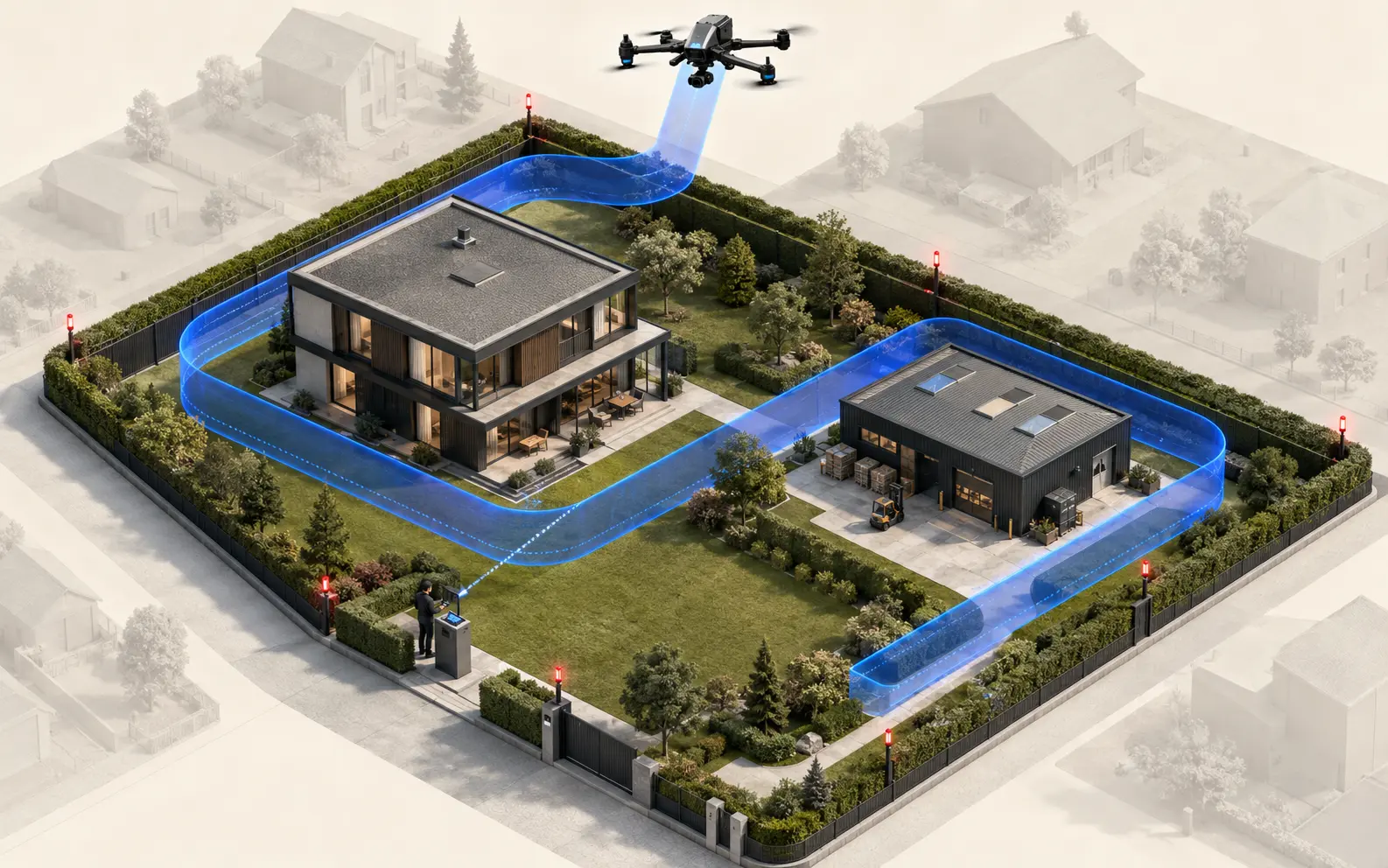
This article provides general information. Any real project must be assessed against its site, intended use and the rules in force at the time of deployment.
Surveillance drones are not prohibited in principle
A drone can quickly inspect a roof, fence, distant entrance or alert zone. On a large estate or industrial facility, it may complement fixed cameras and a ground robot.
Legality does not depend solely on keeping the aircraft above private land. Airspace is regulated, and the camera may capture people or neighbouring properties.
The operator usually needs to register
FOCA requires registration for individuals and organisations operating drones. The exception concerns aircraft below 250 grams with no camera, microphone or other sensor capable of recording personal data. A small camera-equipped drone therefore normally requires operator registration. For verification, see Drone flight rules (FOCA) and Registration as a drone operator (FOCA).
For a deeper analysis, read Intelligent video surveillance. Duties concerning images and identifiable people.
What is possible in the open category
The open category covers lower-risk operations meeting all its conditions. Maximum altitude is 120 metres, the drone may not fly over an assembly of people and it must remain within the remote pilot’s direct visual line of sight.
Visual line of sight limits automation
A programmed route is not necessarily prohibited if the pilot keeps the drone in direct view, monitors the airspace and can regain control. A drone launching while nobody can see it generally does not fit the open category.
Check geographical zones before every flight
The official drone map changes. Areas around aerodromes, heliports, reserves or infrastructure may be prohibited or require authorisation. Owning land inside a restricted zone does not confer an automatic right to fly.
For a deeper analysis, read Swiss robotic security law. An overview of the rules applying in Switzerland.
When the specific category applies
FOCA places operations beyond visual line of sight, above 120 metres, using aircraft of 25 kilograms or more, or above assemblies of people within the specific category. For verification, see Introduction to the specific category (FOCA).
An automated patrol is an operating project
For beyond-visual-line-of-sight operation, the operator must demonstrate that the mission is safe, controlled and compliant. The scenario may require an authorisation or declaration, an operations manual and an emergency plan.
A drone station on a roof is therefore not merely an accessory. The complete system must manage weather, communications, navigation, obstacles, manual takeover and emergency landing.
Privacy remains applicable in the air
FOCA reminds operators that people outside the operation should not be photographed or filmed and that a drone should not fly low above another person’s private property.
Design a surveillance corridor
The route should focus on sensitive parts of the protected site and avoid windows, neighbouring gardens and public roads. Privacy masks, restrained zoom and camera activation only during an alert can reduce intrusion.
- Define the flight perimeter precisely.
- Check the official map before every mission.
- Inform people who may be recorded.
- Limit recording and access to footage.
- Provide immediate termination when emergency services intervene.
For a deeper analysis, read Large-perimeter security. Scenarios where an aerial view can complement protection.
Insurance and responsibility
Liability insurance of at least CHF 1 million is required for drones above 250 grams. FOCA also recommends cover for lighter aircraft. For verification, see Frequently asked questions about drones (FOCA).
A business should distinguish the operator from the remote pilot and assign responsibility for procedures, maintenance, training and incidents. Professional drone security needs governance, not only a capable aircraft.
Frequently asked questions
Can a drone fly automatically around a villa?
A programmed route may be possible if every condition of the relevant category is met. In the open category, the remote pilot must keep the drone in direct visual line of sight.
Must a drone below 250 grams be registered?
Yes if it carries a camera, microphone or another sensor capable of recording personal data. The exemption requires both a weight below 250 grams and no such sensor.
May a drone record a neighbouring property?
No. Privacy must be respected, and both the route and camera orientation should avoid third-party properties.