This page covers the essential concepts and links to more specialised resources. Capabilities, constraints and rules must always be checked against the relevant site and use case.
An autonomous inspection system before a security drone
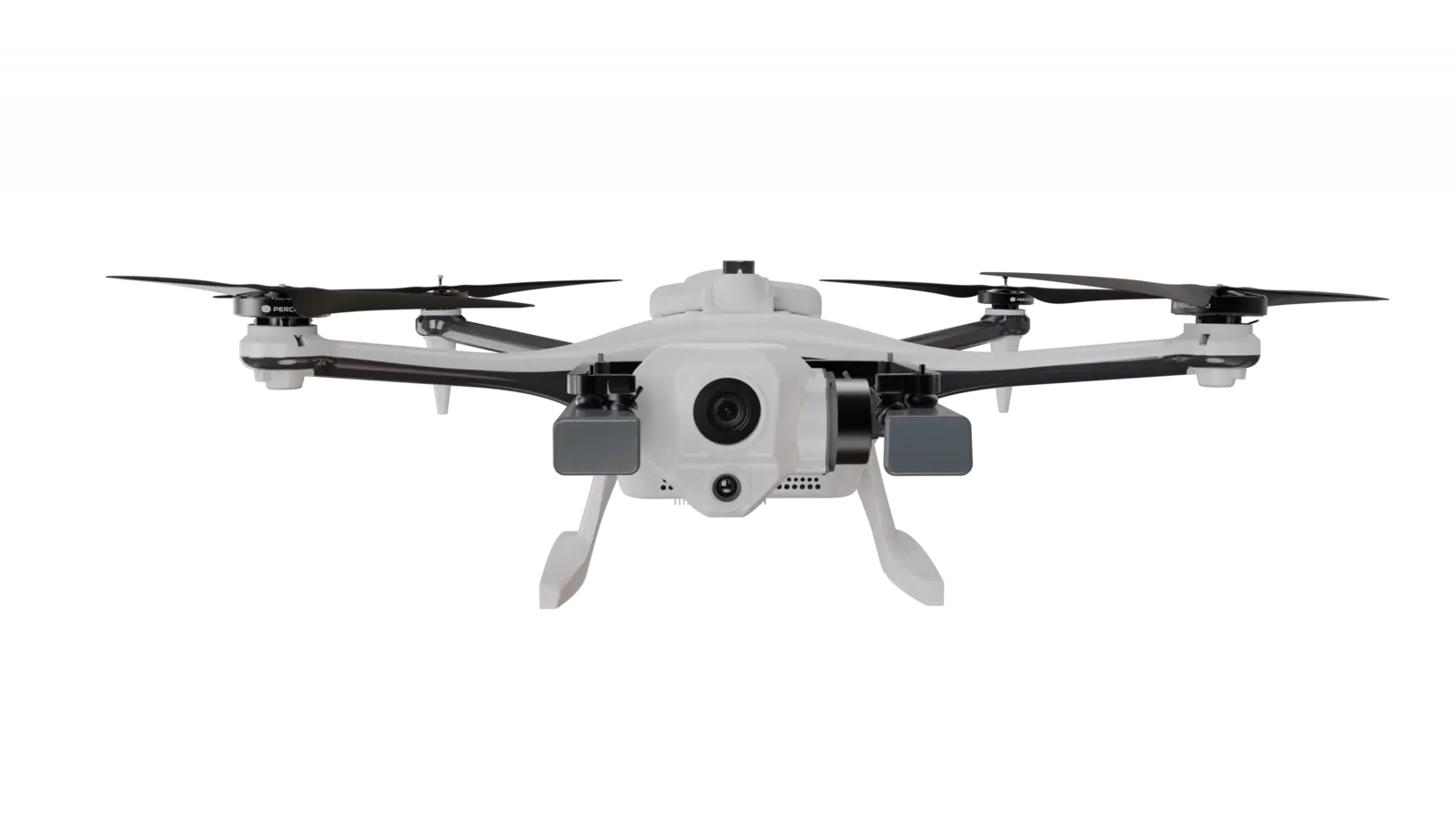
Percepto Air Max is a drone-in-a-box platform intended for inspection and monitoring across large industrial sites. The aircraft remains in Percepto Base, which supports protection, charging, data transfer and local weather awareness. Percepto AIM coordinates missions, organises data and presents analysis to users. For verification, see Official Air Max presentation (Percepto) and Heavy-industry inspection and monitoring (Percepto).
The manufacturer highlights a 61-megapixel full-frame visible camera, radiometric thermal imaging and options including optical gas imaging. The intended environments include energy, mining, oil and gas, utilities and other facilities that benefit from frequent observations.
Security is a credible additional use: scheduled aerial rounds, alarm verification and incident reconnaissance. The primary value of Percepto remains the continuity between mission, data, comparison and workflow. It should not be described as a universal intrusion detector.
This distinction helps a buyer justify the system correctly. An industrial site may use it every day for inspection and occasionally for security, making the platform more valuable than a drone reserved only for rare alarms.
For a deeper analysis, read DJI Dock 3. Compare another drone-in-a-box platform.
Air Max, Percepto Base and AIM form one operating product
The aircraft collects images. The Base enables permanent site presence. AIM turns flights into a repeatable process. A request targets an asset or area, the drone gathers data, analytics compare the observations and the result enters a workflow.
The Base needs a clear position, power, communications, drainage, weather exposure assessment and physical protection. Its advertised environmental resistance should be confirmed for the customer’s climate, altitude and maintenance practices.
AIM can become an important inspection record. Rights, integrations and governance therefore matter. A detected issue should be associated with an asset, severity, owner and deadline. Without that connection, automation creates more images without improving decisions.
The system should keep the source image, position, threshold and history behind any automated result. A user needs to understand why an anomaly was raised, accept or reject it and preserve the reasoning for later review.
Thermal imaging and OGI are powerful when supported by method
Radiometric thermal imaging can compare apparent temperatures across electrical assets, roofs, pipelines or other equipment. It may reveal unusual heating, but the measurement depends on emissivity, angle, distance and environmental conditions. A competent person must interpret the result.
Air Max OGI adds optical gas-imaging capability for selected substances. Percepto describes automated emission detection and source localisation. This can support more frequent surveys and reduce human exposure, but it is not applicable to every gas or every regulatory measurement requirement. For verification, see Air Max OGI (Percepto).
The project must define substances, sensor performance, weather, flight path, confirmation and action. A gas alert requires a stricter process than an image of a fence: safe zones, specialist confirmation, notification and complementary instrumentation.
Artificial intelligence can prioritise observations, yet it should never conceal uncertainty. The customer should measure confirmed anomalies, false positives, missed events and the time taken from detection to an operational decision.
Security use cases should remain targeted
Percepto can complete an aerial round, inspect an access point after an alarm or provide an overview during a crisis. On a mine or plant, the drone can reach a remote zone quickly and reduce exposure before people understand the event.
High-resolution and zoom cameras may observe well beyond the necessary perimeter. Geographic and camera-orientation limits should protect neighbours, roads and employees. The system should not follow a person outside the approved operating area.
For continuous security, Percepto complements fixed sensors and teams. Weather, maintenance or airspace restrictions can make the drone unavailable. Critical scenarios need another means of detection and verification.
The operating procedure should distinguish a technical anomaly, safety emergency and suspected intrusion. Each event reaches different specialists and may justify different retention. One dashboard should not imply that every user can access every data type.
BVLOS, industrial data and Swiss responsibilities
A permanent and remotely operated installation will generally use BVLOS missions. In Switzerland, these belong to the specific category. The operator must document risk to people and airspace, technical failure, weather, maintenance, competencies and emergency arrangements. For verification, see Introduction to the specific category (FOCA).
American waivers or approvals announced by Percepto do not transfer to Switzerland. The exact Swiss operator, route and mitigations require an appropriate process with the Federal Office of Civil Aviation.
The data can be strategically sensitive: maps, assets, defects, emissions, access points and operating patterns. Contracts should state where AIM processes information, which subprocessors are involved, how access is logged and how data is exported or deleted.
When people are identifiable, Swiss data-protection rules apply. Security does not justify unlimited filming. Missions, camera angles and retention should minimise impact, and employees need clear information about the system.
Cybersecurity and continuity belong in the design
AIM, the Base, aircraft and interfaces form a connected operational system. Accounts should be named, privileged roles separated and strong authentication applied. Logs need protection so that mission and data access can be reconstructed.
Connections to maintenance systems or industrial data platforms should use controlled interfaces. The drone environment should not provide a direct route to operational technology. Remote supplier access should be authorised for a defined purpose and time.
Updates require testing and planned windows. The customer needs to know how long security fixes are provided, which components depend on cloud services and how missions behave during a loss of connectivity.
Continuity also includes the ability to operate without the drone. Fixed instrumentation and emergency procedures remain authoritative. Data exports and documented workflows help the customer retain operational knowledge if the service changes.
For a deeper analysis, read Industrial sites. Design a complete inspection and security architecture.
Our view: highly relevant to large-scale industrial inspection
Percepto Air Max is a strong reference for organisations seeking to automate a complete inspection process rather than simply fly a drone. The combination of a robust base, specialist payloads and AIM creates a coherent route from data collection to decision.
For occasional security rounds, the platform may be excessive. DJI Dock 3 provides a different enterprise ecosystem, Skeyetech E2 offers a European sensitive-site proposition and Sunflower Labs Beehive focuses on large-property security.
A Percepto pilot should target selected assets and indicators: missions completed, measurement quality, confirmed anomalies, time to action, availability and staff exposure reduced. The return comes from better decisions and more frequent inspections, not from flight hours alone.
The strongest project defines both the operating value and fallback. If the drone produces trusted measurements that enter maintenance and security procedures while remaining authorisable and supportable, Percepto can become a strategic site capability.
For a deeper analysis, read Skeyetech E2. Review a European alternative.
Frequently asked questions
Is Percepto Air Max a security drone?
It is primarily designed for autonomous industrial inspection, but it can support patrols, alarm verification and incident response.
What does Percepto AIM do?
AIM coordinates missions, organises data, applies analytics and presents results within an operational workflow.
Can Air Max detect gas leaks?
The OGI configuration targets selected emissions. Substances, performance, conditions and confirmation methods must be validated for the specific use.
Can Percepto Air Max fly in Switzerland?
The hardware can be used under a compliant scenario. Remote BVLOS missions belong to the specific category and require an appropriate FOCA process.