This article provides general information. Any real project must be assessed against its site, intended use and the rules in force at the time of deployment.
Repetitive patrols are the first practical use case
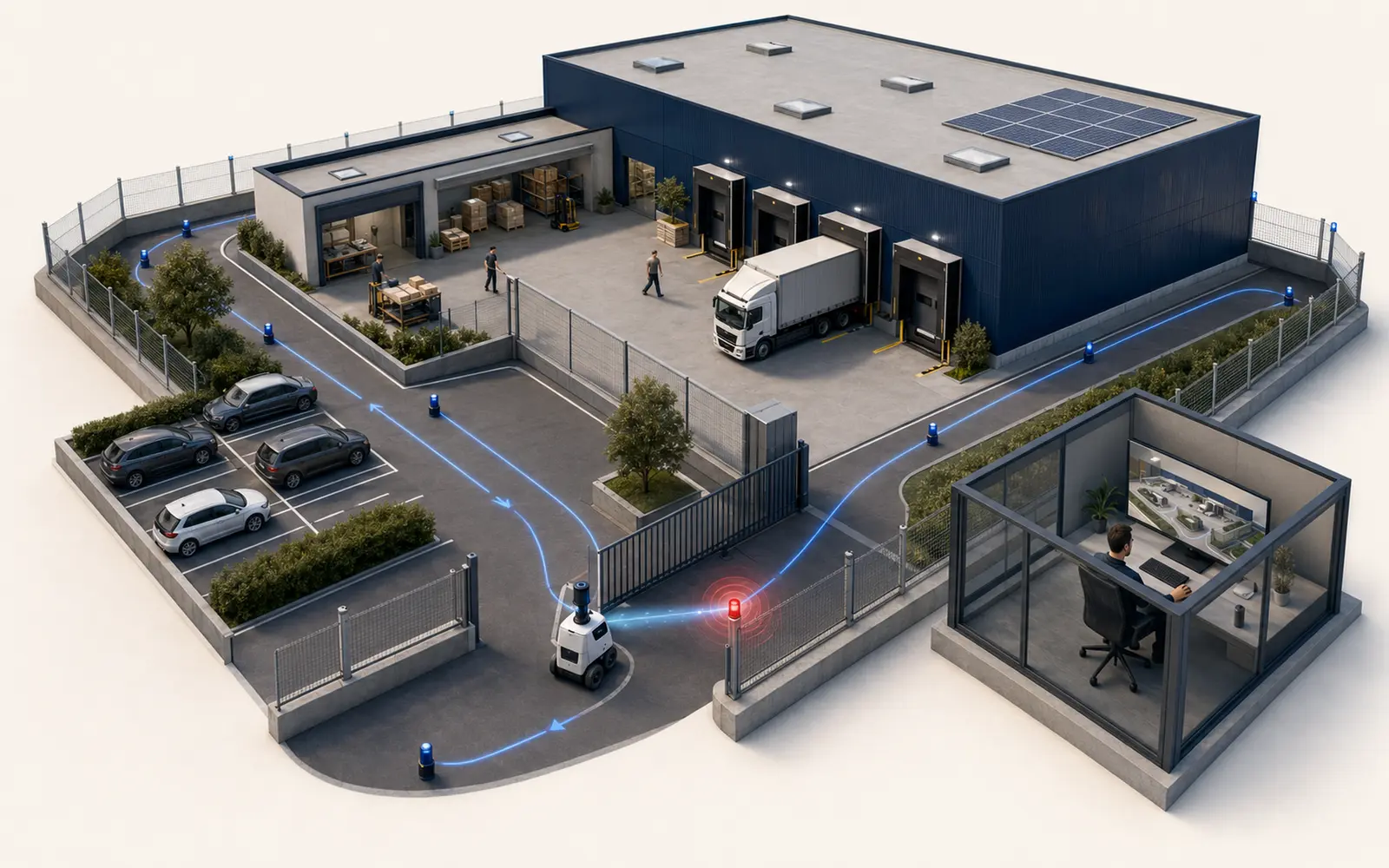
Professional sites often contain secondary entrances, doors, fences, loading bays and outdoor stock. A robotic patrol can visit those points on a schedule, pause at defined positions and report anomalies.
Robots are most valuable where the route is stable, missions are frequent and the information being sought is clearly defined.
What the robot can check
Depending on its sensors, it can provide images, identify a presence, measure apparent temperature, indicate that a door appears open or confirm that a route is clear.
- Fences and gates.
- Loading bays and delivery areas.
- Car parks and outdoor yards.
- Sensitive stock or isolated equipment.
- Technical checkpoints accessible from the route.
For a deeper analysis, read Swiss legal framework. The wider regulation of a robotic security system.
Faster alarm verification
When a fixed sensor raises an alert, a robot may move to the area without waiting for the next human patrol. The operator receives another angle and can decide whether intervention is justified.
Reduce unnecessary call-outs
Animals, moved objects, weather and reflections generate alerts. Mobile verification can avoid deploying an officer unnecessarily while preserving a useful event record.
A robot does not replace every human security task
Robots do not handle every social situation, conflict, emergency or unexpected obstacle well. They also lack the judgement and intervention capabilities of a trained professional.
Assign the roles
The machine completes repetitive missions and gathers information. An operator interprets ambiguous situations, decides escalation and coordinates responders. This division is more realistic than complete replacement.
For a deeper analysis, read Industrial sites. Architectures designed for large perimeters.
Avoid monitoring employees
In Switzerland, a system cannot be used to monitor employee behaviour. Patrols justified by security should minimise the presence of employees within the camera’s field of view.
Programme missions around time and place
Night-time missions on a closed site are easier to justify than continuous monitoring of a workplace. Employees need advance information, unmonitored areas should be defined and access to footage restricted. For verification, see Video surveillance in the workplace (FDPIC).
The robot’s function should appear in internal documentation. Data collected for security must not be repurposed for individual performance evaluation.
For a deeper analysis, read Workplace video surveillance. Principles of proportionality and transparency.
Measure the value of a pilot
Return on investment is not simply the number of patrol hours. Track completed missions, detected incidents, avoided false call-outs, downtime and time spent on manual recovery.
Begin with a limited route
A first pilot can cover a small number of high-value checkpoints during a defined period. This tests connectivity, terrain, weather, acceptance and monitoring integration before the system expands.
Frequently asked questions
Can a robot replace security-officer patrols?
It can automate selected repetitive patrols, but decisions, complex situations and sensitive interventions remain the responsibility of trained people.
Can a robot operate during working hours?
Potentially, but safe movement and the prohibition on monitoring employee behaviour must be built into the project.
Which sites are most suitable?
Sites with stable routes, large areas, repetitive missions and clearly defined checkpoints generally offer the best conditions.