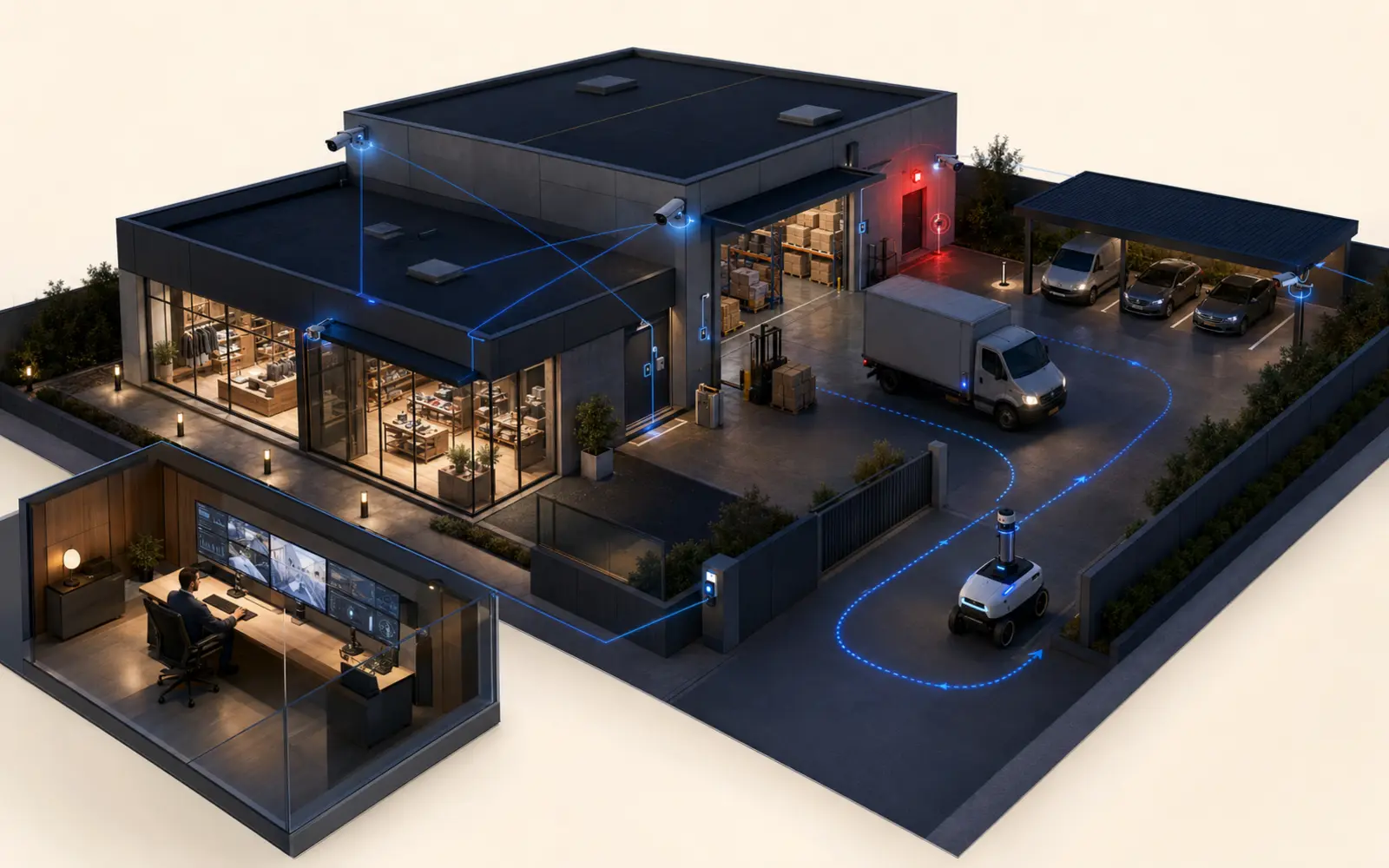
This page covers the essential concepts and links to more specialised resources. Capabilities, constraints and rules must always be checked against the relevant site and use case.
Robotic security turns an alert into a useful decision
For a business, robotic security is not simply a robot stationed at the door. Sensors detect a change, a camera or robot provides context, an operator verifies what has happened, and an agreed instruction triggers the response. This chain complements locks, lighting, access control and staff. It replaces neither robust physical protection nor human judgement.
Its value is clearest when a site is closed, extensive or divided into separate areas: the rear of a shop, a warehouse loading bay, a car park, a technical yard or outdoor storage. A fixed camera retains one viewpoint; a robot can return to a control point or inspect the same area from another angle. Human oversight connects those observations to people authorised and equipped to act. The right objective is therefore not to “see everything”, but to reduce the time between a credible signal and a safe response.
An architecture built around five verbs
Deter, detect, assess, act and document: these five functions make it possible to judge a project without being distracted by a polished demonstration. A fence or lighting makes access harder. A door contact, video analysis or detector signals an event. A person verifies it. The procedure selects intercom, the security team, police or maintenance as appropriate. Finally, a timestamped log supports an investigation and continuous improvement.
- Documented fact: burglary and theft remain issues monitored by Swiss police forces.
- Current capability: robots and cameras can send images and carry out predefined missions.
- Limit: no sensor can guarantee that every intrusion will be detected or that a responder will arrive in time.
- Illustrative scenario: someone near a closed loading bay prompts verification, not an automatic accusation.
For a deeper analysis, read Robotic security: complete guide. The full picture for coordinating sensors, cameras, robots, drones and human oversight.
For a deeper analysis, read Intelligent video surveillance. Video detection, alert quality, verification and data protection.
Map what could genuinely stop the business
The same equipment catalogue cannot protect a jewellery shop, a garage and a wholesaler. Analysis starts with consequences: injury, loss of critical stock, copper theft, fraudulent collection, fire or an enforced closure. Each scenario identifies the access point, time, existing safeguards, speed of the event and person responsible for the decision. This case is also reported in Theft excluding shoplifting, 2024 (Swiss Federal Statistical Office).
The plan separates public spaces, working areas, stockrooms, loading bays, plant rooms and property boundaries. It records keys, badges, codes, network links, power supplies and on-call staff. This map often reveals straightforward improvements before any robotics is considered: permanently close a rarely used door, segregate high-value stock or protect access codes more effectively.
For SMEs and shops, opening and closing are sensitive periods
The last employee may be alone with cash and keys and have a poor view of the street. The risk includes both an assault and coercion to reopen an entrance. Where the risk warrants it, the arrangement should support two-person closing, a discreet alarm button, a visual check of the exterior and a clear non-confrontation rule. An outdoor robot can reveal a blind spot in a yard; it must never encourage an employee to go outside to investigate.
In warehouses and car parks, protect flows as well as walls
A dramatic break-in is only one warehouse scenario. A trailer may leave on false paperwork, a gate may remain open after a lorry, a pallet may be moved into an uncovered area, or metals may be removed gradually. In a car park, risks concern vehicles, catalytic converters, charging points, employee walkways and building entrances. The physical event therefore needs to be checked against the expected schedule: an open door, authorised vehicle, collection slot and verified identity.
- Resale goods: electronics, cosmetics, alcohol, tools and spare parts.
- Materials and equipment: copper, cables, batteries, fuel, machines and components.
- Continuity assets: keys, servers, electrical panels, service vehicles and essential stock.
- People: lone workers, drivers, contractors, visitors and customers.
For a deeper analysis, read Robotic security for villas. Apply the same logic to private property and its occupants.
For a deeper analysis, read Industrial and logistics site security. Explore large perimeters, loading bays, equipment and business continuity.
Three real incidents show where safeguards break down
Real events never prove that a robot would have prevented a theft. They reveal attack paths, timings and dependencies worth testing. These three cases, documented by a cantonal police force or established news organisations, turn an abstract threat into operational questions. This case is also reported in 2025 crime statistics (Bern Cantonal Police).
In Nürensdorf, protecting the cashier comes first
According to Zurich Cantonal Police, on 2 August 2024 two men entered a shop in Nürensdorf, threatened the cashier with a pointed object and took several hundred francs. The suspects were arrested within hours, assisted by witness evidence and police enquiries. The case is a reminder that a useful alarm must be capable of discreet activation and immediately communicate the address, affected zone and verifiable details. The applicable guidance is set out in Burglary protection (Bern Cantonal Police) and Robbery at a shop in Nürensdorf (Zurich Cantonal Police).
Automatic facial recognition is not the answer. A safer design combines the checkout layout, a route of escape, training, a discreet alarm and unambiguous instructions. When opening or closing, a remote external check may prevent an employee walking towards an uncertain situation. If there is a threat, protecting the person remains the priority.
In Huddersfield, an overnight theft hit both warehouse and trailer
ITV reported that in December 2023 approximately £50,000 of stock was stolen in the early morning from a Mamas & Papas warehouse and an adjacent trailer. West Yorkshire Police issued an appeal for information. Without speculating about safeguards that were not reported, the case illustrates a recurring weakness: protecting the building while overlooking the yard, trailers and routes needed to remove goods. This case is also reported in Stock stolen from Mamas & Papas warehouse (ITV News).
A test should follow the full sequence: crossing the boundary, activity near a trailer outside an authorised window, opening it, positioning a vehicle and leaving. Several weak signals become credible when correlated, provided an operator receives their context and knows whom to contact.
In Northampton, compromised codes allegedly opened a normal workflow
In May 2025, the Financial Times reported on legal proceedings concerning the theft of 242,000 Charlotte Tilbury products from a warehouse in January 2023. According to allegations set out in the proceedings, access codes had been left at reception and in a bag, and thieves allegedly loaded three large vehicles over several hours. G4S said its subsidiary would contest the claim. The proceedings are a reminder that a valid badge or code does not make a movement legitimate. This case is also reported in G4S sued over Charlotte Tilbury warehouse heist (Financial Times).
The practical lesson is to separate authorisation from verification: individual credentials, prompt revocation, vehicle checks, a match with the order and two-person approval for exceptional collections. Technology can make a discrepancy visible; the procedure must stop the flow.
Fixed sensors and cameras form the first safety net
A dependable system uses the simplest sensor capable of answering the question. A magnetic contact knows that a door has opened, but not why. An infrared beam covers a passage, but its environment may disrupt it. A camera adds context, but depends on light, viewing angle and a clean lens. Combining them improves verification only when their limitations are measured rather than blindly multiplied.
Detect a change, then establish its cause
Door contacts, shock and vibration sensors, beams, radar and video analytics can monitor doors, shopfronts, fences and traffic lanes. Leak or temperature sensors extend protection to business continuity. An event should include the device, time, prior state and sensor health. “Rear door open for four minutes, outside working hours, with no associated badge” is more actionable than a red warning light.
Cameras should cover the approach, crossing point and likely direction of travel without capturing more than necessary. Night tests must include lighting, headlamp glare, rain, insects and low-contrast clothing. A thermal camera can flag a heat signature; on its own it cannot establish a person’s intention or the cause of an abnormal temperature.
Video analytics classify patterns; they do not judge intent
Depending on configuration, current functions can detect a person or vehicle within a zone, a line crossing, prolonged parking or a left object. The result remains probabilistic. An early delivery driver, reflection, tarpaulin or animal may trigger an alert, while an obscured event may be missed. Thresholds must be evaluated on the actual site, with a clear process for correcting both false alarms and non-detections.
For a deeper analysis, read Security robots: complete guide. Mobility, sensors, autonomy, missions and limits of ground platforms.
A mobile robot provides a viewpoint, not authority
A ground robot is relevant when a patrol is repetitive, fixed cameras leave blind spots or remote verification avoids exposing someone. It follows an authorised route, stops at defined points and transmits visible-light or thermal video. It may travel to an alert if the route is safe. The operator retains responsibility for interpretation and escalation.
Ascento, a company originating at ETH Zurich, presents a two-wheeled autonomous robot with visible-light, infrared and thermal cameras, charging and a monitoring application. Those specifications come from the manufacturer: they are neither a universal certification nor a guarantee of results on a particular site. Every platform must be tested against the site’s slopes, thresholds, gratings, rain, snow, traffic and communications. The stated specifications are detailed in Ascento Guard manufacturer specifications (Ascento).
Missions that create measurable value
A robotic patrol can check that doors are closed, inspect the rear of a building, document the condition of a fence, confirm that an emergency exit is unobstructed or revisit an anomaly. In a car park, it can provide another angle on a person or vehicle. Missions need firm boundaries: route, speed, prohibited zones, priority given to people, behaviour when the network fails and the condition for returning to the station.
- Closing patrols and timestamped control-point checks.
- Visual verification from several authorised positions.
- Intercom operated by a trained human.
- Thermal observations interpreted with care.
- A log of missions, stops, alerts and human takeovers.
Stairs, crowds and physical intervention remain serious limits
A wheeled base may be stopped by a threshold, pallet or snow; a quadruped is more expensive and brings different constraints. No robot should chase, restrain or confront anyone. In occupied areas, speed, safety distances, emergency stops, noise and accessibility become essential. A degraded mode must be planned: cancel the mission, fall back to a fixed camera or human patrol, or temporarily close an area.
Drones complement some sites, but are rarely the first line
A drone can quickly inspect a roof, long fence or inaccessible area. For an urban SME or shop, space, noise, weather, neighbours, data protection and aviation rules often reduce its everyday value. A camera or ground robot may be simpler. Every mission must define its flight zone, required competence, emergency procedure and capture limits. An automated docking station removes neither regulatory duties nor operational oversight.
Choose mobility around the evidence required
A ground robot gives a repeatable door-level view; a drone provides an overview subject to flight conditions; a fixed camera offers continuity. Selection starts with the evidence needed: checking a door leaf, following a fence or understanding movement within a yard. A platform with no distinct mission mainly adds maintenance, data and cyber exposure.
For a deeper analysis, read Surveillance drones: complete guide. Aerial uses, regulation, docking stations and operational constraints.
An alert without a procedure is merely more expensive noise
Human oversight gives the system a purpose. The operator receives the event, consults authorised views, checks other sensors and follows an action card. For each alert, that card sets out timing, evidence to verify, contacts, conditions for calling emergency services and information to preserve.
An attempted gate entry, smoke, assault at a checkout and network failure do not require the same response. Intercom may allow an operator to ask a visitor to identify themselves, but only when doing so creates no danger. Lighting may be activated and a team dispatched. Where a threat is immediate, contacting the competent emergency service takes priority over collecting more footage.
Write the escalation levels before the first night
A technical level covers low battery, an obscured camera or network loss. A low-level security event covers an explainable presence that still requires confirmation. A high level covers an observed break-in, threat or departure with goods. Thresholds and contacts must remain available outside the main software. The procedure should also state what the operator must not do: make accusations, pursue anyone, circulate images or send a lone employee to the scene.
- Identify the exact address, access route and known hazards.
- Cross-check evidence without delaying an obvious emergency.
- Protect people and preserve a safe route of withdrawal.
- Log decisions, calls and changes to instructions.
- Preserve relevant sequences with tightly restricted access.
Exercise the scenarios, including total failures
A tabletop exercise quickly reveals an outdated number, unavailable manager or contradictory instruction. A technical exercise checks timestamps, transmission, return to station and evidence export. It should also simulate power failure, internet loss, a broken robot and an unavailable service provider. The system is mature when everyone can continue without the usual interface.
For a deeper analysis, read Artificial intelligence and surveillance. Understand capabilities, bias, thresholds, errors and human oversight.
In Switzerland, protect the business without monitoring employees
The Federal Act on Data Protection requires, among other principles, purpose limitation, proportionality, transparency and security. Employment law adds a strict boundary: Article 26 of Ordinance 3 to the Employment Act prohibits systems intended to monitor workers’ behaviour. SECO notes that systems required for other reasons, such as security, must be designed so that they do not impair employees’ health or freedom of movement. The applicable guidance is set out in Technical monitoring in the workplace (SECO) and Ordinance 3 to the Employment Act, Article 26 (Fedlex).
The FDPIC indicates that night-time video surveillance can in principle be justified to prevent theft and vandalism when staff are absent, whereas systematic surveillance during the day is problematic. Assessment should proceed zone by zone, with legal advice where necessary: document the purpose, consider less intrusive measures, restrict camera fields, provide advance information, log access and justify the retention period. The applicable guidance is set out in Video surveillance in the workplace (FDPIC).
Staff must understand what the system can see
Before commissioning, the business explains the zones, schedules, purposes, active analytics, recipients, retention periods and process for exercising rights. Changing rooms, toilets and rest areas clearly require protection from surveillance; workstations must not become tools for measuring performance. Privacy masks, out-of-hours activation and framing entrances can reduce intrusion. A microphone should never be added simply for convenience. The applicable guidance is set out in Employers’ rights and obligations (Suva).
Consulting employees and their representatives also improves the system: they know the blind spots, delivery habits and times when people work alone. Their feedback must be capable of changing a robot’s route or disabling disproportionate analytics. Trust is more than a communication exercise; it determines whether procedures are followed.
Safe closing combines organisation and technology
An alarm button, external camera or robot can support the employee who closes the premises, but cannot replace a lone-working assessment. Depending on risk, measures may include two-person closing, variable times, checking from inside, a duress code and a link to the monitoring centre. Staff need one simple instruction: do not protect the till at the cost of a confrontation; seek safety and provide useful information when possible.
For a deeper analysis, read Swiss regulations. Data protection, employees, responsibility and aerial operations.
Cybersecurity must survive both outages and attacks
Cameras, robots and access controllers are connected systems. A shared account, unpatched device or poorly protected remote connection can expose images and commands. The inventory records every device, version, owner, data flow, supplier and end-of-support date. Access is individual, limited by role, protected with strong authentication and revoked without delay.
The security network should be segmented from office IT, with encrypted communications, configuration backups, protected logs and tested updates. NIST highlights the value of assigning connected objects their own identifiers and managing their life cycle. In Switzerland, the NCSC offers SMEs an emergency-planning method; some critical infrastructure operators also have a duty to report cyberattacks within 24 hours. The applicable guidance is set out in Emergency planning for SME cyber resilience (NCSC), Duty to report cyberattacks on critical infrastructure (NCSC) and Secure Onboarding of IoT Devices to Networks (NIST).
A planned degraded mode protects continuity
A cloud outage must not unlock doors or leave a robot roaming. The project defines a safe behaviour for every component: local access control, buffered recording, stopping or returning to station, and an independent contact channel. Essential numbers, plans and instructions are available offline. Recovery targets follow business priorities: personal safety first, essential access second, convenience and reporting last.
After an incident, preserve evidence and learn
The team isolates the compromised component without destroying traces, changes affected credentials, switches to backup measures and preserves a timeline. It also checks duties towards authorities, affected people, insurers and partners. The review is not a search for someone to blame: it corrects excessive permissions, ignored warnings, unrealistic procedures and single points of failure.
A pilot proves value before wider deployment
A pilot starts with two or three costly or dangerous scenarios. It should cover nights, weekends, deliveries, rain and changing shifts. A control zone or the previous period helps explain differences without attributing every improvement to technology. Employees, operations, IT and the provider agree the criteria and stop rules.
Return on investment is not merely a calculation of patrol hours replaced. It compares total cost with observable benefits: cautiously assessed avoided losses, alert-verification time, patrols actually completed, fewer unnecessary journeys, equipment availability, evidence quality and lower human exposure. Hypothetical gains remain separate from confirmed savings.
Measure what the system actually controls
Useful measures include the mission-completion rate, availability, median handling time, proportion of actionable alerts, false alarms by scenario, avoided interventions and incidents lacking adequate images. Causes matter too: network, weather, obstruction, unsuitable threshold or procedural error. “Every out-of-hours door alert is presented with two views within the agreed time” can be tested; “maximum security” cannot.
- Total cost: equipment or service, integration, network, monitoring, maintenance, training and compliance.
- Observed value: time saved, journeys avoided and anomalies genuinely resolved.
- Residual risk: uncovered scenarios, failures, blind spots and response time.
- Decision: extend, correct, continue the pilot or stop without disproportionate sunk cost.
A four-stage roadmap
First, inventory assets, people, flows and incidents. Second, strengthen doors, lighting, accounts and procedures before adding sensors. Third, integrate detection, verification and response within a limited zone. Fourth, exercise, measure and expand only if results hold under real conditions. This sequence creates an understandable architecture instead of a stack of cameras and subscriptions.
My Robot Guard can combine technologies from several manufacturers, define missions and connect the site to human oversight. The final recommendation should remain proportionate: sometimes better access control and two cameras are enough; elsewhere, a robot genuinely reduces blind spots. The assessment exists to distinguish those situations.
Frequently asked questions
What is robotic security for a business?
It is an architecture coordinating physical protection, sensors, cameras, software analytics, optional robots and human oversight. Equipment detects and documents; an authorised person checks the context and follows a procedure. The robot is therefore only one mobile component. Without access control, dependable connectivity, instructions, maintenance and response, a robot alone is not a security service.
Can a security robot replace a guard?
No. It can repeat patrols, reach an observation point, transmit images and avoid some unnecessary or exposed checks. It cannot understand every situation, conduct a physical intervention, or overcome every terrain, weather and network constraint. The best arrangement assigns repetitive observation to the machine and judgement, communication and accountable action to people.
What solution suits a small Swiss shop?
Start with a well-designed checkout and stockroom, robust access points, an alarm button, proportionate camera coverage and an opening or closing procedure. Remote monitoring can check outside before an employee leaves. A robot is useful only where a yard, car park or recurring blind spot creates a distinct mission. The choice depends on risk, layout and who is present.
How can a warehouse be protected from overnight theft?
Cover the entire sequence: perimeter, doors, bays, trailers, sensitive stock, vehicles and exit. Codes should be individual and protected, while exceptional collections receive two-person verification. Sensors and video correlate presence, opening and time before an operator follows a procedure. Tests should include network loss, poor lighting, false paperwork and goods moved outside the expected flow.
Can a Swiss employer film employees to prevent theft?
Surveillance intended to monitor workers’ behaviour is prohibited. A system needed for security may be permissible if it respects purpose limitation, proportionality, transparency and health protection. Less intrusive measures must be considered, fields and schedules limited, staff informed in advance and access restricted. Sensitive zones and uses require case-by-case legal assessment.
How do you reduce false alarms from cameras and robots?
Tune each scenario on the real site and correlate several signals: zone, time, opening, badge and image. Classify alerts by cause and correct them regularly. An operator should be able to mark an animal, reflection or expected delivery without disabling all protection. The useful target is not zero alerts, but a high proportion of events that can be understood and handled.
How should the ROI of robotic security be calculated?
Compare total cost—service or equipment, integration, network, monitoring, maintenance, training and compliance—with observed gains such as completed patrols, avoided journeys, verification time, availability and anomalies handled. Keep avoided losses separate from assumptions. A pilot with stop criteria measures value before extension and includes residual risk in the decision.
What happens if the internet, cloud service or robot fails?
The behaviour must be defined before deployment. Depending on the component, access remains locally controlled, recordings use a buffer, the robot stops or returns to station, and monitoring switches to an independent channel. Plans, contacts and action cards remain available offline. Failure exercises confirm that personal safety and essential operations continue without the central interface.