This article provides general information. Any real project must be assessed against its site, intended use and the rules in force at the time of deployment.
The robot complements fixed sensors
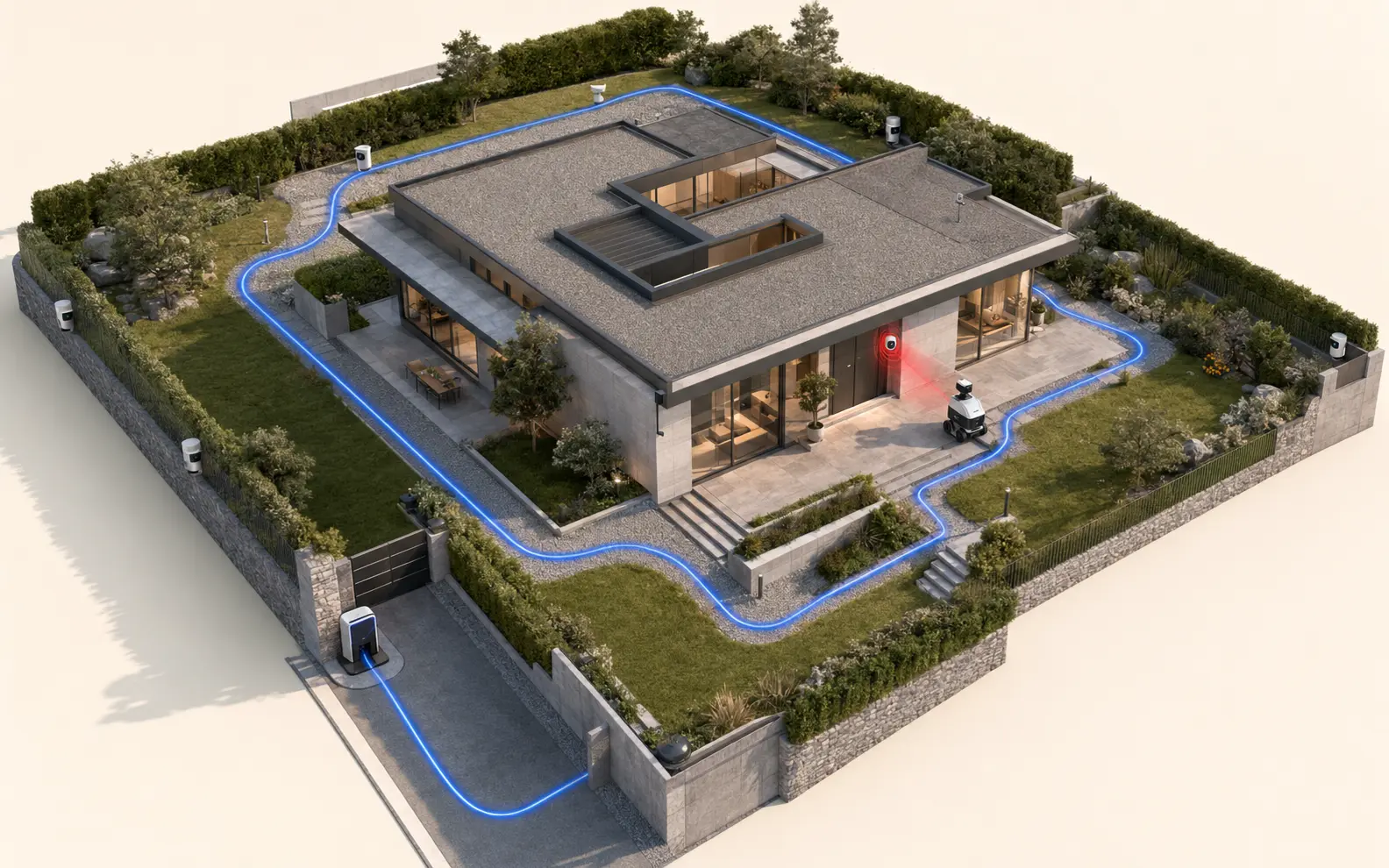
A villa may already have an alarm, opening contacts, cameras and outdoor lighting. The robot does not replace them. It is deployed when the system needs to inspect an area from a different angle.
After movement is detected near an outbuilding, for example, the robot may travel to a predefined observation point and send video so that an operator can distinguish an animal, a displaced object or a person.
A four-stage chain
Value comes from coordination between devices rather than the robot alone.
- A sensor detects an anomaly.
- The system checks context and selects a mission.
- The robot moves to a safe position and gathers information.
- A person or predefined rule determines the response.
For a deeper analysis, read Drone surveillance. When an aerial view may complement a ground robot.
For a deeper analysis, read My Robot Guard technologies. Compare sensors, robots, drones and monitoring.
Which robot formats may suit a villa?
There is no universal model. Four wheels may work well on a stable path. Larger wheels or improved suspension help on paving, gravel and minor unevenness. Very rough ground requires more specialised, expensive and visible platforms.
Criteria that matter more than appearance
Selection should consider turning radius, maximum gradient, ground clearance, traction, rain protection, operating temperature, endurance and spare-parts availability.
The charging station
Regular patrols require a protected docking station with power, reliable connectivity, an unobstructed approach and protection against rain, snow and vandalism.
For a deeper analysis, read Swiss legal framework. Rules to consider before deploying a mobile camera.
The terrain often determines feasibility
Steps, thresholds, gates, pools, gradients, branches and children’s toys are genuine obstacles. The most suitable properties offer continuous routes, identifiable boundaries and limited unexpected change.
Map the zones before choosing a robot
The assessment identifies accessible areas, observation points, alternative paths and places where an unexpected stop would create a hazard. Fixed cameras may remain the better choice for some areas rather than forcing the robot across an obstacle.
Which functions are realistic today?
The most credible functions are patrols along defined routes, travel to a waypoint, broadcasting a message, lighting an area and transmitting sensor data. Understanding a complex situation independently remains far less reliable.
Automation is not general autonomy
An automated system follows precise rules and requests help when it encounters something unexpected. General autonomy would mean understanding the environment and deciding freely without oversight. For dependable villa security, controlled automation is usually preferable.
Plan for practical limitations from the outset
Snow, a branch or a closed door can immobilise a robot. Its camera cannot see through walls, and connectivity can fail. It should therefore remain one layer among several rather than the property’s only protection.
A safe system knows when to stop
Manual takeover, emergency stop, obstacle detection and a safe return to the docking station matter more than a spectacular demonstration. The owner also needs to know which protections remain active while the robot is unavailable.
Frequently asked questions
Can a security robot climb stairs?
Most wheeled patrol robots cannot. The route needs to avoid steps, or the project requires a specialised platform.
How long can a security robot operate?
Endurance varies widely with the platform, terrain, temperature, sensors and speed. Charging infrastructure and mission scheduling are therefore essential.
Does the robot replace the home alarm?
No. It complements fixed sensors and cameras by adding mobility and another means of alarm verification.