This page covers the essential concepts and links to more specialised resources. Capabilities, constraints and rules must always be checked against the relevant site and use case.
What does robotic security actually mean?
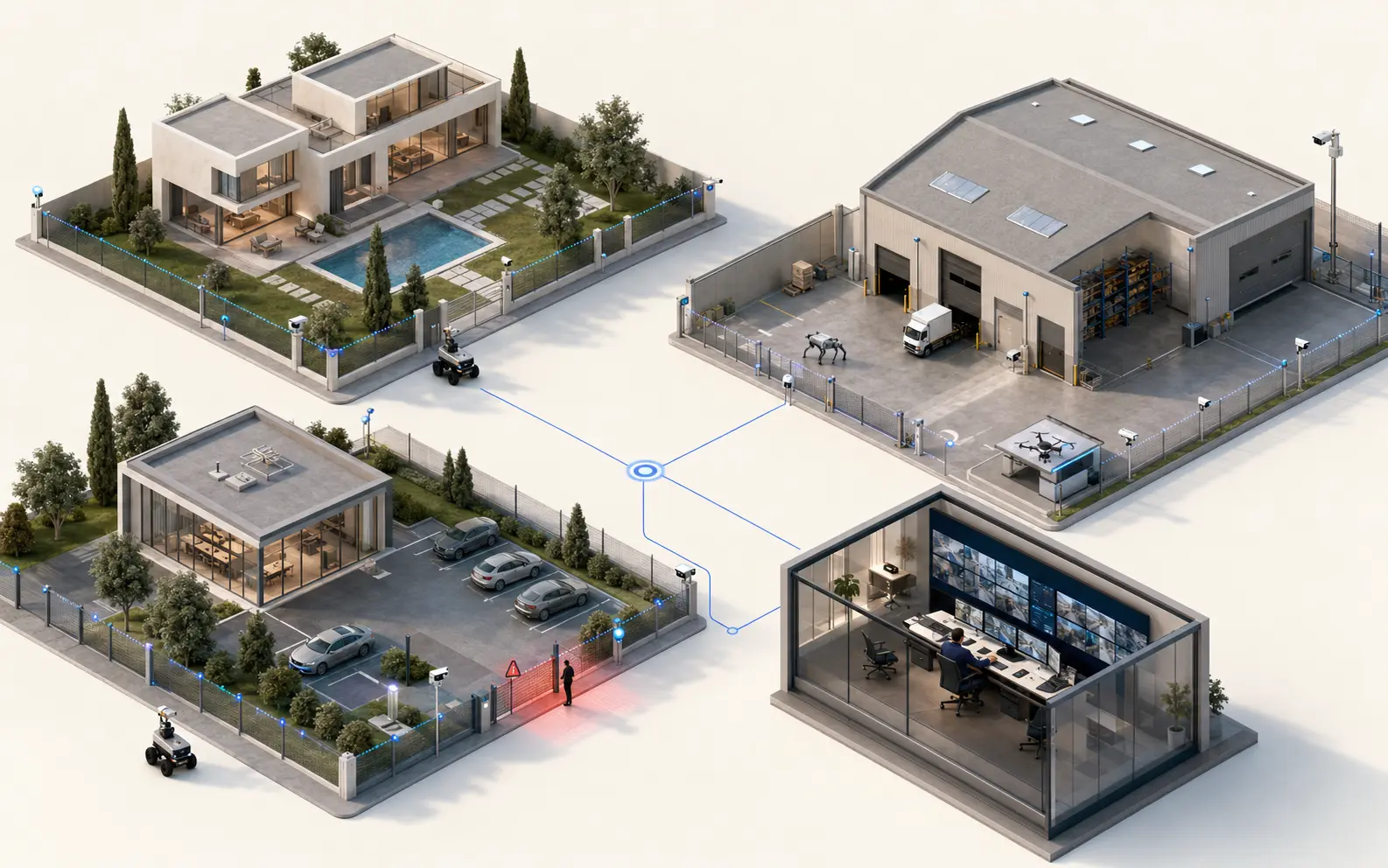
Robotic security brings together fixed sensors, cameras, ground robots or drones, event-correlation software and a human operator. It extends observation across a site, shortens the time needed to verify an alert and documents an event without unnecessarily exposing a person. It complements physical barriers, access control and established procedures; it does not replace them.
A useful system should be easy to explain: detect unusual activity, look for supporting evidence, alert the right person and apply an agreed procedure. Locks, lighting, escalation rules and the availability of an intervention team matter as much as the mobile platform. Occupants, operators, maintenance teams and responders all need to understand this chain.
A coordinated system, not a collection of gadgets
Buying an intelligent camera, a drone and a robot separately does not create coherent protection. Integration must turn notifications into operational events: which sensor reacted, which zone is involved, whether a second source confirms the alert, who should review it and within what time. My Robot Guard selects technologies around the terrain and connects them to human oversight.
- Detect an anomaly as early as reasonably possible.
- Verify the alert through another source or a mobile inspection.
- Assess the risk level before escalating.
- Act under an authorised, documented and reversible scenario.
- Retain only the data that is genuinely necessary.
For a deeper analysis, read Security robots: models, operation and uses. Select a mobile platform around the terrain and mission.
Start with the real risk, not the technology
A serious assessment begins with the events that matter: crossing a fence, night-time presence, a door held open, an unauthorised vehicle, missing equipment, an emerging fire or a technical anomaly. It identifies the likely path, consequences and available response. Without this map, a project may monitor a secondary area while leaving the decisive access point exposed.
Real incidents also show that risk is not limited to someone climbing a fence at midnight. In July 2025, media reports based on information from Vaud cantonal police described home-jackings in Moudon and Echallens. One suspect reportedly posed as a care worker; another wore clothing resembling that of a tradesperson. The cases highlight the importance of front-door procedures, intercom systems and identity checks. They do not prove that a robot would have prevented the attacks. For verification, see Artificial Intelligence Risk Management Framework (NIST), Burglary in Le Vaud and four suspects arrested (Vaud Cantonal Police) and Home-jacking reported in Moudon (Watson / ATS).
Separate prevention, detection and intervention
A fence, lock or access-control system delays entry; a sensor detects an event; an operator interprets it and deploys the appropriate resource. Confusing those functions exaggerates the value of individual equipment. Robotics becomes useful when it closes a real gap: a large property, changing blind spots, distant buildings or an area that would expose a human patrol.
Turn incidents into measurable requirements
For every scenario, define the zone, weather and lighting conditions, detection deadline, confirmation method, recipient, degraded mode and evidence-retention rule. Also state what the system will not do. “Detect a person in the north driveway and present two verification elements to the operator” is more testable than “secure the perimeter intelligently”.
- Which zones and times carry the greatest risk?
- Which ordinary behaviours could create false alarms?
- Who can verify the event and who can intervene?
- Which personal data may be captured?
- What happens when a component is unavailable?
The essential chain: detect, verify, decide and respond
Performance depends on the complete chain, not the number of sensors. Detection that is too sensitive creates noise. Slow verification wastes the value of early warning. A decision without a procedure invites improvisation. Cross-verification is more robust: a vibration sensor reacts, a camera checks for a presence, a robot may provide a second angle, and an operator applies the protocol.
Detect early without recording everything
Perimeter sensors, radar, infrared, opening contacts, thermal imaging and cameras identify different clues. The architecture should choose the least intrusive signal capable of meeting the need. It must be tested with rain, vegetation, animals, reflections and authorised people because thresholds only become meaningful on the actual site.
Verify before escalating
Alarm verification asks three questions: is the event real, is it authorised and what response is justified? An image, second angle, badge or confirmation from a site contact may be enough. AI can prioritise events, but a score is not certainty. The response may be limited to lighting, a voice warning or contacting an operator. A civilian robot informs and deters; it should not chase, restrain or confront anyone.
Use the event trail to improve the system
Each alert should leave a proportionate record: source, time, evidence reviewed, decision, delay and outcome. This reveals overly sensitive sensors, slow procedures and poorly covered areas. Operational metrics can often be separated from identifiable footage, avoiding unlimited retention while preserving the information needed to improve.
For a deeper analysis, read Intelligent video surveillance. Design useful, proportionate alarm verification.
Sensors, robots, drones and AI: a clear role for each component
No technology works everywhere. Fixed sensors provide continuous watch, cameras add context, robots move several sensors, drones reach a distant point quickly and AI sorts signals. An effective architecture combines these strengths without multiplying dependencies.
Ground robots: mobile presence and repeatable inspection
Wheeled robots suit prepared surfaces and stable routes. Quadrupeds can negotiate more obstacles but introduce greater cost and operational complexity. Both require mapping, safe-stop rules, human avoidance, charging and a reliable return path. Payload follows the mission: visible imaging for context, thermal sensors for selected anomalies, lighting or environmental sensors.
ANYbotics, Aker BP and Cognite tested the ANYmal X quadruped for remote inspections on the Valhall offshore platform in 2023. It documents an existing industrial capability; it is not universal proof of security effectiveness or independent validation of every claimed performance. The stated specifications are detailed in Remote robotic inspection on the Valhall platform (ANYbotics).
Drones: speed and height within aviation constraints
A drone can inspect a roof, fence, façade or inaccessible zone quickly. Swiss Federal Railways reports using drones for infrastructure inspection and emergency support. This illustrates the value of an aerial sensor, not permission for permanent autonomous flight. In Switzerland, beyond-visual-line-of-sight operations fall within the specific category and require appropriate authorisation from FOCA. The applicable guidance is set out in Drone flight rules (FOCA), Specific Operations Risk Assessment (FOCA) and Drones at SBB (Swiss Federal Railways).
AI: a useful filter, never an oracle
AI can identify a silhouette, vehicle, direction of travel or thermal anomaly and rank alerts. Reliability varies with the dataset, angle, weather and lighting. Every model therefore needs local evaluation. An uncertain classification should not trigger a serious action on its own, and teams must track missed events as carefully as false positives.
For a deeper analysis, read Surveillance drones: technologies, uses and limits. Understand aerial coverage and operating constraints.
Why human oversight remains essential
Automation performs repetitive tasks well: monitoring a state, following a route or preparing an alert package. Context makes decisions harder. A late courier, neighbour, authorised employee or person in distress can resemble an intrusion. Human oversight must therefore be designed from the start, with prioritised information and clearly permitted actions.
The interface should present an event rather than a wall of video: a site plan, triggering sensor, useful images, uncertainty level, robot status and corresponding procedure. Fifteen unprioritised feeds can reduce vigilance. A good alert package supports judgement without hiding the limits of automated analysis. The applicable guidance is set out in Artificial intelligence regulation (Swiss Federal Chancellery).
Assign responsibilities explicitly
The owner defines the purpose; the integrator designs and tests; the supplier maintains; the monitoring team verifies; and an authorised responder acts. Interfaces, deadlines and responsibility need to be written down. The protocol must allow the status “unverified” when a camera is obscured, a connection is lost or sensors disagree.
Design safe, reversible action
The safest automation limits exposure: illuminate an area, reposition a camera, return a robot to base, notify a person or isolate a compromised component. Decisions concerning an individual, critical access or emergency services require stronger criteria and human validation.
- Present the event, not only the video stream.
- Display uncertainty and sensor health.
- Limit every role to necessary actions.
- Provide escalation, manual takeover and degraded modes.
- Rehearse scenarios regularly with operators.
Adapt the architecture to villas, businesses and industrial sites
The protection chain remains the same, but its scale and priorities change. A villa requires discretion and respect for neighbours. Retail mixes the public, staff and deliveries. A warehouse adds façades, bays, heavy vehicles, moving stock and weak network areas. Copying one sector’s architecture into another creates blind spots.
Villas and luxury residences
Priorities often include the perimeter, entrances, parking and modes for absence, sleep or occupancy. Discreet sensors can trigger verification before someone reaches the façade; a robot may provide a second viewpoint. Routes must respect living areas, animals, children and property boundaries. Deception at the front door is better addressed through intercoms, identification procedures and the ability to alert without opening.
SMEs, retail and offices
The system distinguishes opening hours, contractors, authorised employees and anomalies. Robotic patrols may check doors, technical rooms and car parks after closing. Cameras directed at staff require greater care: the Swiss data-protection authority notes that permanent monitoring of employee behaviour is generally prohibited.
Warehouses, logistics and industry
Large perimeters need layers: fences, gates, buffer areas, bays, stock and plant rooms. A robot repeats patrols on accessible routes; a drone may inspect a roof or distant boundary within aviation rules; thermal imaging can reveal selected anomalies. Security and process alarms must remain clearly separated.
Pilot, cost and value: prove the project on the actual site
A pilot is not a staged demonstration. It is a limited trial during real operating hours and representative conditions. The initial audit records terrain, obstacles, lighting, blind spots, networks, weather, ordinary traffic and personal data that may be captured. The trial measures whether an alert arrives early, whether verification is usable and whether the team can respond.
Test normal events and failures
Acceptance tests should include authorised activity and failure: employee, animal, delivery, rain, network loss, low battery, obscured camera, unavailable docking station and a moved obstacle. Measures include detection, time to a usable alert package, false alarms, availability, manual takeover and evidence quality. Day, night and representative weather all matter.
Deploy in layers
A prudent sequence begins with sensors and monitoring, then adds mobility where it creates additional information. This reveals the value of each layer and prevents premature dependence on new equipment.
- Define two or three priority scenarios.
- Document baseline coverage and limitations.
- Test by day, night and representative weather.
- Train operators before commissioning.
- Base rollout decisions on written criteria.
Measure total cost, not the robot price
Total cost includes assessment, sensors, robot or drone, docking stations, network, integration, monitoring, approvals, maintenance, updates and training. Recurring services should be explicit: hosting, analysed feeds, monitoring hours, updates, support times and data return at contract end. Value is measured in coverage, verification time, false alarms, availability, avoided inspections and human time.
Failure, limitations and cybersecurity: avoid digital blind spots
Obstacles, batteries, ice, gradients or a docking problem can stop a robot. Wind, rain, airspace and endurance constrain a drone. Cameras and networks can fail. The architecture must detect these failures and preserve a minimum level of protection. Connected devices also increase the attack surface, so cyber risk belongs in the original design. The applicable guidance is set out in Cyber resilience of digital products (Swiss National Cyber Security Centre).
Secure the architecture from the outset
Every component needs a managed identity, least-privilege access and controlled updates. Strong authentication, network segmentation, encryption and access logs are foundations. Before purchase, establish support life, patching commitments, third-party dependencies and manufacturer remote access. Contracts should state who receives vulnerability alerts and how quickly fixes are applied. The applicable guidance is set out in Cybersecurity Framework 2.0 (NIST).
Prepare continuity and recovery
A degraded mode should keep fixed sensors operating if the robot stops, buffer events temporarily and permit manual takeover. Configurations and dependencies need backups, and replacement procedures need testing. Most importantly, the interface must show the coverage that is actually available rather than the nominal design. The applicable guidance is set out in Cybersecurity for IoT Program (NIST).
- Network segmentation and multi-factor authentication.
- Signed, planned and tested updates.
- Encryption, logging and access control.
- An inventory of assets, versions and dependencies.
- Continuity plans, backups and recovery exercises.
Swiss rules: protect the site without excessive surveillance
In Switzerland, an image of an identifiable person is personal data. The Federal Data Protection and Information Commissioner expects private video surveillance to be justified, proportionate and transparent, and generally limited to the owner’s property. Access must be restricted and retention reduced to what is necessary. The FDPIC indicates that private footage should generally be deleted after roughly 24 hours, subject to the context. The applicable guidance is set out in Video surveillance by private individuals (FDPIC), Video surveillance of public space by private individuals (FDPIC) and Video surveillance in the workplace (FDPIC).
A camera carried by a robot or drone remains subject to those principles. Employees receive additional protection. For drones, operating category, visual line of sight, geographical zones and authorisations apply alongside privacy law.
Data protection by design
Mask neighbouring areas, record only when necessary, disable unnecessary audio, process locally where appropriate, restrict users and automate deletion. A data-protection impact assessment should be considered where processing is likely to create a high risk. Switzerland does not yet have a general AI act, but existing data-protection law already applies to AI-based processing. The applicable guidance is set out in Current data-protection legislation applies directly to AI (FDPIC).
Legal and operational validation before commissioning
Document the purpose, filmed zones, affected people, retention, recipients, processors and rights. For complex aerial operations, verify FOCA requirements and prepare the required authorisation. Reassess compliance whenever a route, camera, model or purpose changes.
A roadmap from idea to reliable protection
Robotic security is ready to observe large perimeters, repeat patrols, provide a second viewpoint and inspect exposed areas. It does not offer absolute autonomy. Its value appears when it complements physical protection, procedures and human intervention. Every component must connect to a measured risk and a safe operating mode. This case is also reported in Home-jacking reported in Echallens (Blick).
Ten decisions to make before purchasing
Define the priority event, zone, deadline, verification method, operator, response, data, legal basis, degraded mode and success criterion. The assessment turns these decisions into an architecture: fixed detection, useful mobility, human oversight, segmented networks, configured retention, maintenance and a controlled pilot.
- Audit risks, terrain, data and procedures.
- Choose a high-value, low-ambiguity first scenario.
- Design the complete chain through to intervention.
- Test performance, errors and failures.
- Extend only on the basis of documented results.
What My Robot Guard adds
My Robot Guard integrates existing technologies rather than imposing one device. The assessment may conclude that a well-positioned sensor is enough, or that mobility solves a genuine blind spot. A discussion about the site, feared events and existing protection identifies what is possible, permitted and worth testing.
Frequently asked questions
What is a robotic security system?
It is an architecture coordinating sensors, cameras, ground robots or drones, analytics and human oversight. The system detects an event, gathers evidence, presents it to the right person and applies an agreed procedure.
Can a robot replace a security officer?
It can automate selected patrols, carry sensors and inspect an area without exposing an officer, but it cannot replace human judgement, communication and physical response.
Is robotic security suitable for a villa?
Yes, particularly for a large perimeter, multiple entrances or hard-to-see areas. The system must remain discreet, respect neighbours and adapt to children, visitors and animals.
Can a surveillance drone fly automatically in Switzerland?
Not without assessing the operation. Typical drone-in-a-box missions beyond visual line of sight fall within the specific category and require the appropriate FOCA authorisation.
Does AI eliminate false alarms?
No. It can classify events, but performance changes with angle, light, weather and training data. Thresholds require local testing and important decisions need human oversight.
How much does a robotic security project cost?
Cost depends on the perimeter, terrain, network, sensors, mobile platform, integration, monitoring, approvals and maintenance. A limited pilot provides a more meaningful estimate than a catalogue price.
Which Swiss data-protection rules apply?
Private surveillance must be justified, proportionate and transparent. Its field of view should generally stay within the property, access should be restricted and retention kept to what is necessary.
How can a project start with limited technology risk?
Begin with two or three measurable scenarios in a limited area. Audit terrain, data and networks, define human roles and degraded modes, then test day, night and difficult conditions.