This article provides general information. Any real project must be assessed against its site, intended use and the rules in force at the time of deployment.
Robotic security is possible, but existing law still applies
A ground robot patrolling private property is not prohibited in principle. It may carry a camera, thermal sensor, microphone or communication system. The legal question is not limited to the machine itself: the operator must assess what it observes, where it travels, which data it records and which decisions it triggers.
The same reasoning applies to a drone. It may be technically automated, but its operation remains subject to aviation rules. Regular missions around a villa or warehouse must also respect the privacy of neighbours, visitors and employees.
Five frameworks to examine
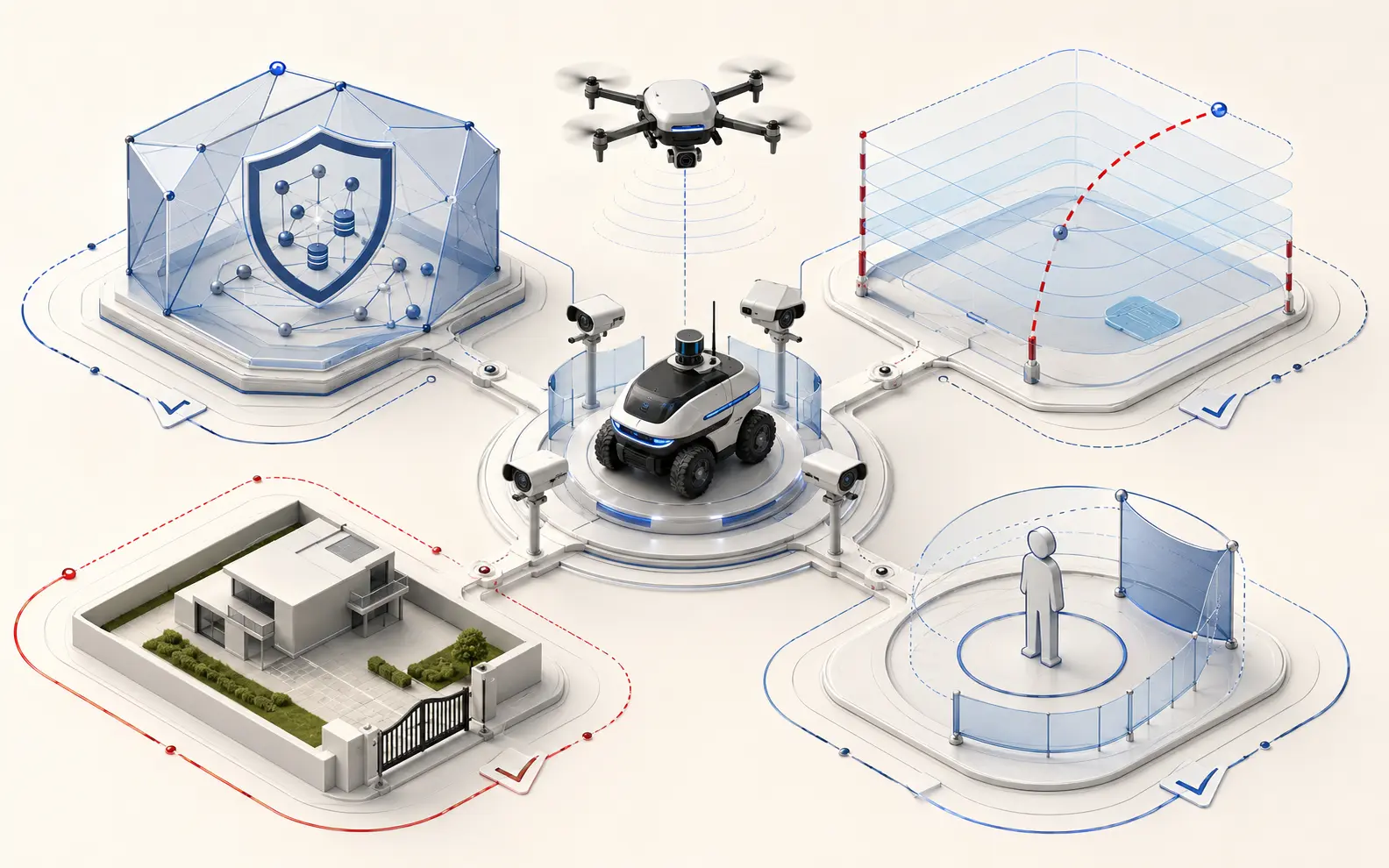
A serious assessment separates the legal questions before bringing them together in one operational scenario.
- The Swiss Federal Act on Data Protection when people are identifiable.
- Video-surveillance rules applying to private individuals or businesses.
- Employment law when employees may be recorded.
- Aviation regulation for surveillance drones.
- Civil liability and safe robot movement on the site.
For a deeper analysis, read Surveillance drones in Switzerland. Aviation rules and the limits of automated patrols.
What a ground robot may do on private property
On a controlled private site, a robot may complete scheduled patrols, travel to an alert, transmit images and report an anomaly. It can carry sensors that would be costly to install at every point of the perimeter.
Technical freedom does not remove the need for exclusion zones, an appropriate speed, safe stopping, degraded modes and a procedure for loss of connection. Children, animals, customers and vehicles materially change the risk assessment.
A mobile camera is still a camera
Mounting a camera on a robot instead of a wall does not remove data-protection obligations. If people can be recognised, personal data is being processed and the field of view must remain proportionate to the security purpose.
The robot should not travel or point its camera towards neighbouring properties. A private security need must not turn into general surveillance of the street.
For a deeper analysis, read Security robots for villas. How mobile residential protection works in practice.
Activities that are usually prohibited or tightly restricted
The FDPIC states that private individuals are generally not entitled to monitor public space. A small section of pavement may sometimes appear when a private entrance cannot reasonably be protected otherwise, but this is a narrow and proportionate exception. For verification, see Video surveillance by private individuals (FDPIC), Video surveillance of public space (FDPIC) and Video surveillance in the workplace (FDPIC).
Public space and neighbours
An owner cannot record an entire street simply to prevent damage. Public security belongs to the authorities, so camera angle, privacy masking and configuration are decisive.
Permanent employee monitoring
A business cannot use the system to monitor employee behaviour. Security surveillance may be permissible only where a less intrusive measure cannot achieve the purpose, employees are informed and the intrusion is minimised.
Fully autonomous aerial patrols
In the open category, a drone must remain within the remote pilot’s direct visual line of sight. Beyond-visual-line-of-sight operation, typical of an unattended drone-in-a-box patrol, normally falls within the specific category and needs an appropriate FOCA procedure or authorisation. For verification, see Drone flight rules (FOCA) and Introduction to the specific category (FOCA).
Build data protection into the design
Compliance is not achieved by adding a sign after installation. Purpose, field of view, retention, access and information security must be decided before commissioning.
Purpose, proportionality and transparency
Define a specific purpose, such as protecting an entrance or verifying a night-time alert. People who may be recorded should understand that surveillance takes place and be able to identify the controller.
- Limit cameras to genuinely sensitive areas.
- Avoid continuous recording when event-based activation is sufficient.
- Restrict access to people who need it.
- Set a short, justified retention period.
- Document automated scenarios and human decisions.
For a deeper analysis, read Video surveillance and data. Design a proportionate and transparent system.
A realistic method for launching a project in Switzerland
Begin with a concrete risk. Map the site, affected people and ordinary movements, then choose the least intrusive technology able to address the scenario.
A limited pilot measures false alerts, verification quality, navigation safety and acceptability. Drone operations need a separate aviation workstream, and functions that cannot run in the open category should never be marketed as immediately available.
The decision matrix
For each function, answer four questions: which risk does it address, which data does it collect, who controls the action, and what happens if it fails? If one answer remains unclear, the function is not ready for deployment.
Frequently asked questions
Do you need authorisation to use a ground security robot?
There is no general federal authorisation for a ground robot on private property. The project must nevertheless comply with safety, civil-liability, data-protection and site-specific requirements.
May a private individual film the street outside a villa?
Generally no. The FDPIC accepts only narrow exceptions where a small area of public space cannot reasonably be excluded.
Can a drone launch by itself to follow an alert?
That depends on the scenario. If the flight is beyond visual line of sight, it does not fall within the open category and needs a framework under the specific category.