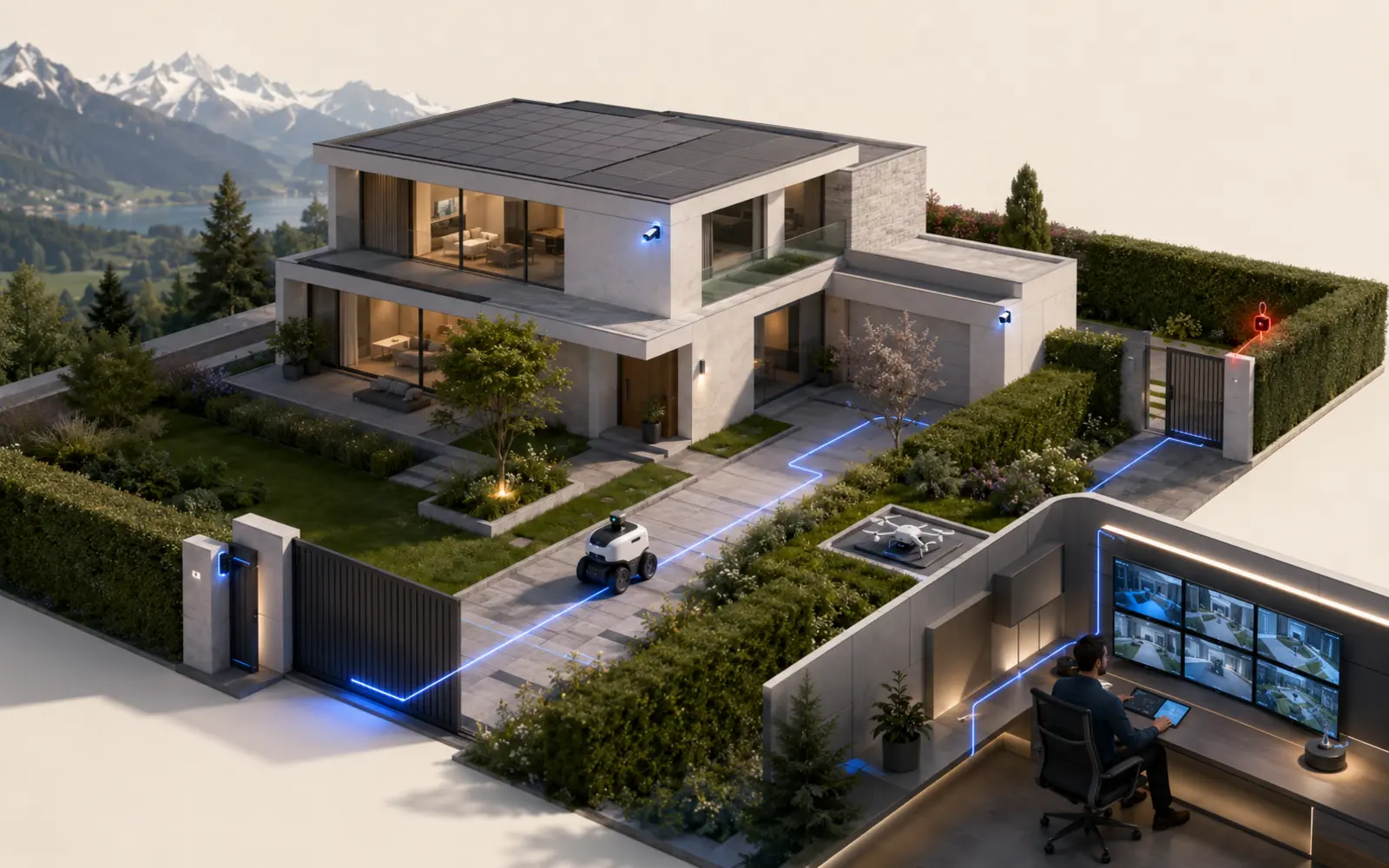
This page covers the essential concepts and links to more specialised resources. Capabilities, constraints and rules must always be checked against the relevant site and use case.
Villa protection in ten seconds
Effective robotic security works as a chain: sensors detect a crossing or opening, lighting makes the scene legible, cameras provide context, a ground robot supplies another viewpoint where useful, then an operator assesses the alert and follows the agreed response procedure. A drone may complement the system on some large properties, but it is neither essential nor automatically free to fly.
This architecture primarily protects time: detecting someone before they reach the house, verifying an alert without sending an occupant outside and giving a responder actionable information. It cannot guarantee that no intrusion will occur and replaces neither resistant doors, prudent habits nor the police. Properly designed, it is almost invisible in daily life and intensifies only when corroborating signals appear.
A simple chain, even when the technology is advanced
Residents should not have to operate five applications. A good system turns equipment outputs into four understandable states: normal, uncertain and requiring verification, probable threat, and confirmed incident. Each state permits defined actions, from targeted lighting to contacting emergency services. This orchestration, more than the number of cameras, separates coherent protection from a collection of gadgets.
- Detect on the approach route.
- Correlate evidence before deciding.
- Give the operator useful context.
- Deter without confrontation.
- Return to a safe state.
For a deeper analysis, read Robotic security: complete guide. Understand the complete architecture from detection to response.
For a deeper analysis, read Industrial and logistics site security. Extend protection to large perimeters and technical zones.
Burglary and home-jacking: two scenarios, two priorities
Burglary generally targets an unoccupied home; home-jacking is a violent intrusion into an occupied home involving threat or coercion. The Canton of Geneva associates the latter with robbery under Article 140 of the Swiss Criminal Code. In 2025, the canton recorded 18 home-jacking cases, compared with 15 in 2024, while reporting fewer villa burglaries. These figures describe one canton, not an individual risk or a uniform Swiss trend. This case is also reported in Crime in Geneva in 2025 (Canton of Geneva) and Violent burglary in Yverdon (SWI swissinfo.ch).
During an absence, priorities are delaying forced entry, detecting, verifying and preserving traces. When the family is home, people come before property: discreet alerts, the ability to seek shelter, clear communication and no confrontation. A robot must never chase, block or provoke an intruder. Its possible contribution is remote observation and better information.
Three Swiss cases, three practical lessons
According to Le Temps, a Geneva trial that opened in April 2025 concerned, among other events, an attack committed in Cartigny in February 2023. As the newspaper reported from the indictment, the perpetrators had conducted reconnaissance, waited for an occupant to return, then assaulted the couple in an attempt to gain access to a safe. The alarm sounded later and the suspects fled. A cautious lesson is that the route from gate to parking and front door matters as much as the windows. This case is also reported in A trial lays bare the violence of home-jackings (Le Temps).
In Yverdon-les-Bains, Vaud Cantonal Police reported that a 95-year-old woman was threatened and tied up in her villa in December 2025. She managed to use her Secutel device; the on-call doctors’ centre alerted law enforcement, which coordinated a search and made arrests. The documented point is the value of an accessible call device and a responsive human chain. The outcome cannot be attributed to robotic technology. The applicable guidance is set out in Arrests after a violent burglary in Yverdon-les-Bains (Canton of Vaud) and Request a security assessment (Canton of Vaud).
In Nyon, the Vaud public prosecutor reported that in May 2026 several masked people entered an occupied home at around 8.30 am, threatened the family and forced someone to open a safe. The event shows that an attack may happen in the morning as the gate opens and the household starts its day. None of these cases proves that a robot would have prevented the events; they are useful for testing realistic scenarios. This case is also reported in Robbery at a family home in Nyon (Canton of Vaud) and Nyon family forced to open their safe (SWI swissinfo.ch).
- Assess arrivals by car, deliveries and service providers.
- Make a discreet alarm available from several rooms.
- Keep the safe separate from immediate personal safety.
- Do not publish absences, routines or valuables.
- Rehearse the rule: seek safety, do not confront, call 117.
For a deeper analysis, read Surveillance drones: complete guide. Assess the value and operating framework of an aerial sensor.
Protect the approach before defending the façade
The best opportunity to understand an unusual presence is before it reaches the door. A site assessment follows routes that can actually be used: gate, driveway, pedestrian entrance, garage, terrace, slope, waterside, outbuilding and access from neighbouring land. It also records obstructions such as dense hedges, walls, parked vehicles and changes in level. The security plan then divides the property into zones instead of relying on one boundary.
The first zone observes without recording unnecessarily, using a gate contact, suitable detector, infrared beam or carefully oriented radar. The second adds context with a camera and targeted lighting. The third protects the envelope with locks, glazing, shutters and opening contacts. Inside, an accessible alert and a professionally selected safe area complete the plan. Each layer must still work when the preceding one is bypassed.
A welcoming home by day, a more attentive one by night
Modes must reflect real life: daytime presence, an evening in the garden, sleep, a short absence, holidays and a contractor’s visit. A camera that activates constantly while children play will eventually be ignored. Conversely, disabling the entire perimeter when one authorised person enters creates an unnecessary window. Zones, schedules and access profiles preserve discreet protection without treating occupants as anomalies.
Lighting first supports visibility and safe movement. Soft light may accompany a resident’s arrival; a local increase can then improve the image and show that movement has been detected. Floodlighting the whole property at every motion disturbs neighbours, tires residents and reduces the significance of a genuine alert. Graduated deterrence is more credible.
Neighbours are a resource, not a surveillance zone
Bern Cantonal Police recommends good neighbourly relationships, informing trusted neighbours about absences and simulating occupancy with programmed lighting. These simple measures complement technology. Clear rules are still required: a trusted neighbour knows whom to contact but is not invited to confront anyone or watch camera feeds. Discretion also protects against the accidental disclosure of family routines. The applicable guidance is set out in Burglary prevention (Bern Cantonal Police).
For a deeper analysis, read Intelligent video surveillance. Understand video analytics, alert verification and personal data.
Sensors, cameras and AI: confirm without spying
A sensor does not need to identify someone to report that a gate opened, vibration occurred or a presence crossed a zone. This restraint benefits both privacy and reliability. A camera is used when an image answers a practical question: is it a family member, an expected courier, an animal or someone advancing towards the house? Artificial intelligence may sort these clues, but must never turn probability into certainty.
Cross-checking reduces noise. A moving branch may trigger local analysis, but cannot alone justify escalation. A boundary crossing, persistent trajectory and opening contact make a stronger case. Thresholds need testing on the property in rain and fog, with headlamps, shadows, seasonal work and moving vegetation. Unnecessary alerts and missed events must be tracked together.
Animals, children and staff: learn the home’s context
Cats, dogs, deer, foxes and birds move at different heights and along different routes. Configuration combines exclusion zones, apparent size, direction and confirmation from another signal. Zero false positives is not a credible promise; the goal is a manageable level with a quick closure procedure. Authorised people need an easy way to indicate their presence without being continuously tracked.
AI should help the operator prioritise and display uncertainty. An alert marked “probable person” still requires verification, especially when a face is covered, the scene is dark or the angle poor. Models and rules are retested after hedge cutting, new lighting, a camera change or software update. This discipline, rather than a label such as “smart”, creates quality.
Swiss privacy: camera coverage ends at the property
The FDPIC states that private video surveillance should generally be limited to the owner’s property, remain proportionate and transparent, restrict access and retain images only as long as needed; as a rule, it refers to deletion after 24 hours. Neighbours and public space must not be included except in narrowly limited circumstances. Privacy masks, physical framing, disabled microphones and access logs are therefore design choices. The applicable guidance is set out in Video surveillance by private individuals (FDPIC) and Video surveillance of neighbouring property (FDPIC).
Security does not justify permanent recording in living spaces. Exterior cameras can face access points while family areas remain outside the frame. Recordings connected with an offence go to the authorities, not social media. A short notice explains purpose, zones, recipients, retention and the process for exercising a right of access.
For a deeper analysis, read Security robots: complete guide. Compare platforms, missions, sensors and limits.
The ground robot: investigate without sending someone outside
A villa security robot is a mobile sensor platform. In response to an alert or on a scheduled patrol, it can travel to an authorised point, provide another video angle, add local lighting and report its condition. Its value is clearest on a large property with a long drive, several buildings or changing blind spots. On a small, heavily planted plot, well-positioned fixed sensors may be simpler and more effective.
Mobility does not mean complete autonomy. The robot follows mapped routes, observes speed limits and stopping areas, avoids people and returns to a protected station. It must stop when an obstacle, positioning loss or degraded communication makes a mission uncertain. It observes and reports; it carries no weapon, intercepts nobody and replaces neither a guard nor the police.
The terrain decides before the specification sheet
Slopes, gravel, steps, snow, wet leaves, irrigation, gate thresholds and movable furniture all change feasibility. A route open in July may be unavailable in January. The assessment measures passages, identifies a retreat route and defines weather stop conditions. The charging station must remain accessible, ventilated, protected from moisture and connected to backup power appropriate to the expected service level.
Dogs need particular care. Introduce the robot gradually under supervision, using a route away from food, bedding and play areas. Suspend missions while children or guests occupy the route. Discreet signage and an immediate-stop procedure allow household staff and gardeners to work without surprise.
A useful patrol answers a question
“Go around the garden” is too vague. A useful mission checks whether the side gate is closed, whether someone remains by the garage or whether the pavilion alarm corresponds to a presence. The route, observation points, expected time and completion criterion are defined in advance. The case shown to the operator places fixed and mobile sensor evidence on the same timeline.
For a deeper analysis, read Robotic security for businesses. Apply the same principles to shops, offices and SMEs.
A drone is an option, not a requirement
A drone can quickly reach a roof, distant boundary or terrain made inaccessible by relief. On a large isolated property, it can occasionally provide an angle unavailable from the ground. Noise, wind, rain, trees, people, airspace and privacy all restrict its use, however. For many residential projects, ground robots and fixed cameras offer more predictable availability.
In Switzerland, FOCA rules for the open category include a maximum altitude of 120 metres, keeping the drone in direct visual line of sight and respecting distances from people. Beyond-visual-line-of-sight operations fall within the specific category and require the applicable authorisation or procedure. Operators generally need to register when a drone carries a camera, including many devices below 250 grams. The applicable guidance is set out in Rules applicable to drone flights (FOCA) and Introduction to the specific category (FOCA).
Take-off must remain a controlled decision
Before adding a drone, check the restriction map, proximity to aerodromes, remote-pilot competence, weather, the emergency landing area and the presence of third parties. An automated station removes none of these obligations. A security flight around a villa must not fly low over neighbouring land or record its occupants without their knowledge.
The failure scenario matters as much as the normal mission: loss of link, low battery, positioning error, unexpected people or a blocked landing area. The aircraft follows a validated procedure and does not improvise a route. If conditions are outside the approved operating domain, the mission is refused and fixed or ground-based protection remains active.
Oversight and response: technology prepares, people decide
A useful alert arrives as a case: zone, time, triggering sensor, relevant images, expected people, robot state and uncertainty. The operator checks whether the event is real, authorised and serious enough to escalate. They may request another angle, activate lighting, contact the resident or trigger the agreed procedure. Software accelerates this review; it does not decide by itself that someone is hostile.
The response should be written before the incident. An uncertain outdoor presence may lead to observation and a remote message. A confirmed break-in while residents are away calls for alert and response without an improvised entry. If residents are present, they should seek safety and avoid confrontation. Authorities and authorised responders act only within their legal powers.
Degraded operation reveals the system’s quality
An internet outage must not make doors unusable. A robot failure must not disable fixed sensors. Backup power, a secondary link, limited local recording, manual control and fault notification maintain essential functions. The system clearly reports what it can no longer see; it must never present an unobserved area as safe.
Contacts are prioritised: principal occupant, designated trusted person, monitoring centre, responder and emergency services. Numbers, codes and authorisations are reviewed after a move, staffing change or long absence. Short exercises confirm that the discreet alert works, the operator receives the right context and everyone knows their role.
- No automatic or physical confrontation.
- Human validation before significant escalation.
- Timestamped log of alerts, decisions and image access.
- Distinct procedures for absence, sleep and active presence.
- Call 117 or 112 in an emergency under the agreed criteria.
For a deeper analysis, read Artificial intelligence and surveillance. Understand classification, uncertainty and human oversight.
Pilot the project before equipping the entire property
Cost depends less on a generic floor area than on topography, access, network, oversight level, integration work and expected availability. Whole-life cost includes the assessment, possible civil works, equipment, software, connectivity, monitoring, response, servicing, batteries, updates and planned replacement. A quote covering hardware alone cannot compare two architectures.
A pilot limited to one priority zone avoids misdirected spending. Over several weeks and under varied conditions it measures relevant alerts, false positives, verification time, equipment availability and occupant acceptance. The goal is not a flawless demonstration but controlled discovery of constraints: a blind spot, unstable Wi-Fi, impassable route or slow procedure.
Write success criteria before installation
Start with authorised scenarios such as a night-time crossing at the side gate, an expected vehicle, an animal on the drive, network loss and activation from a bedroom. For each, define what should be detected, what the operator sees, the target time and the response. Treat test images as real data with agreed access and retention.
Expand only after weaknesses are corrected. This may mean adding a sensor, moving a camera, simplifying a patrol or dropping the drone. The option to reduce the system is healthy: the optimum solution covers priority risks with the least reasonable complexity, intrusion and maintenance.
- Map risks and family use.
- Test by day, night and season.
- Measure unnecessary alerts and missed events.
- Validate procedures with responders.
- Calculate total cost over several years.
Maintenance, cybersecurity and lasting trust
A hedge grows, a camera gets dirty, a battery ages and a password sometimes circulates for too long. Real protection is the maintained system, not the one accepted on installation day. A schedule covers cleaning lenses, testing sensors, checking batteries and backup supplies, inspecting stations, reviewing accounts and exercising procedures. Every garden or building alteration triggers a targeted reassessment.
Connected equipment is separated from the family network where possible, with individual accounts, stronger authentication, minimum permissions, managed updates and logging. Temporary installer access is removed after work. Backups mainly concern configuration and procedures; retaining more footage does not automatically improve security and increases exposure after unauthorised access.
A restrained dashboard keeps residents in control
A few indicators are enough: component availability, confirmed alerts, unnecessary alerts, verification time, interrupted missions, pending updates and privacy incidents. A quarterly review identifies drift, while an annual test replays priority scenarios. Logs should explain who viewed what and why without becoming continuous surveillance of domestic habits.
The contract defines the roles of controller, maintenance provider, monitoring centre, host and responder. It sets repair times, degraded modes, data return and exit arrangements. This reversibility protects against obsolescence and makes it possible to replace one component without rebuilding the architecture.
For a deeper analysis, read Swiss robotic surveillance regulations. Explore data protection, drones and responsibilities.
A well-protected villa does not look watched; it is prepared
High-end protection is not measured by an impression of force. It consists of early detection, the right image at the right time, a robot moving only when it adds information, an operator who understands the situation and a response already organised. Residents continue to welcome guests, enjoy the garden and entrust the house to others without bypassing the system.
The starting point remains an on-site assessment of routines, risks, terrain, neighbours, animals, network, legal framework and response capacity. My Robot Guard can then assemble useful layers, test them in a pilot zone and document their limitations. The reasonable promise is not “no intrusion”; it is a villa that is harder to approach unnoticed, an alert that is better verified and people better prepared to respond.
Your next decision
Begin with three scenarios: a night-time approach, access while the family is home and a communications outage. If the proposed system cannot explain simply what it detects, who verifies and who acts in each case, it is not ready. A My Robot Guard assessment turns these questions into a coverage plan, measurable pilot and everyday procedure.
Frequently asked questions
Can a security robot prevent a home-jacking?
No robot can guarantee that a violent intrusion will be prevented. It may detect an approach, provide another angle and avoid an occupant going outside to investigate. Protection also relies on physical access, a discreet alarm, family procedures, human oversight and response. The robot must never chase or confront anyone.
Should cameras cover every part of the villa perimeter?
No. Cameras should answer specific questions and face access points or protected areas. Contacts, radar and detectors can report an event without identifying people. In Switzerland, coverage should generally remain within the property, collection be proportionate and people be informed. Family areas, neighbours and unnecessary sections of road stay outside the frame.
How can false alarms caused by animals be reduced?
Configuration combines zones, height, apparent size, direction, schedules and confirmation by another sensor. The cat’s, dog’s or wildlife’s usual routes are observed during the pilot. Track both unnecessary alerts and missed events. Zero false positives is not a credible promise; fast verification remains essential.
Can a drone patrol automatically around a Swiss property?
Not without assessing the operation precisely. In the open category, FOCA requires, among other rules, direct visual line of sight, a maximum height of 120 metres and respect for third parties. Beyond-visual-line-of-sight flight falls within the specific category and needs the applicable authorisation or process. Local restrictions, privacy, weather, noise and emergency landing may make a fixed camera or ground robot preferable.
What happens if internet access or power fails?
Essential functions should enter a degraded mode: backup power, local detection, a secondary link where needed, limited recording and manual control. Doors and exits remain usable independently of the cloud. The centre and residents are told about lost coverage. A robot failure must never disable fixed sensors or conceal the system’s true state.
How much does robotic security for a villa cost?
Cost depends on terrain, access, network, works, equipment, oversight and required response. Compare the total cost of assessment, installation, software, connectivity, maintenance, batteries, updates and response. A pilot in a priority zone measures value before expansion and may justify simplifying the architecture.
Do neighbours need to accept the cameras and robot?
The system should remain within your property and avoid observing neighbours. If a shared area or right of way may be recorded, the FDPIC recommends consulting affected people and seeking a proportionate solution. Privacy masks, restricted angles, disabled microphones and internal routes reduce the impact. Clear neighbourly relations also strengthen prevention.
Where should an existing villa security project start?
Begin with an assessment of access points, routines, approach routes, safe areas, network and response capacity. Choose three to five measurable scenarios, then test a pilot zone with physical protection, sensors, a camera and human oversight. Add a robot or drone only where it closes an identified gap. Full deployment follows validation of alerts and procedures.