This page covers the essential concepts and links to more specialised resources. Capabilities, constraints and rules must always be checked against the relevant site and use case.
ANYmal is not primarily a robotic security guard
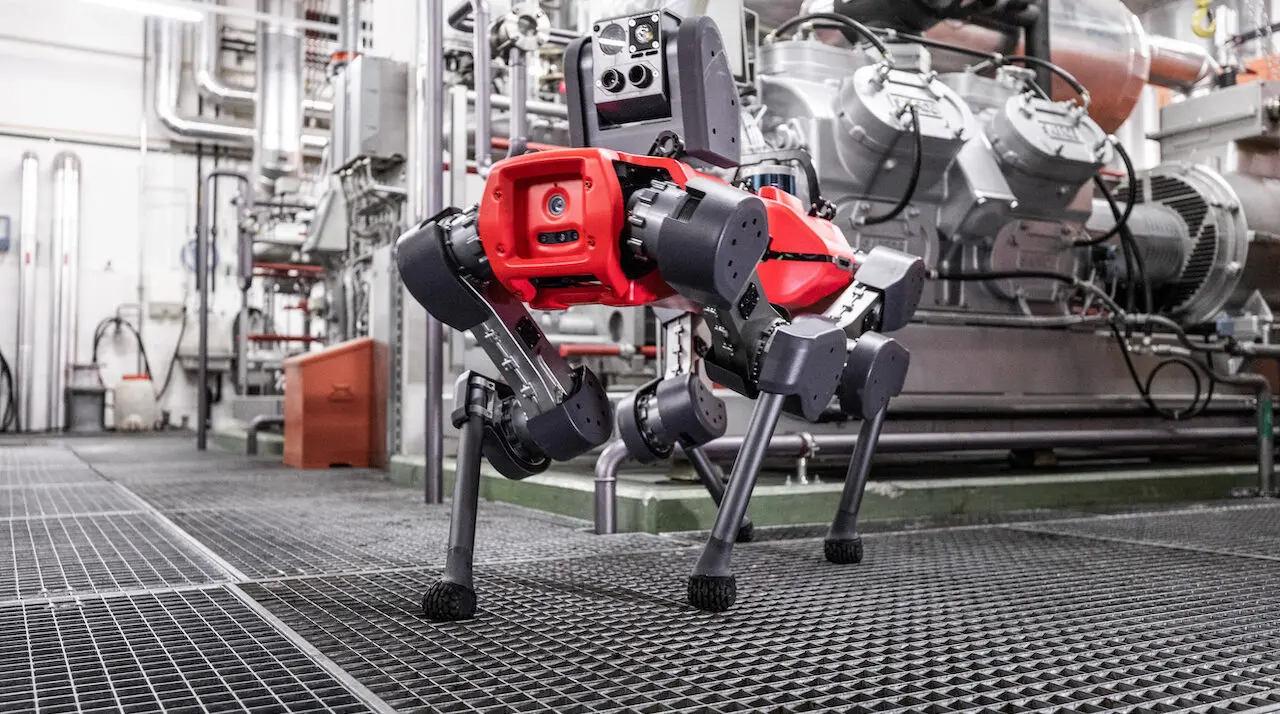
ANYmal is developed by the Swiss company ANYbotics as an autonomous inspection robot for industrial environments. Its core mission is to move through plants, energy facilities, mines and other complex sites while collecting repeatable visual, thermal and acoustic measurements. For verification, see Official ANYmal presentation (ANYbotics).
That distinction matters. A platform designed for inspection can contribute to security by observing access points, reaching an alarm location or providing an additional camera view. It does not automatically include the complete alarm management, deterrence, monitoring and intervention service expected from a dedicated security system.
The most credible projects use ANYmal where inspection and safety already justify frequent missions. Security then becomes an additional layer on a platform that is present, maintained and integrated into operations. Buying such a sophisticated quadruped solely to check one gate each night would rarely be proportionate.
ANYbotics has published industrial case studies showing remote and autonomous inspection. These examples provide stronger evidence than a laboratory demonstration, but every customer must still validate its own route, payload, interfaces and operating conditions.
Why a quadruped can create value in industry
Industrial routes often include stairs, grated floors, thresholds, narrow passages and uneven ground. A wheeled robot may be more efficient on a smooth logistics yard, but it cannot always reach equipment spread across several levels. Four articulated legs allow ANYmal to adapt its support points and maintain stability across more demanding terrain.
Mobility is only useful when the robot carries the correct sensors. A visible camera may read a gauge or record an asset. Thermal imaging may reveal an apparent temperature difference. Acoustic analysis may identify a changing sound signature. Gas sensors can measure selected substances when the payload and calibration support that mission.
The robot should connect every observation to an asset, location, time and reference. A useful alert is not simply an image labelled abnormal. It should allow a technician to review the source measurement, compare it with history and decide whether maintenance or further investigation is required.
For security, the same navigation can take the robot to a door, fence or isolated room after an alarm. An operator receives the context without entering an uncertain area immediately. Fixed sensors remain essential because the quadruped cannot observe every place at once.
For a deeper analysis, read Security robots. Compare mobility and operating models.
ANYmal and ANYmal X are not the same configuration
ANYbotics offers configurations intended for different industrial requirements. ANYmal X is positioned for inspection in potentially explosive environments and carries certifications relevant to hazardous locations. Those certifications apply to defined equipment configurations and conditions; they should never be generalised to every accessory or modified payload.
A customer must begin with the zone classification, substances, temperature, required measurements and applicable standards. Adding an unapproved camera, radio or sensor can change the certification basis. The integrator and site safety specialists need to review the complete configured system rather than relying on the robot’s model name.
For an ordinary warehouse or outdoor perimeter, a hazardous-area configuration may add cost without value. For oil and gas, chemicals or certain energy facilities, the ability to operate in controlled hazardous zones may be central. This is why product selection follows the operating scenario rather than the other way around.
The same principle applies to autonomous features. A stated capability may depend on software licences, mapping, connectivity or an additional payload. The contract should list precisely which functions are included, which need engineering work and which remain subject to site acceptance.
For a deeper analysis, read Industrial solutions. Design a system around site constraints.
Operational constraints remain significant
A quadruped requires route preparation, mapping, charging, maintenance and supervised exception handling. Doors may need automation, lifts require integration and temporary works can invalidate a planned path. A person must be able to recover the machine safely when autonomy reaches its limit.
Battery life depends on terrain, payload, temperature, computing and mission duration. The relevant indicator is not the best laboratory endurance but the number of useful checkpoints completed between charges. The docking strategy must also preserve access for technicians and keep the robot protected when idle.
Connectivity can fail behind metal structures, underground or inside process buildings. The robot needs a safe response to lost communication and should not depend on continuous cloud access for every basic movement. Recorded data must synchronise reliably once the connection returns.
Safety around people, vehicles and machinery needs a formal analysis. The robot’s speed and route should adapt to shared areas. Workers need to understand its signals and emergency stop procedure. A technically successful mission that creates confusion or interferes with production is not an operational success.
Data, cybersecurity and employee monitoring
ANYmal can build detailed maps and collect images, thermal readings, sounds and equipment information. These data may reveal production processes, asset condition and site layout. They should be classified and protected as operational information, not treated as ordinary camera footage.
The architecture should separate the robot network from critical industrial control systems. Named identities, strong authentication, encrypted communications, controlled software updates and protected logs are basic requirements. Supplier access should be granted for a defined purpose and duration, then reviewed.
When employees are identifiable, Swiss data-protection and workplace rules apply. Inspection routes should avoid unnecessary observation of workstations and break areas. Data collected to check equipment or protect a perimeter should not later be reused to evaluate individual performance. For verification, see Video surveillance in the workplace (FDPIC).
The customer should document hosting, subprocessors, export formats, retention and deletion. It should also plan how to retrieve mission history if the service ends. Operational continuity requires access to the customer’s own measurements and evidence without permanent dependence on one dashboard.
For a deeper analysis, read Industrial-site security. Connect mobile inspection to layered protection.
Our view: a major industrial platform for the right mission
ANYmal is one of the most credible industrial quadrupeds available. ANYbotics combines Swiss robotics expertise, a product designed around autonomous inspection and documented deployments in demanding sectors. Its value is strongest where frequent measurements and difficult access already create a clear business case. For verification, see Industrial deployments and customer stories (ANYbotics).
For straightforward security patrols on smooth ground, a wheeled platform such as Ascento Guard, Argus S5 or OTSAW O-R3 may be easier to operate. For broad quadruped integration, Boston Dynamics Spot, DEEP Robotics X30 and Unitree B2 provide alternatives with different ecosystems and commercial models.
A pilot should include actual stairs, doors, wireless shadows, personnel movements and representative sensors. The customer should measure mission completion, manual interventions, data quality, anomaly confirmation, charging and time saved for technicians or security teams.
The final decision is not a contest of robot agility. It is a comparison of complete services: reliable missions, useful measurements, integration, local support, cybersecurity and total operating cost. ANYmal deserves serious consideration when these requirements align with complex industrial terrain.
Frequently asked questions
Is ANYmal a security robot?
ANYmal is primarily an industrial inspection platform. It can support security missions when equipped and integrated for alarm verification or patrol observations.
Can ANYmal climb stairs?
Its quadruped mobility is designed for stairs and uneven industrial terrain, but the exact route must be tested under real operating conditions.
What is ANYmal X?
ANYmal X is a configuration intended for certain hazardous and potentially explosive environments. Certification scope and payload compatibility must be verified.
Does ANYmal replace an inspector or security officer?
No. It automates selected data-collection missions, while qualified people interpret results, make decisions and intervene.