This page covers the essential concepts and links to more specialised resources. Capabilities, constraints and rules must always be checked against the relevant site and use case.
Spot is a mobile platform, not a ready-made security service
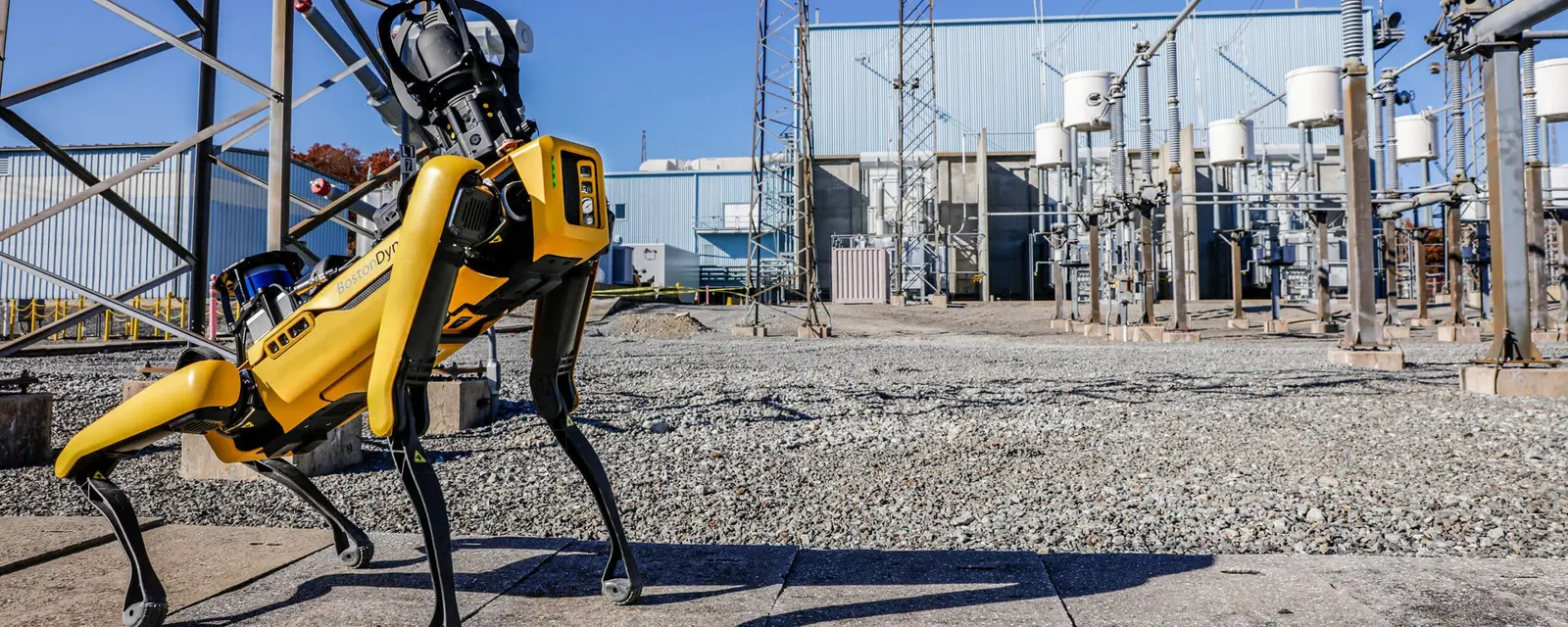
Boston Dynamics Spot is a four-legged robot designed to move through environments built for people and industrial operations. It can climb stairs, cross uneven surfaces and carry different payloads. The platform is highly visible in robotics, but recognition should not be confused with a complete security product. For verification, see Official Spot product page (Boston Dynamics).
A working solution may combine Spot, cameras or specialist sensors, autonomous navigation software, the Spot Dock, network connectivity, an operator interface and integration with the customer’s systems. Each component affects reliability. Purchasing the robot alone does not produce alarm verification, incident management or a maintained patrol service.
Spot’s broad ecosystem is one of its strengths. Integrators and customers have adapted it to thermal inspection, acoustic imaging, gauge reading, three-dimensional capture and hazardous-area reconnaissance. Security can use the same mobility to reach an alarm location or patrol selected checkpoints.
The correct starting point is a mission statement: what information must be collected, from which location, how often and what decision should follow? Without that definition, Spot risks becoming an impressive demonstration rather than a productive operational tool.
For a deeper analysis, read ANYmal. A Swiss platform focused on industrial inspection.
Autonomous inspections already have documented applications
Boston Dynamics and its customers have documented Spot deployments in energy, manufacturing, construction and other industrial settings. Typical missions include capturing thermal images, reading analogue instruments, detecting changes and creating repeatable records without sending a person into every area. For verification, see Spot use cases and customer stories (Boston Dynamics).
The Spot Dock supports repeatable missions by providing a protected charging location and a known starting point. The robot can leave, follow a configured route, gather data and return. Practical autonomy still depends on doors, route changes, connectivity and a safe method for recovering the robot when an exception occurs.
Repeatability is often more valuable than raw agility. If Spot captures the same asset from a similar position every day, software and engineers can compare trends. A one-off image from an unusual angle may be visually impressive but less useful for maintenance.
For security teams, a documented autonomous route proves that the platform can move and collect observations. It does not prove that it can classify every person or detect intent. Security analytics and escalation procedures require their own validation.
For a deeper analysis, read Industrial sites. Design a complete operating architecture.
Credible security uses for Spot
A realistic use is remote alarm verification. A fixed sensor detects movement or an open door, and Spot travels to a predefined observation point. The operator reviews visible and thermal images before deciding whether to dispatch a person. This can reduce exposure and improve the information available to responders.
A second use is a scheduled patrol combining security and technical checks. The robot observes access points, records an equipment reading and checks a thermal reference during the same mission. Sharing the platform across departments may strengthen the economic case, provided access to data remains separated by purpose.
A third use is reconnaissance after a suspected incident. Fire, gas, structural damage or an unknown person may make immediate entry undesirable. Spot can provide an initial view while professionals plan a safe response. The robot supplements emergency procedures; it does not certify that an area is safe.
Fixed cameras, perimeter sensors and human response remain necessary. Spot cannot be at every point simultaneously and may be charging, maintained or blocked. A resilient architecture continues to detect and escalate when the mobile platform is unavailable.
Spot Arm does not turn the robot into an autonomous officer
Spot Arm adds manipulation. It can interact with selected objects, open certain doors, operate handles or position sensors when the task is engineered for the environment. This capability may extend inspection and emergency work, but it also increases complexity and risk.
Manipulation should be limited to approved tasks with known forces and clear exclusion zones. A failed grip, unexpected person or modified door can change the situation. Remote supervision and an emergency-stop process remain essential.
Security projects should avoid using the arm to restrain, confront or pursue people. Such behaviour creates serious safety, legal and ethical issues. The appropriate role is technical interaction or reconnaissance, not coercion.
Every tool attached to the arm changes weight, reach and operating assumptions. The complete configuration requires testing. Marketing footage of one successful action is not evidence that the robot can repeat the same task reliably across a changing site.
Total cost, data and Swiss operation
The budget includes more than the base robot. Payloads, Dock, software, integration, mapping, network work, training, maintenance, spare parts and remote support can be substantial. The relevant comparison is the total cost per useful mission and the human time or risk actually reduced.
Spot generates video, maps, measurements and operational logs. A Swiss customer should identify where each data type is processed, who can access it, how long it is retained and how it is exported. Images containing identifiable people require a proportionate purpose and controlled access.
On a workplace, the route should avoid permanent observation of employees. Staff need clear information about the robot’s purpose, schedule and sensors. Security footage should not become a hidden performance-monitoring tool. For verification, see Video surveillance in the workplace (FDPIC).
The robot and Dock belong on a segmented network. Named accounts, strong authentication, controlled updates, supplier-access logs and tested behaviour during a connection loss are minimum safeguards. Operational technology connections need particular care so that a mobile device does not become a bridge into critical systems.
Our view: a benchmark to compare, not an automatic choice
Spot is a benchmark because its mobility, documentation and integration ecosystem are mature. It deserves consideration for industrial sites with difficult terrain, several sensor missions and teams capable of maintaining a sophisticated robotic service.
ANYmal may be a stronger fit where autonomous industrial inspection is the primary objective, particularly for buyers seeking a Swiss provider. Ascento Guard addresses security patrols more directly. DEEP Robotics X30 and Unitree B2 offer alternative quadruped platforms with different costs, interfaces and support models.
A serious pilot should include representative stairs, reflective surfaces, doors, people, temporary obstacles and wireless blind spots. It should measure mission completion, manual recoveries, data quality, downtime, charging and the speed at which a real decision can be made.
Spot creates value when mobility and sensor data solve a recurring operational problem. The best decision may still be a simpler wheeled robot or additional fixed cameras. Choosing the least complex system that reliably achieves the required outcome is a sign of sound engineering, not a lack of ambition.
For a deeper analysis, read Security robots. Compare platform categories and selection criteria.
Frequently asked questions
Is Spot a security robot?
Spot is a general-purpose mobile platform. It can support security when fitted with suitable sensors and integrated with alarms, supervision and response procedures.
Can Spot patrol autonomously?
It can execute configured missions and return to a Dock, but site changes, exceptions and decisions still require supervised operation.
Can Spot climb stairs?
Yes, stair and uneven-ground mobility are central capabilities, subject to route, payload and operating-condition validation.
Does Spot replace a security officer?
No. It collects information and can reduce exposure, while trained people interpret events and manage intervention.