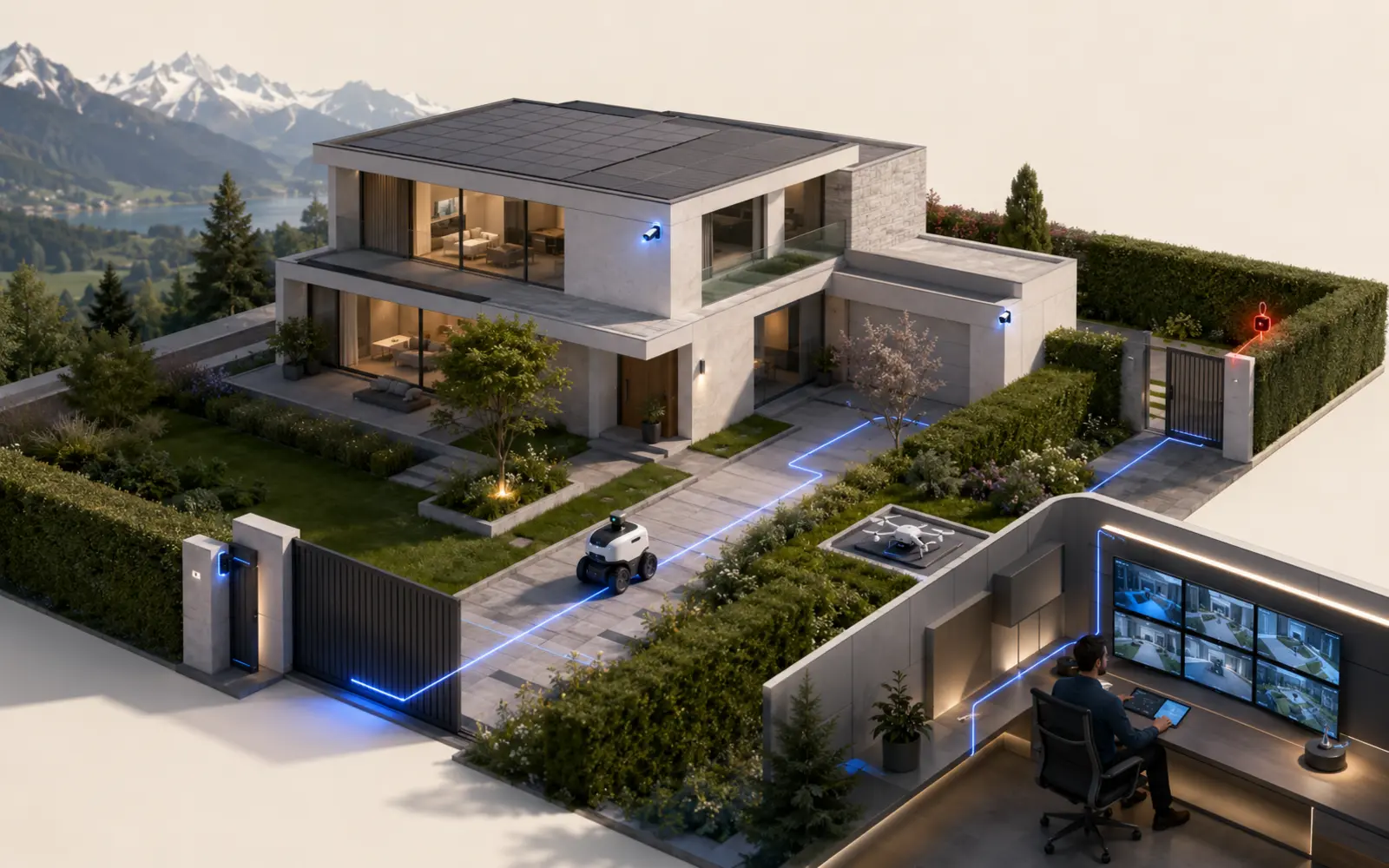
Protecting an empty house and protecting a family inside it are different needs. An alarm you switch off when you come home does not, on its own, meet the second. To guard against home invasion, examine access points, detection while occupants are present and how an alert will be handled.
This guide offers a method for deciding what to improve first. The aim is to make intrusion harder, identify an abnormal situation and allow occupants to get to safety. No equipment guarantees that an assault will never occur.
Is an intrusion in progress, or do you feel directly threatened? Call the police on 117 from a safe place. Do not go looking for the intruder. Afterwards, if the situation allows, consult our guide on what to do if someone enters your home.
What is home invasion, or “homejacking”?
In its crime reporting, Geneva police describe homejacking as a violent intrusion into an occupied home involving threats or coercion against the people present. The distinction matters: a theft committed quietly while occupants sleep is not automatically homejacking under this definition. Nor does the term refer only to theft of car keys. Source: Geneva’s 2025 crime report.
For protection design, the useful question is broader than the criminal label: what happens if someone tries to enter while the family is having dinner, sleeping or returning from work? A system designed solely for absences leaves that question unanswered.
Is home invasion increasing in Switzerland? What the figures say
In Geneva, authorities recorded 18 cases in 2025, compared with 15 in 2024. That is three additional cases, an increase of 20%. These cantonal figures, confirmed in a statement dated 14 August 2026, do not establish an increase of the same scale throughout Switzerland. Nor do they describe 2026. Source: Geneva cantonal police clarification.
Home invasion, burglary and all property offences must also be distinguished. The FSO’s 2025 police crime statistics concern offences recorded by police. A change in a broader category does not demonstrate a change in home invasion. The official sources consulted for this guide do not provide us with a national series isolating this phenomenon on a comparable basis.
A sound decision means examining your home without turning a news story, or a cantonal change involving small numbers, into your personal probability. Your layout, access points used and family arrangements offer more concrete action than a misinterpreted national figure.
Where to start: examine three moments in home life
Before requesting quotes, describe how you use your home. The same house may need several protection configurations. The list below prepares a discussion with a specialist; it does not calculate a risk level.
| Situation | Question to resolve | Expected result |
|---|---|---|
| You are awake at home | Which access points remain open or unmonitored during everyday activities? | Operation compatible with the garden, deliveries and movement. |
| The family is asleep | Which access points need monitoring without triggering on a trip to the bathroom? | A night protection mode everyone understands. |
| Someone arrives or leaves | How can you open, enter and close up without unnecessarily disabling the whole system? | A simple procedure, including for a teenager or authorised guest. |
Add specific needs: reduced mobility, hearing difficulties, children, pets and household staff. A system disabled because it disrupts daily life no longer fulfils its intended role. Address usability during design, not after installation.
First layer: keep control of access
Prevention starts with simple habits. Vaud police recommend closing doors and windows, including those of outbuildings, even when you are home. This includes access points you rarely use. Source: Votre Police.
Walk around the home with a sheet of paper: front entrance, terrace, garage, side door, cellar and outbuilding connected to the living space. For each access point, note who uses it, how closure is checked and what happens if a key or badge is lost. This map of uses avoids concentrating the entire budget on the front façade.
For visitors, provide a way to communicate before opening, such as a peephole or intercom. An expected appointment and identity checked with the relevant organisation help you decide calmly. A uniform or claimed urgency should not force you to open immediately.
Second layer: have doors and windows assessed
Physical protection is assessed as an assembly: door, frame, fixings and locking. Swiss Crime Prevention stresses appropriate equipment selection and installation quality. A high-performance lock is not enough to rate an entire door. Source: “À double tour!” brochure.
Ask the professional to separate necessary repairs from convenience improvements. A door that closes badly needs a different response from a sound door you wish to automate. Also have accessible windows and patio doors examined, along with the connection between garage and house.
The quote should specify the assemblies concerned, documented performance and how the installation affects leaving the home. See our checklist for comparing work on doors, windows and the garage.
Third layer: detect while the home is occupied
An alarm suited to occupants being present must distinguish access points to monitor from areas where the family moves around. Some systems offer partial arming, often called “night mode”. Its coverage depends on the devices and configuration: the mode’s name does not tell you which access points are actually protected. Technical example: Ajax night mode documentation.
Request a demonstration using your real habits: going to the kitchen, letting the dog out, returning late or sleeping with a room ventilated. The aim is not to activate every sensor but to agree on operation everyone can use correctly.
The next question is decisive: who receives the alert, and what can that person do? A phone notification is not an intervention. If the phone is silent, out of coverage or held by someone being threatened, what other route remains available? Our article on alarms while people are at home sets out questions for an installer and remote monitoring centre.
Give cameras and lighting a precise task
Before adding a camera, state the need: seeing who is at the door, verifying a terrace alert or keeping footage of an event. These uses do not necessarily require the same position, framing or retention period.
A camera is not a physical barrier. It provides information whose usefulness depends on clarity and handling. Lighting can make an access point easier to use; it also needs adjustment to avoid dazzling residents or neighbours. Make the choice on site, in the conditions where the equipment will be used.
In Switzerland, private video surveillance must respect principles including proportionality and transparency. Framing should be limited to the legitimate need; filming neighbouring property or public space raises further issues. Source: FDPIC. To select equipment, see alarm or camera: which to prioritise?, then our guide to securing outdoor access.
Robots and drones: an addition to justify
Large grounds, several buildings or a remote verification need may lead you to assess mobile observation. Its value needs to be demonstrated against fixed sensors or cameras, with a defined task and on-site tests.
A robot or drone must not be presented as physical protection for occupants against an attacker. Examine availability, areas it can actually observe, behaviour during a fault and who uses the information. Drone operation also depends on aviation rules, including on private land.
The right question for My Robot Guard is therefore: which concrete need would remain poorly covered by a simpler solution? Our analysis of the uses and limits of robots and drones for home invasion protection provides a decision checklist.
Prepare a simple family response
Prepare calmly in advance. Everyone should know the police number, exact address and useful information for explaining where occupants are. Adapt preparation to children’s ages and everyone’s abilities, without staging a frightening scenario.
When an intruder is present, avoid confrontation. If you can take shelter without exposing yourself, do so and call 117. Do not cross the house to confirm what a camera appears to show. Our night-time intrusion guide explains what to prepare and what to tell the police.
Do not turn neighbours into responders. A trusted contact can help raise the alarm, welcome the family afterwards or assist with a practical step. They should not be tasked with entering a home potentially occupied by an attacker.
What budget should you plan, and what comes first?
A total price without a home visit risks comparing different services. Instead, request three priced groups: essential corrections, protection while occupants are present and additional observation. You can then decide what needs immediate action and what merits a trial.
| Priority | Decision to make | Evidence to request |
|---|---|---|
| Restore the basics | Correct a defective access point or unclear closing procedure. | On-site findings and a description of the correction. |
| Protect the occupied home | Define active zones and the response to an alert. | Demonstration with occupants and written instructions. |
| Add observation | Add video, outdoor detection or a mobile device if a need remains. | Comparative tests in the site’s conditions. |
Compare initial cost and recurring charges: subscriptions, communications, storage, maintenance, batteries and possible call-outs. Also ask what remains usable when the contract ends. An essential function should not depend on a commercial condition discovered after purchase.
Public advice is also available. In the canton of Vaud, police offer a free security assessment for eligible homes. In another canton, contact its prevention service: arrangements are not necessarily identical.
Your checklist before requesting a quote
- I have listed access points into the home, including through the garage and outbuildings.
- I know what remains protected while we are at home and while we sleep.
- Each relevant occupant can use the controls without help.
- I know who receives an alert and the procedure if nobody answers.
- The work preserves safe escape and access for emergency services.
- Cameras, if needed, have a defined purpose and limited field of view.
- The quote distinguishes installation, recurring charges and service limitations.
- Acceptance includes tests and written instructions.
An “I do not know” answer is a point to clarify. It is neither proof of immediate danger nor an invitation to buy more equipment. Start by obtaining an understandable answer.
After an assault, protection also includes support for people
Repairing property does not necessarily resolve the effects of a violent intrusion. In Switzerland, 142 connects callers to victim support, free of charge and confidentially. This number does not replace emergency services. Source: Victim Support Switzerland.
Our guide to the aftermath of a home invasion: practical steps and support helps organise contact with police, insurers and support services without requiring everything to be handled immediately.
Frequently asked questions
Is being at home enough to deter an intrusion?
Your presence is not a protection system. It mainly changes how measures should be designed: you need to move around, receive visitors and sleep while maintaining control over access.
Should I start by installing cameras everywhere?
Start by identifying the problem you want to solve. If an access point closes badly, an image does not fix it. If an alert reaches a phone nobody checks, adding views does not organise the response.
Can I request a system that works without a smartphone?
State this need at the quote stage. Ask for a demonstration of the proposed alternative controls and alerts, including their limits. Involve the people who will actually use the installation.
Does insurance replace protection?
It addresses a different question: compensation provided by the contract after a loss. Prevention, emergency response and support for people need to be organised separately.
Plan your project with My Robot Guard
For an initial discussion, describe your home type, when you want to protect it and the equipment already installed. Avoid sending access codes, a valuables inventory or a detailed plan through a simple form. The useful next step is identifying which questions require a visit and which options merit assessment.
Explore our approach for villas and private properties or tell us about your project.