For the first discussion, describe the property type, main access points, existing equipment and situations that concern you. These details help define an appropriate assessment, followed by a pilot if the project warrants one.
Tell us about your projectProtect your family,
even when you are at home.
Home invasion protection designed around your daily life.
Protection, point by point.
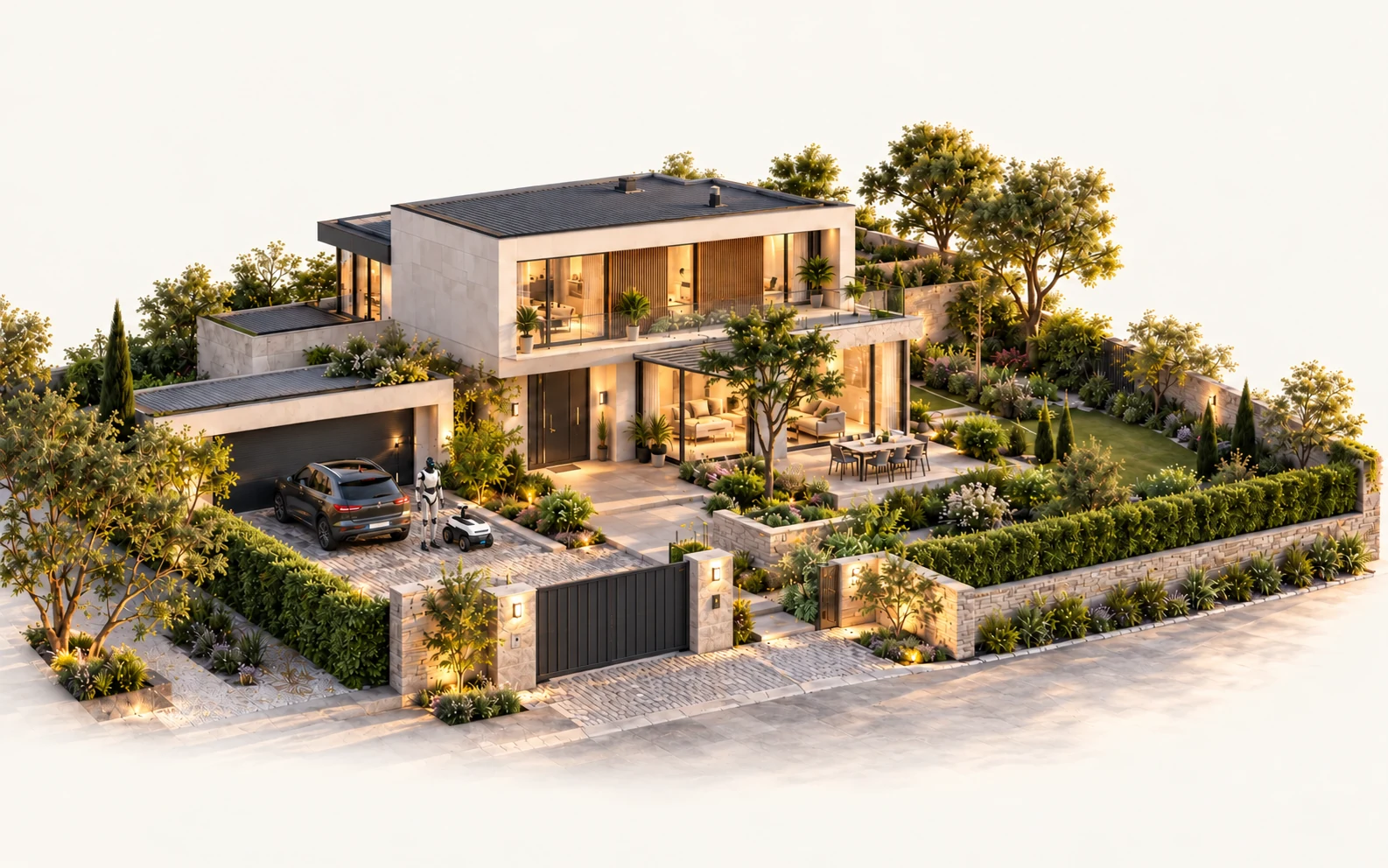
Choose a topic or a marker on the villa to understand its role.
What about your daily routine?
You are living in the house.
Plan access protection compatible with family movement, visitors and pets.
Educational example: these buttons explain protection measures; they do not control equipment. In 3D, the scenario also changes the lighting. Layout and operation must be defined for each property.
An occupied home
changes the priorities.
In the evening, while asleep or when loved ones are alone, protection must remain compatible with life at home.
An alarm designed only for absences may be difficult to use day to day. A camera may show a scene when nobody is available to handle the alert. Our starting point is therefore simple: who is present, which access points need monitoring and what happens when an event is detected?
The aim is to reduce uncertainty and make instructions understandable for the whole family. Equipment follows, in response to those needs.
Understand home invasion in SwitzerlandOur contribution:
connect the layers of protection.
A structured assessment to decide what to improve, in what order and against which success criteria.
- 01A shared picture of the site
An assessment of your property
Access points, garage, patio doors, outbuildings, movement, network and existing equipment. We define scenarios with you: at home, at night, away and access for authorised people.
- 02Explained choices
A prioritised protection plan
Points to strengthen, areas to monitor and useful functions are identified before equipment selection. The proposal distinguishes essential measures from options, as well as initial and recurring costs.
- 03Defined roles
An explicit alert chain
For each scenario: detection, verification, recipient and follow-up. Responsibilities of occupants and any providers are clarified, including when nobody answers or a fault occurs.
- 04Verifiable criteria
Tests in real conditions
A pilot project can check covered areas, false alerts, notification reception and ease of use. Results determine adjustments and whether deployment is worthwhile.
Scope, deliverables and participants are specified in the assessment proposal. Each installation depends on technical validation and the commitments agreed.
Useful technology.
In its proper place.
The role of robots and drones A distant access point or outbuilding may justify mobile verification. Not every villa needs it.
Our expertise allows us to assess how a security robot could complement fixed sensors and cameras. Its usefulness depends on the terrain, routes, connection, weather and the viewpoint it can actually provide.
A robot observes and transmits information. It does not physically protect occupants or replace human intervention. Any proposed drone requires a separate feasibility and operating conditions assessment.
Discretion is also part of the project: filmed areas, excluded spaces and access to images need to be defined during design.
Your questions,
before we begin.
What is home invasion protection?
It aims to reduce the risk of intrusion into an occupied home and prepare a response suited to the people present. It combines access assessment, detection compatible with daily life, alert handling and instructions occupants understand. No system guarantees that an intrusion will not occur.
Can we keep our alarm and cameras?
The assessment starts with existing equipment. Its condition, settings, compatibility and the way alerts are handled determine what can be retained. Complete replacement is not automatic.
Is a robot or drone essential?
No. Access, detection and alert handling come first. A mobile solution is considered if the size of the grounds, blind spots or outbuildings justify an additional viewpoint. Its value needs to be demonstrated through on-site tests.
Can protection work while we sleep?
This is one of the scenarios to assess. Night mode needs to distinguish monitored access points from permitted indoor movement, account for pets and provide for alert reception. Its operation should be checked with occupants rather than relying only on a theoretical setting.
Do you provide round-the-clock response or remote monitoring?
This page describes an assessment and design process, followed by a possible pilot project. It does not advertise an operational remote monitoring or response service. If a provider is needed, their role, availability, commitments and contract must be defined separately within the project.
How much does protection suited to my villa cost?
The budget depends on access points, grounds, existing equipment, work, maintenance and selected services. The initial discussion defines the need and assessment scope. A detailed proposal should distinguish initial investment from recurring costs.
Let’s start with your home.
Prepare your next steps.
Access to your home
Doors, windows and garage: points to examine.
An alarm through the night
Adapt protection to occupants’ movement.
The garden and outdoor access
Plan lighting, detection and use of the grounds.
Alarm or camera: which to choose?
Compare functions before adding equipment.
Prepare the family for an intrusion
Understand priorities and instructions for a night-time alert.
Steps after a home invasion
Find your way between police, insurance and victim support.