This page covers the essential concepts and links to more specialised resources. Capabilities, constraints and rules must always be checked against the relevant site and use case.
A robot family directly aimed at securing large sites
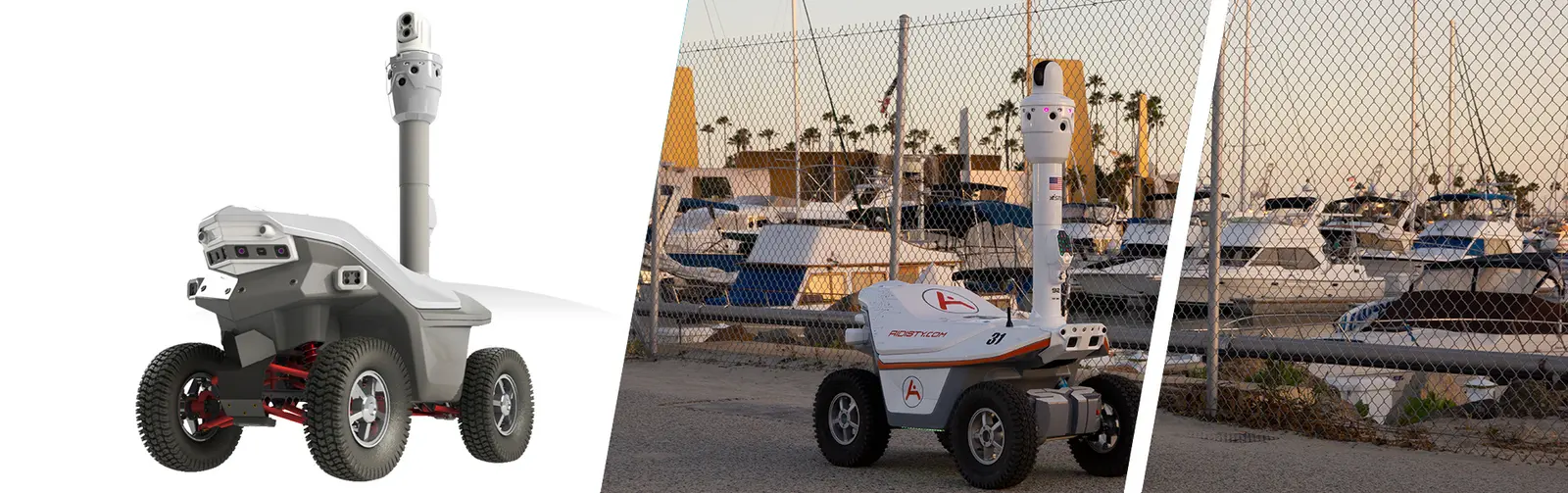
SMP Robotics positions the Argus family for autonomous security patrols across industrial facilities, logistics areas, campuses, car parks and other large properties. The robot uses a substantial wheeled base designed to travel efficiently over long outdoor routes while carrying several observation sensors. For verification, see Official security robot presentation (SMP Robotics).
The concept is straightforward: instead of installing a camera at every possible viewpoint, the robot visits predefined locations and transmits a mobile view. It can follow scheduled patrols or be directed towards an area after another sensor raises an alarm.
Argus S5 should be assessed as part of a complete system. Navigation, cameras, thermal imaging, communications, software integration, charging, maintenance and remote supervision all contribute to the operational result. A robot that moves reliably but produces poorly prioritised alerts does not improve security.
The product range and configuration may vary by market and integrator. A buyer should request the current specification, supported payloads and exact commercial package rather than assuming that every capability shown in a manufacturer presentation is included.
For a deeper analysis, read Business security. Connect patrols to a complete response.
For a deeper analysis, read Industrial sites. Design protection for large perimeters.
Cameras, thermal imaging and detection require precise interpretation
A visible camera provides context: the condition of a gate, a vehicle near a fence, an object left in a route or a person moving through a restricted zone. Panoramic coverage can reduce blind angles around the robot, while zoom or directional cameras may support detailed verification.
Thermal imaging can help at night and may reveal a person, running engine or unusual apparent temperature. It cannot see through walls and does not identify intent. Sun-heated surfaces, animals, exhausts and reflections can explain an apparent anomaly. The visible image and site context remain necessary.
Video analytics may detect a person or vehicle, identify a line crossing or flag a stationary object. Performance depends on distance, angle, weather, lighting and the model configuration. A Swiss pilot should test authorised workers, visitors, animals, rain and vegetation rather than presenting only ideal intrusion footage.
Two-way audio or a loudspeaker can allow an operator to communicate. Messages should be informative and proportionate. The robot should not simulate an aggressive authority, threaten people or attempt physical confrontation. Its strongest role is observation and guided escalation.
Integration with video-management software is an important advantage
Security teams already work from video-management systems, alarm platforms and incident procedures. A robot creates more value when its live feed, position, health and alerts appear within those existing workflows rather than in an isolated application that operators must monitor separately.
Integration should allow a fixed perimeter alarm to request a robot mission, display the relevant cameras and preserve the event record. It should also show when the robot is unavailable so the operator does not wait for a response that cannot arrive.
Compatibility claims need detail. A standard video stream is not the same as full control, health monitoring or alarm exchange. The customer should list each required action and ask who is responsible for the interface, testing and future software updates.
The architecture must avoid creating a single point of failure. Fixed sensors and cameras continue to operate while Argus charges or receives maintenance. The robot adds a second viewpoint and a mobile response, but it should never be the only way to detect a critical event.
Terrain, endurance and maintenance are the real pilot questions
A large wheeled robot is efficient on asphalt, concrete and compact outdoor surfaces. Kerbs, loose gravel, steep slopes, drainage channels, snow and construction changes can reduce reliability. Every section of the intended route should be tested with the final payload and representative weather. For verification, see Photos and video surveillance (FDPIC).
Manufacturer endurance figures provide a reference, not a patrol schedule. Stops, sensor power, slopes, temperature, network quality and route speed influence useful operating time. The relevant figure is the number of completed checkpoints before a reliable return to charge.
The docking area needs power, communications, drainage, physical protection and maintenance access. The route back to the station should remain available during normal site activity. If parked vehicles or delivered goods can block it, the operating procedure needs an alternative.
Maintenance includes tyres, batteries, sensors, cleaning, calibration, software and emergency recovery. The customer should know who responds when the robot is stranded at night, which spare parts are held nearby and how long a replacement takes.
Data and compliance on a Swiss site
A mobile platform can record people, licence plates, buildings and operational activity. Routes and camera angles should minimise neighbouring land, public space and areas unrelated to security. Signs and staff information need to describe the purpose without suggesting unlimited surveillance.
On a workplace, security footage must not become continuous employee-performance monitoring. Missions outside operating hours are easier to separate from day-to-day work. When patrols occur during activity, observation zones and access permissions should be particularly narrow. For verification, see Video surveillance in the workplace (FDPIC).
The data architecture should document hosting, subcontractors, accounts, retention and export. Routine patrol footage can often be deleted quickly, while a confirmed incident follows an authorised evidence process. Every consultation and export should be traceable.
The robot belongs on a segmented network with named accounts, strong authentication and controlled updates. Supplier support access should be approved for a defined period. The project must also test what happens when communications fail and ensure the robot stops or returns safely.
Our view: a serious candidate for large perimeters
Argus S5 deserves consideration where long outdoor routes, regular surfaces and integration with an existing control room are central. Its format can carry several sensors and create a visible presence while covering more distance than many smaller platforms.
Ascento Guard offers distinctive hybrid mobility and a Swiss service orientation. Knightscope K5 has extensive visibility in American security deployments. OTSAW O-R3 provides another service-led wheeled option. Quadrupeds become more relevant when stairs or highly irregular terrain are unavoidable.
A pilot should include a complete night shift, changing weather and representative site traffic. Measures should cover route completion, alarm quality, manual recovery, time to useful video, charging, downtime and support response.
The decision depends on the delivered operating service, not the largest sensor list. If Argus can repeatedly reach high-value checkpoints, integrate with the control room and remain supportable in Switzerland, it can form a useful mobile layer. If the route is unstable or support remote, simpler fixed coverage may be more reliable.
For a deeper analysis, read Ascento Guard. A Swiss outdoor security robot.
Frequently asked questions
What is Argus S5 designed for?
It is designed for autonomous outdoor patrols, mobile video observation and alarm verification across large structured sites.
Can thermal imaging detect an intruder reliably?
It can reveal heat contrasts, but visible context and human verification remain necessary because animals, engines and surfaces can create similar signals.
Does Argus replace a video-management system?
No. Its greatest value comes from integration with the customer’s existing video, alarm and incident workflows.
What should a pilot measure?
Route completion, useful alarms, manual recoveries, charging, downtime, operator response and local support should all be recorded.