This guide complements our series on security for villas and private estates.
To plan a security budget, first separate installation, recurring services and variable expenditure. Then compare quotes that protect the same access points and provide for the same alert response. An equipment price alone does not allow this comparison.
An already equipped villa, a house with a detached garage and a large estate require different work. Models and offers also change. We therefore give no generic price range in Swiss francs: this guide helps you obtain current, detailed and verifiable amounts for your property.
The first useful document is not a camera list. It is a page specifying the areas to protect, family activities and the people responsible for handling alerts. Give the same version to each provider, then use the comparison checklist.
Define the need before requesting a price
Start with situations that concern you: entry during an absence, an approach to the garage at night or an alert while occupants sleep. For each, specify the outcome you expect: deterrence, detection, understanding what is happening, notifying someone or arranging a response.
Swiss Crime Prevention recommends examining organisational, physical and electronic measures and seeking prevention advice. The budget may therefore include reinforcing an access point before adding connected equipment. Our guide to doors, windows and garages helps prepare this assessment.
Write a short brief with these six details:
- Priority areas: access to the house, pedestrian gate, garage or outbuilding, with a simple plan.
- Uses: presence at night, absences, pets, visitors, a gardener or household staff.
- Existing arrangements: alarm, cameras, locks, power supply, cables and ongoing contracts.
- Expected response: app, trusted person, operator or on-site responder.
- Constraints: neighbours, shared passages, private areas, acceptable work and network checks.
- Acceptance criteria: scenarios to test and results expected before accepting the installation.
In the canton of Vaud, police offer a free security assessment to individuals, businesses and institutions in the canton. This prevention advice can help define priorities; it does not replace a technical installation quote.
Which costs belong in a villa security budget?
Request a breakdown of initial costs, subscriptions and services billed per use. Each line should identify who performs the work and what remains your responsibility. “Installation included” does not, on its own, tell you whether a trench, electrical connection or adjustments after the first week are included.
| Item | Details to clarify | When the cost occurs |
|---|---|---|
| Assessment and physical protection | Visit, plan, review of existing equipment, door or access adaptations and coordination of providers. | Before and during the project |
| Work and connections | Electricity, cables, network, supports, drilling and surface restoration. | At installation |
| Equipment and configuration | References, quantities, licences, settings, tests, training and documentation provided. | At installation, sometimes rented |
| Connectivity and continuity | Possible backup connection, mobile subscription, backup power and functions maintained during faults. | Initial, then recurring depending on the choice |
| Images and software | Local or remote storage, capacity, retention, access, export and subscription-dependent functions. | Initial and/or recurring |
| Supervision and response | Alert verification, hours, calls, attendance and billing conditions. | Subscription and/or per-use services |
| Maintenance and support | Cleaning, batteries, parts, updates, labour, travel and any temporary equipment. | Periodically or per event |
| Changes and exit | System extension, support end, replacement, termination, returns and data recovery. | According to needs and contract |
Allow for the work around cameras
The FDPIC states in particular that private video surveillance must be proportionate, limited to the property, transparent and accompanied by restricted access to images. Price the necessary configuration: angles and privacy masks, retention period, access rights and information for people. These points cannot be resolved simply by buying more storage.
To prepare this part of the quote, see our guide to video surveillance and data protection in Switzerland.
Assign maintenance and updates
The National Cyber Security Centre recommends securing connected devices and updating them regularly. Put in writing who handles this, how faults are reported and what support covers. Also ask for the manufacturer’s announced support period: a hardware warranty and the availability of software patches answer different questions.
Fictional example: an occupied villa with a detached garage
This example was created to explain the method. It represents neither a customer nor a completed installation. A family lives in a villa with an old alarm. The garage is detached, a dog uses the garden and network quality at the garage is unknown. The family wants to understand alerts while away and continue using the garden freely.
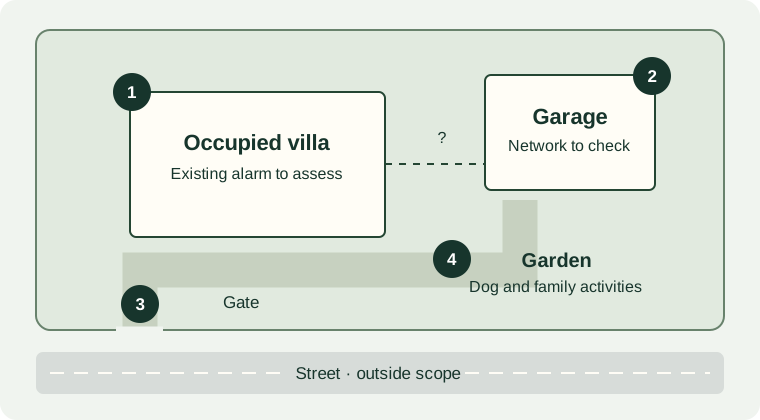
- Villa: check whether the alarm can be retained, maintained and connected to the proposed system. Price reuse and replacement separately if both are relevant.
- Garage: check power and network connectivity before choosing equipment. Request an alternative with work clearly described if the existing connection is unsuitable.
- Pedestrian gate: specify the event to detect and how to verify it, accounting for the street and normal movement.
- Garden: plan tests with the dog, occupants and night-time conditions. Identify who corrects settings after these tests.
Now suppose offer A includes cameras with phone notifications, while offer B adds operator verification and possible attendance billed separately. They meet different needs: in the first, the family handles the alert itself; in the second, some of the work is assigned to a third party under the contract.
The useful next step is to request a common scope : the same areas, scenarios and comparison period, with additional services shown as options. Offer A is not necessarily insufficient, and offer B is not automatically preferable. The choice depends in particular on the actual availability of alert recipients.
Where would a robot or drone fit in this project?
A villa security robot needs a precise task, such as obtaining another view of an area. Request a separate option including terrain assessment, charging station, integration, tests and maintenance. The scenario should remain understandable when the robot is unavailable.
For a drone, clarify operational feasibility before focusing on the device price. FOCA distinguishes several procedures within the specific category, with different preparation requirements. A commercial option does not validate the operation; our guide to drone surveillance of private property in Switzerland details the questions to examine.
Compare total cost over the same duration
Choose a common analysis period consistent with your project and the commitments proposed. Enter only amounts in the offers, with their validity dates. Compare in the same currency and on the same VAT basis.
Documented cost over the period
= initial costs + recurring charges over the period + known one-off costs + variable charges under an explicit scenario.
If recurring charges are fixed monthly amounts, multiply them by the chosen number of months. If a rate changes on a date specified in the contract, calculate each period separately. Do not artificially extend a limited promotion over the entire duration.
For travel or call-outs billed per use, request the rate and billing trigger. You can compare a scenario with no call-outs and one with a number you choose. These are comparison assumptions, not incident forecasts. If no rate is supplied, mark the item “To clarify”.
Also avoid counting a service twice: when maintenance is included in the subscription, check its coverage before adding another line. Conversely, do not assume a subscription automatically includes battery replacement or travel.
Finally, have the contract end position described: equipment retained, rented or returned, functions still usable, possible charges and data access. Rental and purchase do not necessarily leave you with the same equipment at the end of the period.
Your checklist for comparing two security quotes
Complete the twelve items below from the offers received. Note exclusions or the quote page in the free-text field, then export the result as CSV to keep it or send it to providers yourself. The checklist helps prepare questions; it does not automatically select a winning offer.
Use providers’ written answers. “Included” describes the quote; it is not a quality score. Use “Not applicable” only when the item does not concern your project.
1. Project and installation
2. Daily operation
3. Duration and contract
Your inputs stay in this tab and are not sent by this tool. They are cleared if you reload or leave the page: export your checklist to keep it.
What should you check before accepting the offer and installation?
Before signing, get written answers on unresolved items. Quantities, work, services and exclusions must be precise enough for both parties to understand what will be delivered. A sales demonstration does not replace acceptance criteria suited to your villa.
Plan these checks in particular with the provider:
- Actual use: operation of the chosen day and night scenarios, with the family’s access points and habits.
- Complete alert chain: test trigger, reception, verification and transmission to the right person. Participants must be informed of the test.
- Degraded operation: a supervised connection or power loss test to observe what remains available and what is reported.
- Images and accounts: fields of view, masks, retention, access rights and removal of temporary installation accounts.
- System handover: plans, references, simple instructions, support contacts, troubleshooting procedure and a list of outstanding corrections.
The budget becomes usable when you can connect every expense to a function, an owner and a verifiable condition. If an option remains hard to justify, isolate it and test its value before expanding the system.
Frequently asked questions about budgets and quotes
Can the budget be estimated from the villa’s floor area alone?
Floor area gives context, but does not describe the number of access points, work needed or expected response. A detached garage without a network and an already wired house may require very different services. A plan and site assessment make the estimate more useful.
Does a remote monitoring subscription include on-site response?
Check the offer. Receiving an alert, verifying it, calling the owner and attending the site are separate services. Ask who responds, under what conditions, in which area and with what billing. Do not infer an arrival time from a simple statement of round-the-clock availability.
Does existing equipment need replacing?
Not systematically. Have its condition, compatibility, software support and remaining functions examined. Ask for retained equipment and limitations of reuse to be identified. Our comparison of home alarms and cameras helps distinguish their roles.
How can you compare rapidly changing prices?
Use dated quotes that are still valid, keep the versions and compare an identical scope. Before deciding, confirm amounts, availability and revision conditions. The budget structure remains useful even when models and rates change.
Does the checklist calculate an installation price?
No. It lists the content of two offers and missing information. It is neither a quote nor an automated estimate. Total cost calculation must use amounts supplied for your property and clearly stated assumptions.
Sources and method
Guide written by My Robot Guard using the official sources below, consulted on 23 October 2026. They support the points on prevention, data protection, cybersecurity and drone operation. The comparison method, checklist and fictional example are editorial tools created for this article; they are not a technical assessment of your property.